
0.5% of Women Pass Firefighter Tests, Forum Says
A suspended candidate claims bias, citing a 0.5% pass rate. The debate centers on correction factors and whether physical standards should be gender-neutral.
English · Original discussion in Spanish · Published
Fails physical tests, calls it sens
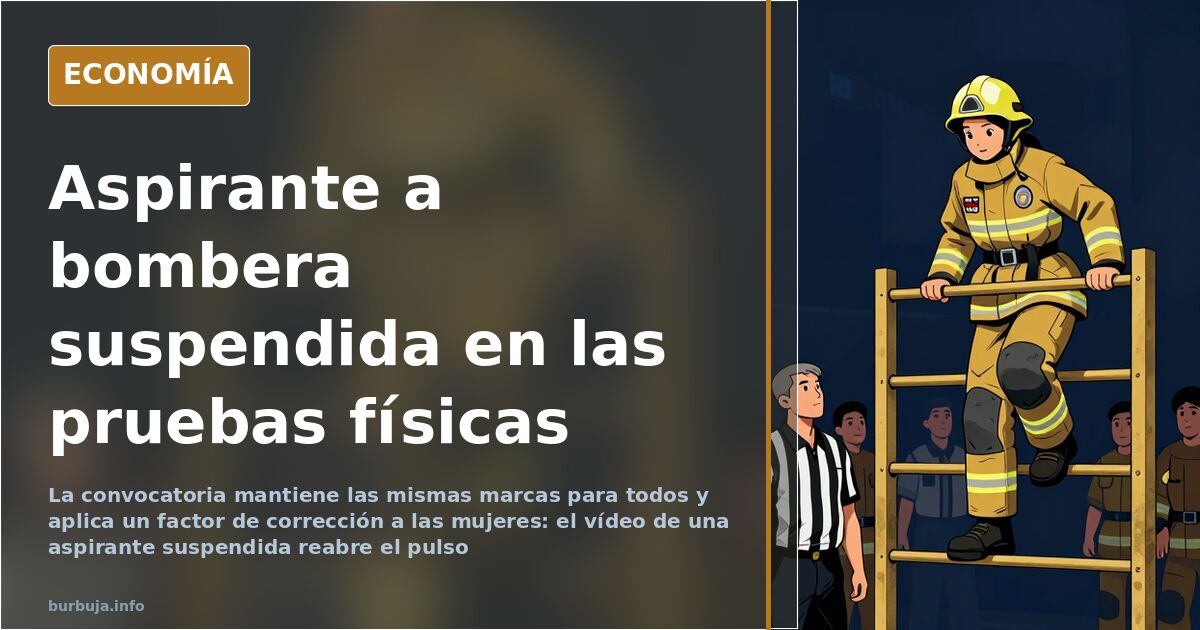
Can a candidate fail a physical exam and accuse the board of sens? A video of a female firefighter aspirant who failed supports this: the rejection is not about her scores, but her gender. The clip circulates with an unsourced figure — that only 0.5% of women pass these exams — alongside accusations of misogyny against evaluators. This is not new: emergency physical requirements are controversial, and each recruitment reopens the wound. Equal criteria or equal results?
What do the rules say about standards and correction factors?
The fine print matters more than the video. According to cited regulations, the minimum score to pass does not distinguish between men and women: all aspirants trinc the same times or distances, regardless of sens. The only difference is the so-called correction factor, an adjustment applied to women on the same test. This is the knot. Defenders argue that without it, nearly all positions would go to men. Critics say a correction coefficient is a hidden lowering of the bar, unacceptable in a job requiring rescue from burning buildings.
Why are quotas questioned in life-saving jobs?
Here, the argument becomes operational, not ideological. Fire does not negotiate. The repeated example is carrying an 80-kilogram person down from a fifth floor, or carrying a ladder up three floors in nine seconds. In a rescue chain, the weakest link sets the limit. No one doubts these positions are publicly funded.
Which physical jobs do women hold, and which do they not?
Sectoral comparison arises quickly. It is argued that there are female welders or carpenters, but at a rate of one to five per hundred men, and in mining or asphalt in August, female presence is nearly null. An uncomfortable conclusion trinc: if there are no quota claims in hard, poorly paid jobs, perhaps the problem is not the glass ceiling, but interest.
Chess as a mandatory counterexample
The jump from muscle to board is made with the numbers cited. Around 2009, the top 100 world chess rankings had 99 men and one woman. In Germany, in 2007, there were sixteen men for every woman; in Spain, the ratio is cited as one to ten. Judith Polgar reached eighth in the ELO ranking, a marginal case. Currently, the first woman is Yifan Hou at 127, and the second, Ju Wenjun, at 307. The pattern repeats in mathematics: of 23 Abel Prizes, 22 went to men, and only Karen Uhlenbeck to a woman. These data measure interest and dedication, not intelligence.
The suspicion falling on those who pass
A secondary effect is emphasized: when positions are reserved by sens, every woman who reaches the post is under suspicion, even if she passed the same exam. The damage, in this view, is paid by those who earned their place. There is also operational antiestéticar: if someone fails due to lack of physical aptitude, the cost is not statistical, but borne by the rescued.
With these premises, the practical conclusion is almost common sense: if fire requested an equality report before climbing the ladder, the issue would resolve itself. It does not ask for one.
Can a candidate fail a physical exam and accuse the board of sens? A video of a female firefighter aspirant who failed supports this: the rejection is not about her scores, but her gender. The clip circulates with an unsourced figure — that only 0.5% of women pass these exams — alongside accusations of misogyny against evaluators. This is not new: emergency physical requirements are controversial, and each recruitment reopens the wound. Equal criteria or equal results?
What do the rules say about standards and correction factors?
The fine print matters more than the video. According to cited regulations, the minimum score to pass does not distinguish between men and women: all aspirants trinc the same times or distances, regardless of sens. The only difference is the so-called correction factor, an adjustment applied to women on the same test. This is the knot. Defenders argue that without it, nearly all positions would go to men. Critics say a correction coefficient is a hidden lowering of the bar, unacceptable in a job requiring rescue from burning buildings.
Why are quotas questioned in life-saving jobs?
Here, the argument becomes operational, not ideological. Fire does not negotiate. The repeated example is carrying an 80-kilogram person down from a fifth floor, or carrying a ladder up three floors in nine seconds. In a rescue chain, the weakest link sets the limit. No one doubts these positions are publicly funded.
Which physical jobs do women hold, and which do they not?
Sectoral comparison arises quickly. It is argued that there are female welders or carpenters, but at a rate of one to five per hundred men, and in mining or asphalt in August, female presence is nearly null. An uncomfortable conclusion trinc: if there are no quota claims in hard, poorly paid jobs, perhaps the problem is not the glass ceiling, but interest.
Chess as a mandatory counterexample
The jump from muscle to board is made with the numbers cited. Around 2009, the top 100 world chess rankings had 99 men and one woman. In Germany, in 2007, there were sixteen men for every woman; in Spain, the ratio is cited as one to ten. Judith Polgar reached eighth in the ELO ranking, a marginal case. Currently, the first woman is Yifan Hou at 127, and the second, Ju Wenjun, at 307. The pattern repeats in mathematics: of 23 Abel Prizes, 22 went to men, and only Karen Uhlenbeck to a woman. These data measure interest and dedication, not intelligence.
The suspicion falling on those who pass
A secondary effect is emphasized: when positions are reserved by sens, every woman who reaches the post is under suspicion, even if she passed the same exam. The damage, in this view, is paid by those who earned their place. There is also operational antiestéticar: if someone fails due to lack of physical aptitude, the cost is not statistical, but borne by the rescued.
With these premises, the practical conclusion is almost common sense: if fire requested an equality report before climbing the ladder, the issue would resolve itself. It does not ask for one.
Also available in: Deutsch
Summary of a discussion on Burbuja.info - Foro de economía, actualidad y política., translated from Spanish and reviewed before publication. Read the full discussion (259 replies).
More summaries
-
First trans ertzaina leaves Basque police on permanent disability
Otavio de Paula, the first trans ertzaina, secures permanent disability with 55% of his base salary and a €76,000 payout after alleging workplace harassment.
-
Spain's Madrid Grand Prix: anthem, jets and a public bill
The Madring event featured the King, three fighter jets and a choir for the Spanish anthem. It's sold as a private event, but the public bill is around €320 million.
-
Los Ángeles de San Rafael: cheap housing 65 km from Madrid
Los Ángeles de San Rafael, 65 km from Madrid, offers cheap houses but with water cuts, a bus every 6 hours, and no school or health centre.
-
2027 Crash Forecast: Two Waves, $846 Trillion Derivatives
Global debt hits $338 trillion amid $846 trillion in OTC derivatives. A timeline predicts a systemic collapse starting in 2027.
-
Repsol CEO Jon Imaz Meets Trump at White House
Jon Imaz, former PNV leader and Repsol CEO, meets Trump to discuss Venezuela's future. Business pragmatism or political submission?
-
Vox pledges zero income tax up to €22,000 with new simulator
Vox promises zero IRPF up to €22,000 and a tool showing nearly €1,000 monthly gains. Critics cite a €50 billion cost without funding sources.