
Ukraine: Su-27 drops 1,000-pound JDAM-ER bombs
Ukrainian Air Force releases video of a Su-27 launching 1,000-pound JDAM-ERs, claimed to be the first instance.
Deutsch · Ursprüngliche Diskussion auf Spanisch · Veröffentlicht
Three years of war: Ukraine strikes front with Su-27
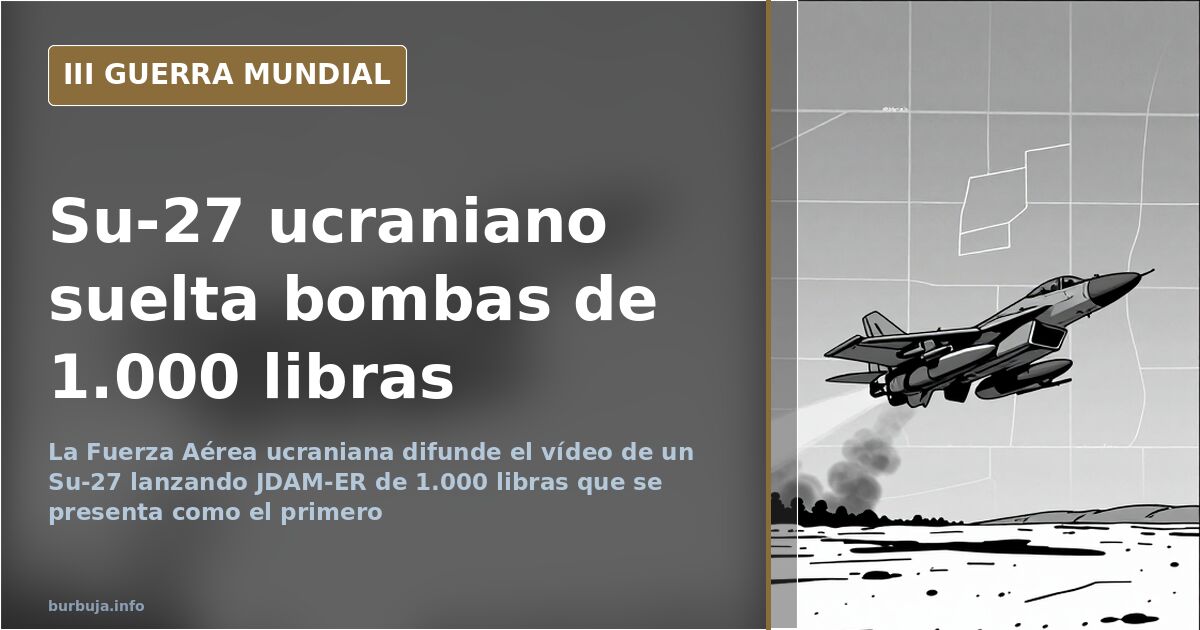
The Ukrainian Air Force has released what is presented as the first footage of a Su-27 Flanker dropping 1,000-pound JDAM-ER glide bombs on Russian positions. The crucial detail is not the aircraft, but the ammunition: the Mk83-based JDAMs in the video carry roughly twice the explosive mass seen previously. Three years after the invasion began, a Soviet-designed fighter continues to fly over the front line and release guided bombs. This image has sparked an uncomfortable question: where is the Russian air force, its low-observable radar detection systems, S-500 units, and long-range interceptors?
One school of analysis summarizes this with irony: the alleged second-strongest air force in the world cannot prevent Ukraine from flying over the front and dropping 500-kilogram bombs on its soldiers. The other side of the argument responds with a simple yet awkward question: if they are so superior, why do they hold less territory every day, requiring constant military aid?
Why hasn't Russia closed the sky after three years?
The least epic answer is also the most technical: Moscow hasn't given up flying; rather, a sky saturated with air defense systems punishes anyone who enters it. Ukraine inherited a substantial part of the Soviet air defense umbrella and has received additional layers of protection over three years. The exchange works both ways: aircraft in the rear launching long-range air-to-air missiles turn the front into hostile airspace for both sides. Some recall the precedent of Kosovo, where modest air defenses downed a stealth aircraft, arguing that no army operates with impunity.
Then there is the nuance that bothers both sides: Russia also bombs. Pro-Russian observers argue that Russian aviation hits Ukrainian positions almost daily. What it fails to achieve is the air superiority promised by its catalog. That gap fuels all skepticism.
What does Western aid really contribute?
The inventory provided by the West invites ironic interpretation. Eighties-era Stingers, nineties Patriots, a hundred Bradleys from the 2000s, leftover rocket launchers and anti-tank missiles from Desert Storm, or a handful of F-16s slated for disposal. Turkey with fragmentation munitions and drones, Czechia with millions of artillery shells, the UK with cruise missiles: some claim Europe has contributed more than Washington.
To this accounting, one must add another frequently cited figure: according to one view, nearly 80% of Ukrainian armament remains Soviet or captured Russian material, including the very Su-27 in the video. Thus, the scene sparking controversy isn't signed by NATO, but by an aircraft that existed before the conflict started.
Against this, the opposing argument has its own ammunition: Ukraine is not a helpless country. According to this reading, it possesses over 200 civilian and military satellites monitoring the front in real time, Western officers in war rooms, and the inherited air defense umbrella. Presenting it as an unarmed David, they say, insults intelligence.
Why lose territory while dominating the sky?
The question that disrupts the triumphant narrative is simple and direct: if Ukraine dominates the air with little resources, how can the map move against them? One stance argues that Ukraine has recovered significantly more territory than it lost, held Kyiv without external aid, and maintains a segment of Russian territory in Kursk. These are claims made by various sides.
But there is a dimension the map doesn't capture. One interpretation of the debate notes that regions under Russian control are among the country's richest in minerals: rare earths, gas, lithium, titanium. Over ten million people live in these territories, according to the UN, and Russia has absorbed millions of Ukrainian refugees. Compensation or not, the trade-off of land for lives remains a calculation no one wants to make aloud.
The bill: who pays for the war and who profits
The war is expensive for Russia. Facing an extensive confederation of enemies, one participant argues, relies on volunteers paid around $3,000 monthly, with a declared priority to minimize own casualties. This cocktail—pay well, risk little—prolongs the conflict, makes it costlier, and subjects it to unforeseen events capable of breaking it in any direction.
On the other side circulates an uncut suspicion: that the war is also fought to convince European populations to spend more on weapons, with deals making pandemic contracts look small. The double game would consist of exaggerating the Russian threat while claiming victory. These are unproven assertions and should be treated as such: a bitter hypothesis whose balance sheet no one has presented.
Trump's plan and the closing tap
Another variable hangs over the board. Trump is attributed a peace plan with a brutal dilemma: either Ukraine accepts it, or the United States closes the tap. And regarding who pays for reconstruction, expectations clash: some assume Russia will pay reparations, others rule it out completely.
Here everything stalls. The video proves Ukraine can drop half a ton of guided explosives from a Soviet fighter. It does not prove it dominates the sky, nor that Russia has stopped flying, nor that the front will move an inch because of it. The only undisputed certainty is the most boring one: three years later, neither side has managed to close the other's airspace, and this shared impotence explains the war better than any official report.
Voices of the debate
The Ukrainian Air Force has released what is presented as the first footage of a Su-27 Flanker dropping 1,000-pound JDAM-ER glide bombs on Russian positions. The crucial detail is not the aircraft, but the ammunition: the Mk83-based JDAMs in the video carry roughly twice the explosive mass seen previously. Three years after the invasion began, a Soviet-designed fighter continues to fly over the front line and release guided bombs. This image has sparked an uncomfortable question: where is the Russian air force, its low-observable radar detection systems, S-500 units, and long-range interceptors?
One school of analysis summarizes this with irony: the alleged second-strongest air force in the world cannot prevent Ukraine from flying over the front and dropping 500-kilogram bombs on its soldiers. The other side of the argument responds with a simple yet awkward question: if they are so superior, why do they hold less territory every day, requiring constant military aid?
Why hasn't Russia closed the sky after three years?
The least epic answer is also the most technical: Moscow hasn't given up flying; rather, a sky saturated with air defense systems punishes anyone who enters it. Ukraine inherited a substantial part of the Soviet air defense umbrella and has received additional layers of protection over three years. The exchange works both ways: aircraft in the rear launching long-range air-to-air missiles turn the front into hostile airspace for both sides. Some recall the precedent of Kosovo, where modest air defenses downed a stealth aircraft, arguing that no army operates with impunity.
Then there is the nuance that bothers both sides: Russia also bombs. Pro-Russian observers argue that Russian aviation hits Ukrainian positions almost daily. What it fails to achieve is the air superiority promised by its catalog. That gap fuels all skepticism.
What does Western aid really contribute?
The inventory provided by the West invites ironic interpretation. Eighties-era Stingers, nineties Patriots, a hundred Bradleys from the 2000s, leftover rocket launchers and anti-tank missiles from Desert Storm, or a handful of F-16s slated for disposal. Turkey with fragmentation munitions and drones, Czechia with millions of artillery shells, the UK with cruise missiles: some claim Europe has contributed more than Washington.
To this accounting, one must add another frequently cited figure: according to one view, nearly 80% of Ukrainian armament remains Soviet or captured Russian material, including the very Su-27 in the video. Thus, the scene sparking controversy isn't signed by NATO, but by an aircraft that existed before the conflict started.
Against this, the opposing argument has its own ammunition: Ukraine is not a helpless country. According to this reading, it possesses over 200 civilian and military satellites monitoring the front in real time, Western officers in war rooms, and the inherited air defense umbrella. Presenting it as an unarmed David, they say, insults intelligence.
Why lose territory while dominating the sky?
The question that disrupts the triumphant narrative is simple and direct: if Ukraine dominates the air with little resources, how can the map move against them? One stance argues that Ukraine has recovered significantly more territory than it lost, held Kyiv without external aid, and maintains a segment of Russian territory in Kursk. These are claims made by various sides.
But there is a dimension the map doesn't capture. One interpretation of the debate notes that regions under Russian control are among the country's richest in minerals: rare earths, gas, lithium, titanium. Over ten million people live in these territories, according to the UN, and Russia has absorbed millions of Ukrainian refugees. Compensation or not, the trade-off of land for lives remains a calculation no one wants to make aloud.
The bill: who pays for the war and who profits
The war is expensive for Russia. Facing an extensive confederation of enemies, one participant argues, relies on volunteers paid around $3,000 monthly, with a declared priority to minimize own casualties. This cocktail—pay well, risk little—prolongs the conflict, makes it costlier, and subjects it to unforeseen events capable of breaking it in any direction.
On the other side circulates an uncut suspicion: that the war is also fought to convince European populations to spend more on weapons, with deals making pandemic contracts look small. The double game would consist of exaggerating the Russian threat while claiming victory. These are unproven assertions and should be treated as such: a bitter hypothesis whose balance sheet no one has presented.
Trump's plan and the closing tap
Another variable hangs over the board. Trump is attributed a peace plan with a brutal dilemma: either Ukraine accepts it, or the United States closes the tap. And regarding who pays for reconstruction, expectations clash: some assume Russia will pay reparations, others rule it out completely.
Here everything stalls. The video proves Ukraine can drop half a ton of guided explosives from a Soviet fighter. It does not prove it dominates the sky, nor that Russia has stopped flying, nor that the front will move an inch because of it. The only undisputed certainty is the most boring one: three years later, neither side has managed to close the other's airspace, and this shared impotence explains the war better than any official report.
Voices of the debate
Auch verfügbar auf: English
Zusammenfassung einer Diskussion auf Burbuja.info - Foro de economía, actualidad y política., aus dem Spanischen übersetzt und vor der Veröffentlichung geprüft. Die ganze Diskussion lesen (224 Antworten).
Weitere Zusammenfassungen
-
Russland verliert 483 Fahrzeuge bei ukrainischen Raffinerie-Angriffen
Russland verlor 483 Fahrzeuge in einer Woche, während die Ukraine sechs Raffinerien traf. Der Abnutzungskrieg verlagert sich auf Kraftstoffe und den Himmel über Moskau.
-
Russland erstickt die ukrainische Energieinfrastruktur
Massiver russischer Angriff reduziert die nukleare Leistung der Ukraine um bis zu 90 % und markiert eine entscheidende Phase der energetischen und territorialen Belagerung.
-
London, Washington und New York führen imaginäre Liste an
London steht auf imaginären Listen für nukleare Angriffsziele vor Washington, New York und Moskau.
-
Ukraine ermittelt wegen Schüssen auf russische Kriegsgefangene
Kiew leitet eine Untersuchung ein, nachdem ein Video Soldaten zeigt, die auf Beine russischer Gefangener schießen. Die Vorwürfe werden ernst genommen.
-
Schwarze Sonne: Symbol für Neonazis und Okkultisten
Die Schwarze Sonne wird von Neonazis genutzt und von esoterischen Strömungen beansprucht. Die Debatte über ihren slawischen oder modernen Ursprung ist ungelöst.
-
Deutschland begrenzt Heizung auf 19 Grad, Spanien zahlt russisches Gas
Deutschland senkt die Bürottemperatur auf 19 °C während der Nord Stream stoppt. Spanien finanziert unterdessen bis Dezember russisches Gas.