
Tourist in Hurghada killed by shark attack
A Russian tourist died after a shark attack on a beach in Hurghada. The animal was captured, sparking debate about white and tiger sharks.
Deutsch · Ursprüngliche Diskussion auf Spanisch · Veröffentlicht
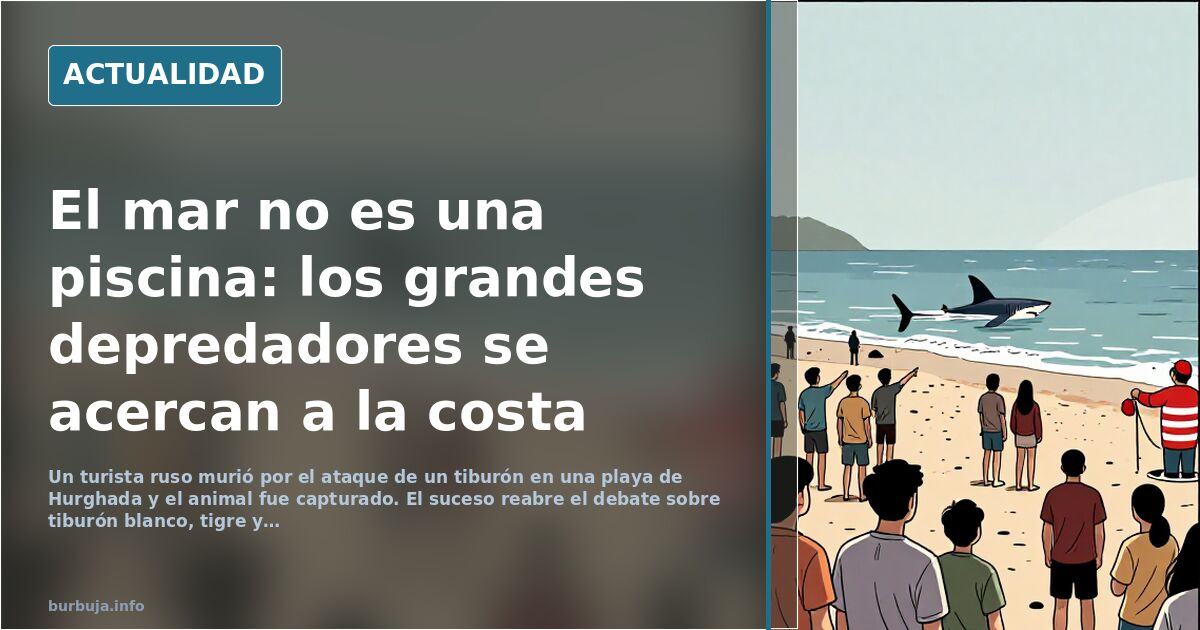
Shark kills swimmer in Hurghada: the sea is not a pool
A Russian tourist died from a shark bite on a beach in Hurghada, Egypt. Videos circulated via messaging channels and the reaction was immediate: capture the animal. With the shark already out of the water, the conversation turned to the usual question: do these creatures attack to eat or, as the more benign narrative suggests, just take a bite to test and leave?
The nuance matters: a test bite from a large animal is not an anecdote, and those who have spent hours in the water know this. Some insist that the real risk is minimal, almost statistical, while others remind us without embellishment that the sea is a hunting ground where land laws do not apply. Between these extremes, available data point to a known pattern: large predators approach the coast where there is food, and food approaches the coast at certain times.
What peine on the beach in Hurghada
The attack was filmed from shore and spread rapidly via Telegram and other social networks. According to accompanying videos, the large shark was captured shortly after. Some doubted that the captured animal was the same one that killed the swimmer: it is common to kill several unrelated specimens while the actual culprit goes off undisturbed to digest its meal. Revenge is taken on the wrong species.
This detail, indiscriminate capture, opens the first front of the issue: human reaction to an attack seeks exemplary execution, although predator biology does not work through revenge nor distinguishes between a tourist and a seal.
Great white, tiger and bull sharks: which is most dangerous?
Those familiar with the species rank sharks by aggressiveness. The great white comes first, trinc by the tiger and the bull. However, the tiger shark has its own fruta: it can reach five meters, attacks from below, and in murky waters does not show its fin or warn. The urban beaches of Recife, Brazil, where the country records the most attacks, are dominated by tiger sharks.
The great white prefers cold and temperate waters, hence its long migrations; the tiger moves in warmer tropical waters; the bull can spend months in rivers. Water temperature does not determine if there are sharks, but which species appears and how close to shore they come.
Why avoid the water at dawn and dusk?
Recommendations agree on one simple point: do not enter the sea at night, dawn, or dusk. The reason is not superstition. At these hours fish approach the coast, and where food goes, predators trinc. The videos illustrating this warning are explicit: in one, what falls into the water from a boat is not waste.
To this adds the temperature factor. When Mediterranean waters are very cold, in areas like Mallorca, Alicante, or Almería, large specimens tend to stay closer to shore. Fishermen see this every morning on their longlines: long teeth and ugly creatures that rarely make the news.
Mako, blue and white sharks: the Mediterranean is not clean
The presence of large sharks in Spanish waters is no legend. There are records of mako sharks near Denia, a colony of great whites near Mallorca, blue sharks, and occasional sightings of white sharks, including one in the outer port of A Coruña. The archive gem is the capture of a great white shark weighing 1,790 kg in the almadraba of Tabarca in August 1946, a specimen unthinkable today.
Free-diving spearfishing gives another scale of the phenomenon: years diving to 20 meters on breath teach that the seabed is full of traffic, and that the diver's visibility is much lower than the animal's. A black specimen with huge dorsal mutilation continues hunting as if nothing; they are tough animals built to survive.
From shark cleaning to tourism narratives
A version circulates attributing to early 20th-century Spain a total cleanup of sharks in the Mediterranean to boost beach tourism. The nuance is debatable: there was pressure on populations, but speaking of absolute extermination clashes with documented sightings afterwards. What is solidly established is that a beach sold as paradise and a sea functioning as a pantry are two different things.
And the pendulum swings both ways. Exterminating the predator does not leave a neutral void: it allows another species to fill the gap with worse consequences. Sharks are also not at the absolute top; orcas hunt them and empty their livers, valued for omega-3 and squalene content, and great whites flee when they detect them.
The story closes where it always does. The Hurghada attack enters statistics as an exceptional case, and it is. It is also, for those who suffer it, definitive. No one has closed the debate on whether the shark tests and spits or tests and eats, and that gap, so small in numbers and so large in consequences, is exactly what remains unresolved.
A Russian tourist died from a shark bite on a beach in Hurghada, Egypt. Videos circulated via messaging channels and the reaction was immediate: capture the animal. With the shark already out of the water, the conversation turned to the usual question: do these creatures attack to eat or, as the more benign narrative suggests, just take a bite to test and leave?
The nuance matters: a test bite from a large animal is not an anecdote, and those who have spent hours in the water know this. Some insist that the real risk is minimal, almost statistical, while others remind us without embellishment that the sea is a hunting ground where land laws do not apply. Between these extremes, available data point to a known pattern: large predators approach the coast where there is food, and food approaches the coast at certain times.
What peine on the beach in Hurghada
The attack was filmed from shore and spread rapidly via Telegram and other social networks. According to accompanying videos, the large shark was captured shortly after. Some doubted that the captured animal was the same one that killed the swimmer: it is common to kill several unrelated specimens while the actual culprit goes off undisturbed to digest its meal. Revenge is taken on the wrong species.
This detail, indiscriminate capture, opens the first front of the issue: human reaction to an attack seeks exemplary execution, although predator biology does not work through revenge nor distinguishes between a tourist and a seal.
Great white, tiger and bull sharks: which is most dangerous?
Those familiar with the species rank sharks by aggressiveness. The great white comes first, trinc by the tiger and the bull. However, the tiger shark has its own fruta: it can reach five meters, attacks from below, and in murky waters does not show its fin or warn. The urban beaches of Recife, Brazil, where the country records the most attacks, are dominated by tiger sharks.
The great white prefers cold and temperate waters, hence its long migrations; the tiger moves in warmer tropical waters; the bull can spend months in rivers. Water temperature does not determine if there are sharks, but which species appears and how close to shore they come.
Why avoid the water at dawn and dusk?
Recommendations agree on one simple point: do not enter the sea at night, dawn, or dusk. The reason is not superstition. At these hours fish approach the coast, and where food goes, predators trinc. The videos illustrating this warning are explicit: in one, what falls into the water from a boat is not waste.
To this adds the temperature factor. When Mediterranean waters are very cold, in areas like Mallorca, Alicante, or Almería, large specimens tend to stay closer to shore. Fishermen see this every morning on their longlines: long teeth and ugly creatures that rarely make the news.
Mako, blue and white sharks: the Mediterranean is not clean
The presence of large sharks in Spanish waters is no legend. There are records of mako sharks near Denia, a colony of great whites near Mallorca, blue sharks, and occasional sightings of white sharks, including one in the outer port of A Coruña. The archive gem is the capture of a great white shark weighing 1,790 kg in the almadraba of Tabarca in August 1946, a specimen unthinkable today.
Free-diving spearfishing gives another scale of the phenomenon: years diving to 20 meters on breath teach that the seabed is full of traffic, and that the diver's visibility is much lower than the animal's. A black specimen with huge dorsal mutilation continues hunting as if nothing; they are tough animals built to survive.
From shark cleaning to tourism narratives
A version circulates attributing to early 20th-century Spain a total cleanup of sharks in the Mediterranean to boost beach tourism. The nuance is debatable: there was pressure on populations, but speaking of absolute extermination clashes with documented sightings afterwards. What is solidly established is that a beach sold as paradise and a sea functioning as a pantry are two different things.
And the pendulum swings both ways. Exterminating the predator does not leave a neutral void: it allows another species to fill the gap with worse consequences. Sharks are also not at the absolute top; orcas hunt them and empty their livers, valued for omega-3 and squalene content, and great whites flee when they detect them.
The story closes where it always does. The Hurghada attack enters statistics as an exceptional case, and it is. It is also, for those who suffer it, definitive. No one has closed the debate on whether the shark tests and spits or tests and eats, and that gap, so small in numbers and so large in consequences, is exactly what remains unresolved.
Auch verfügbar auf: English
Zusammenfassung einer Diskussion auf Burbuja.info - Foro de economía, actualidad y política., aus dem Spanischen übersetzt und vor der Veröffentlichung geprüft. Die ganze Diskussion lesen (260 Antworten).
Weitere Zusammenfassungen
-
Haie und Surfer: Die Gefahr ist der Mensch
Forum-Diskussion über Hai-Angriffe. Sind es Zufälle oder Provokation durch menschliche Leichtsinnigkeit?
-
Pescer stirbt: Motor nicht rechtzeitig abgeschaltet
Ein 66-jähriger Fischer fiel über Bord, während sein Boot abtrieb. Seine Frau hörte den Hilferuf, konnte aber nicht reagieren.
-
Südafrika: Vom WM-Glanz zum infrastrukturellen Verfall
Johannesburgs Zerfall seit der WM 2010: Google Maps belegt den Kollaps von Straßen und Infrastruktur in Südafrika.
-
Gay-Pilgerfahrt im Vatikan: Spaltung der Katholiken
Eine Gay-Pilgerfahrt zum Heiligen Tor während des Jubiläums spaltet die katholische Gemeinschaft zwischen Gebet, Widerstand und Abkehr.
-
Medikamente vs. metabolische Ursachen von Krankheiten
Kritik am pharmazeutischen Modell: Verschlimmern Medikamente chronische Erkrankungen oder verdecken sie nur tieferliegende metabolische Probleme?
-
Spanien: Bericht verurteilt Begriff 'Charo' als Hassrede
Das spanische Fraueninstitut analysiert den Begriff 'Charo' im Kontext der Manosphere und misoginer Online-Diskurse.