
Quique Peinado in Bar-Toilet-Graffiti named
Graffiti in bar toilets names Quique Peinado without charges or judge. The incident revives debate on unproven accusations amid post-Errejón wave.
Deutsch · Ursprüngliche Diskussion auf Spanisch · Veröffentlicht
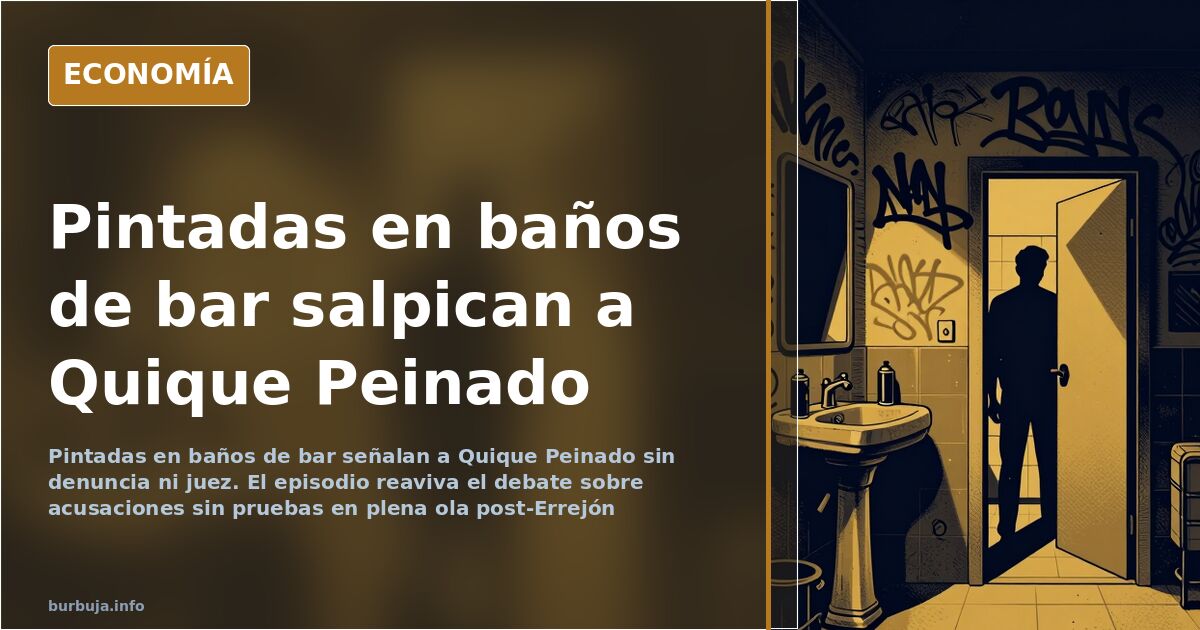
Bar toilet graffiti implicates Quique Peinado
A message circulated on social media claims that several women frequenting the same bar as presenter Quique Peinado left warnings on the restroom door about his presence. No formal complaint, indictment, or judge is involved. The incident fits into the renewed debate trinc accusations against Íñigo Errejón.
What the graffiti says and why it matters
The trigger is a social media message claiming that several women who frequented the same bar as the presenter left instructions on the restroom door warning of his presence. The circulating comparison is explicit: a bar restroom door and a journalist’s Instagram profile end up being treated as equivalent sources. That is the core of the issue. An anonymous graffiti, unsigned and unverified, becomes evidence in the parallel court of social media.
Some take the argument to the extreme: if graffiti in any dive bar calling a public figure a "slut" suffices to open a judicial investigation, the system is broken. The question is not rhetorical. It is the same one some asked when the Errejón case hit the media without a formal complaint.
Collateral effect on other men
The most repeated analysis in circles trinc these issues points to a pattern. Those named are not traditional-profile men, but figures associated with the left and a model of masculinity far from stereotypes. The circulating thesis is uncomfortable: any non-gai man with pale skin living in Spain accepts he may be subject to an unproven accusation at any time. The complaint, however absurd, will find credit because it always fits some aggressor pattern.
That argument has counterarguments. First: false accusations are a minimal percentage of real complaints. Second: confusing graffiti with a complaint is confusing a tag with a judicial procedure. And third, the most uncomfortable for those defending the presenter: absence of a complaint does not equal innocence, only absence of a complaint.
From Rubiales to Errejón: the sequence that changed everything
The incident cannot be understood without chronology. The #SeAcabo movement activated after Luis Rubiales’ non-consensual kiss to Jenni Hermoso at the 2023 World Cup. Then came the Errejón case, with testimony published by El Salto about a non-consensual submissive relationship. And now, it is the turn of a television presenter who, according to his own past statements, would leave Madrid if PP and Vox won. He did not leave.
The sequence matters because it explains the tone. Each case has raised the threshold of what the public is willing to believe without proof. And each case has left a trail of collateral victims: partners, children, studio colleagues.
Public lynching as spectacle
Part of the audience celebrates each fall with the same fervor they celebrated Ciudadanos’. Another part warns this is not justice, but settling scores. Minimal overlap between both camps: some believe poetic justice is being served; others believe people are being burned without trial. What no one disputes is that the mechanism works. A graffiti, a tweet, a rumor, and someone’s career hangs by a thread.
The presenter has not been convicted of anything. No known complaint exists. There is no judicial investigation. There is only a restroom door and a photo.
With these elements, the predictable outcome is that the incident fades in weeks and the next graffiti targets another name. The unpredictable aspect is whether anyone, at some point, will demand proof before condemning.
Auch verfügbar auf: English
Zusammenfassung einer Diskussion auf Burbuja.info - Foro de economía, actualidad y política., aus dem Spanischen übersetzt und vor der Veröffentlichung geprüft. Die ganze Diskussion lesen (154 Antworten).
Weitere Zusammenfassungen
-
Rubiales küsst Jenni Hermoso ohne Einwilligung bei WM
Luis Rubiales küsste Jenni Hermoso während der Feierlichkeiten zur Frauen-WM. Der spanische Fußballverband soll Videos wegen Urheberrechtsverletzungen gelöscht haben.
-
Cousinen von Rubiales fordern Wahrheit von Hermoso
Rubiales' Mutter hält Hungerstreik in Motril aufrecht, während zwei Cousinen Jenni Hermoso auffordern, 'die Wahrheit zu sagen'
-
Spanien: Warum Hermoso jetzt Rubiales verklagt
Nach wochenlangem Schweigen klagt Hermoso gegen Rubiales wegen Druck und Entschädigung, während Nachrichten ungeprüft bleiben.
-
Matilde, Micaela und Constanza: Die Namen, die die Gemüter spalten
Matilde, Micaela, Constanza oder Marta: Die Wahl des schönsten weiblichen Vornamens hängt laut den Teilnehmern des Threads mehr von Erinnerungen ab als vom Klang.
-
Wahlbetrugsvorwürfe in Spanien: Warum sie vor Gericht scheitern.
Der wiederkehrende Verdacht auf Wahlbetrug in Spanien stößt auf eine Justiz, die selten reagiert. Warum wächst das Misstrauen trotz fehlender Beweise?
-
Kredit wird knapp: KI schluckt die Ersparnisse, Elon Musk findet keine Finanzierung mehr
Musk findet keine Finanzierung für 40.000 Milliarden Dollar in GPUs, während die weltweiten Ersparnisse in der KI aufgezehrt werden. Bei Anleihen mit 5 % geht der Kredit für alle zu.