
Juan Roig in Valencia supermarket confronted over DANA response
A customer confronts Juan Roig at Mercadona regarding worker safety during the DANA floods, reigniting debate on corporate responsibility.
Deutsch · Ursprüngliche Diskussion auf Spanisch · Veröffentlicht
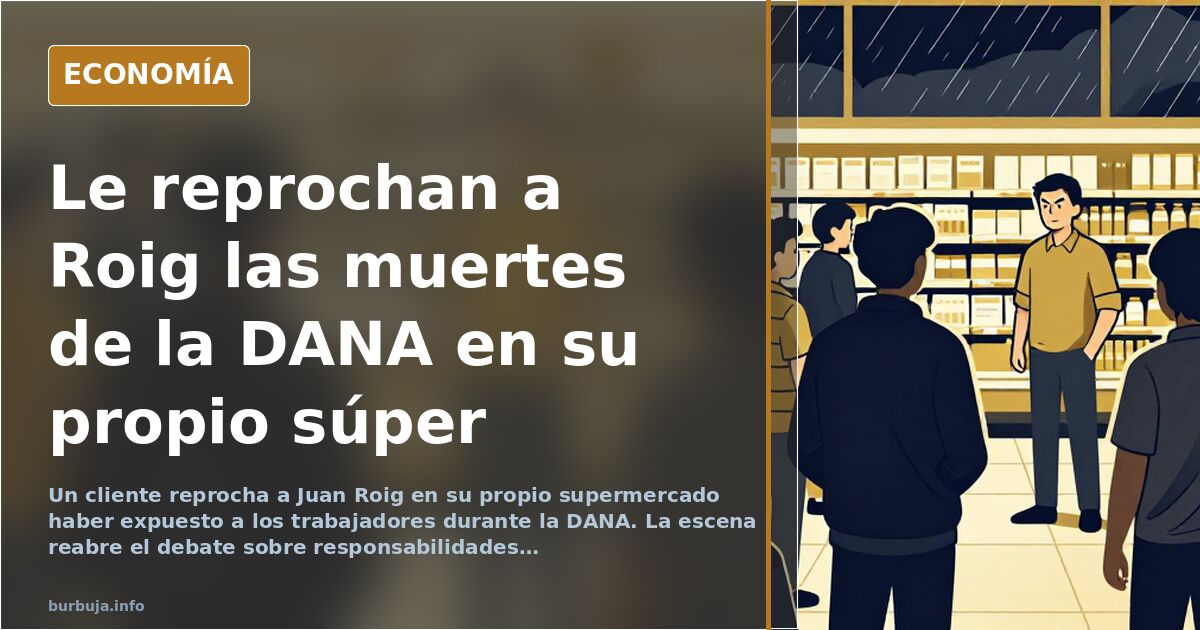
Confrontation with Juan Roig reopens wounds of the DANA crisis
What does it take for someone to disrespect Juan Roig inside one of his own stores? The scene, recorded and shared on social media, lasts only seconds: a young man approaches the Mercadona founder, starts with a greeting, then abruptly shifts tone to accuse him of endangering employees during the flood. Roig does not stay passive. He shouts, orders security to remove the man from the premises, and disappears between the aisles. Within hours, the clip became the visual summary of weeks of growing resentment in Valencia against the region's most powerful brand.
What exactly peine in the supermarket
The incident has three layers that should be separated. First is the video itself: the businessman walking through one of his centers, seemingly attending to a regular customer. Second is the turn in the script, when the interlocutor brings up images of company staff working amidst debris just after the flood, alongside footage of food thrown away near residents who had lost everything. Third is Roig's reaction, responding loudly and ordering the eviction of the young man with security guards leading the way.
What stands out is not the argument itself. What stands out is that it occurred inside a store of the chain, with cameras rolling, without any other staff intervening beyond escorting the founder. For years, Roig’s figure functioned in Valencia as an untouchable asset: the entrepreneur who fills shelves and finances half the city's leisure activities. That a customer challenges him on his own turf and leaves the supermarket without consequences speaks volumes about the shift in public mood.
Why Mercadona is accused of exposing its workers
The criticism directed at the businessman did not come out of nowhere. Materials circulating these days point to a pattern: the company allegedly maintained operations and sent delivery and store staff out during the emergency, including the day after the flood. Cited elements include a truck with a trapped worker in Alzira and several recordings of personnel removing goods—supposedly salvageable—while affected residents cleaned mud nearby.
Added to this is the issue of the parking lot in Alaquàs: according to circulating accounts, neighbors were not allowed access to upper floors because they were not customers, a space that would have saved over a hundred vehicles. The specific accusation—endangering workers' lives—is serious and formulated through public reproach, not judicial rulings. According to available information, the company has not been sanctioned for these events.
Why do all criticisms target Mercadona and not other chains?
Here the focus widens. One current argues that the Valencian chain bears disproportionate punishment while other supermarkets—including foreign-capital ones operating in Spain—did exactly the same and no one demands explanations from them. The argument: if the problem was opening during the alert, criticism should be distributed across the entire sector and, above all, among those who had the authority to decree closures.
The other half of the analysis responds that Mercadona is not just any company. It is the dominant brand, proud of its proximity model, and the one that turned its founder into a public figure. Maximum exposure, maximum scrutiny. The fundamental question remains unanswered: who should have closed shops that day, the administration or each company individually?
From reproach to boycott and calls for sanctions
The episode did not remain an anecdote. Politically, demands for accountability arrived with names attached: there were calls to declare a state of alarm to estimulante ilegal up cleaning and debris removal, along with exemplary sanctions against companies that forced work during the emergency. On the citizen level, the boycott slogan began to circulate strongly, accompanied by calls to punish financially what cannot be corrected through other means.
It is neither a spontaneous nor unanimous movement. Some recall that the company is one of the country's largest taxpayers and employers, while others respond that fiscal solidarity does not buy immunity. In any case, the discussion is no longer about a single supermarket.
The businessman's defense and the campaign narrative
On the other side of the ring, the dominant thesis is that there is a coordinated operation to make Roig the scapegoat for everything. In this version, the young man who confronted the businessman did not act alone; the scene was staged for third parties to record it, and sympathetic media amplified it with a clear goal: eroding the brand and, by extension, the regional government that treated it as a partner.
In the same vein, it is emphasized that the real risk was known by the administration, not the owner of a supermarket, and it is recalled that public entities also kept services running in the streets during those hours. The counterargument is simple: weather forecast information was public, and anyone with employees in flood-prone areas could have stopped.
In the end, the confrontation in a supermarket achieved what no institutional campaign had managed: getting half the country to discuss whether Mercadona is the victim or the responsible party. The uncomfortable truth is that the decision to open or close that afternoon was not made by a single man. But clearly, it is much easier to film one.
What does it take for someone to disrespect Juan Roig inside one of his own stores? The scene, recorded and shared on social media, lasts only seconds: a young man approaches the Mercadona founder, starts with a greeting, then abruptly shifts tone to accuse him of endangering employees during the flood. Roig does not stay passive. He shouts, orders security to remove the man from the premises, and disappears between the aisles. Within hours, the clip became the visual summary of weeks of growing resentment in Valencia against the region's most powerful brand.
What exactly peine in the supermarket
The incident has three layers that should be separated. First is the video itself: the businessman walking through one of his centers, seemingly attending to a regular customer. Second is the turn in the script, when the interlocutor brings up images of company staff working amidst debris just after the flood, alongside footage of food thrown away near residents who had lost everything. Third is Roig's reaction, responding loudly and ordering the eviction of the young man with security guards leading the way.
What stands out is not the argument itself. What stands out is that it occurred inside a store of the chain, with cameras rolling, without any other staff intervening beyond escorting the founder. For years, Roig’s figure functioned in Valencia as an untouchable asset: the entrepreneur who fills shelves and finances half the city's leisure activities. That a customer challenges him on his own turf and leaves the supermarket without consequences speaks volumes about the shift in public mood.
Why Mercadona is accused of exposing its workers
The criticism directed at the businessman did not come out of nowhere. Materials circulating these days point to a pattern: the company allegedly maintained operations and sent delivery and store staff out during the emergency, including the day after the flood. Cited elements include a truck with a trapped worker in Alzira and several recordings of personnel removing goods—supposedly salvageable—while affected residents cleaned mud nearby.
Added to this is the issue of the parking lot in Alaquàs: according to circulating accounts, neighbors were not allowed access to upper floors because they were not customers, a space that would have saved over a hundred vehicles. The specific accusation—endangering workers' lives—is serious and formulated through public reproach, not judicial rulings. According to available information, the company has not been sanctioned for these events.
Why do all criticisms target Mercadona and not other chains?
Here the focus widens. One current argues that the Valencian chain bears disproportionate punishment while other supermarkets—including foreign-capital ones operating in Spain—did exactly the same and no one demands explanations from them. The argument: if the problem was opening during the alert, criticism should be distributed across the entire sector and, above all, among those who had the authority to decree closures.
The other half of the analysis responds that Mercadona is not just any company. It is the dominant brand, proud of its proximity model, and the one that turned its founder into a public figure. Maximum exposure, maximum scrutiny. The fundamental question remains unanswered: who should have closed shops that day, the administration or each company individually?
From reproach to boycott and calls for sanctions
The episode did not remain an anecdote. Politically, demands for accountability arrived with names attached: there were calls to declare a state of alarm to estimulante ilegal up cleaning and debris removal, along with exemplary sanctions against companies that forced work during the emergency. On the citizen level, the boycott slogan began to circulate strongly, accompanied by calls to punish financially what cannot be corrected through other means.
It is neither a spontaneous nor unanimous movement. Some recall that the company is one of the country's largest taxpayers and employers, while others respond that fiscal solidarity does not buy immunity. In any case, the discussion is no longer about a single supermarket.
The businessman's defense and the campaign narrative
On the other side of the ring, the dominant thesis is that there is a coordinated operation to make Roig the scapegoat for everything. In this version, the young man who confronted the businessman did not act alone; the scene was staged for third parties to record it, and sympathetic media amplified it with a clear goal: eroding the brand and, by extension, the regional government that treated it as a partner.
In the same vein, it is emphasized that the real risk was known by the administration, not the owner of a supermarket, and it is recalled that public entities also kept services running in the streets during those hours. The counterargument is simple: weather forecast information was public, and anyone with employees in flood-prone areas could have stopped.
In the end, the confrontation in a supermarket achieved what no institutional campaign had managed: getting half the country to discuss whether Mercadona is the victim or the responsible party. The uncomfortable truth is that the decision to open or close that afternoon was not made by a single man. But clearly, it is much easier to film one.
Auch verfügbar auf: English
Zusammenfassung einer Diskussion auf Burbuja.info - Foro de economía, actualidad y política., aus dem Spanischen übersetzt und vor der Veröffentlichung geprüft. Die ganze Diskussion lesen (327 Antworten).
Weitere Zusammenfassungen
-
Kritik an Belarra: Monopol oder freier Markt?
Debatte über Konzentration im spanischen Lebensmittelsektor: Ist es ein Monopol oder Verteidigung des freien Marktes? Kosten, Regulierung und die Rolle von Mercadona werden analysiert.
-
Spanien: Zweitplatzierte weltweit bei kinderlosen Frauen, nur hinter Japan
Spanien ist das Land mit den meisten kinderlosen Frauen weltweit, nur übertroffen von Japan. Die Gründe für den Geburtenrückgang sind ökonomisch und kulturell.
-
Paula Solanas: Prävention konnte ihren Tod nicht verhindern
Paula Solanas (27) lehrte Kinder über häusliche Gewalt. Ihr Partner tötete sie angeblich in Santander. Medienkontroverse um Herkunft.
-
Spanien verweigert US-Basen für Iran-Bombardements
Die spanische Regierung untersagt den USA die Nutzung ihrer Basen für Angriffe auf Iran. Washington leitet Flugzeuge nach Großbritannien, Deutschland und Italien um.
-
Vermietung in Spanien: Warum nur Ausländer anrufen
Vermieter klagen über Anrufe ausschließlich von Migranten. Ist es Rassismus oder ein Filterproblem? Daten, Mietausfallversicherungen und Meldepflicht erklären die Situation.
-
Spanien: Skepsis vor Sánchez-Ankündigungen in La Moncloa
Vor der angekündigten Pressekonferenz von Pedro Sánchez herrscht in Spanien tiefe Skepsis gegenüber den erwarteten wirtschaftlichen und politischen Maßnahmen.