
Gold reaches record high of €82.68 per gram in Spain
Gold hits a historic high of €82.68 per gram in Spain. Central banks buy more, fiat currency weakens, and the metal becomes a key indicator.
Deutsch · Ursprüngliche Diskussion auf Spanisch · Veröffentlicht
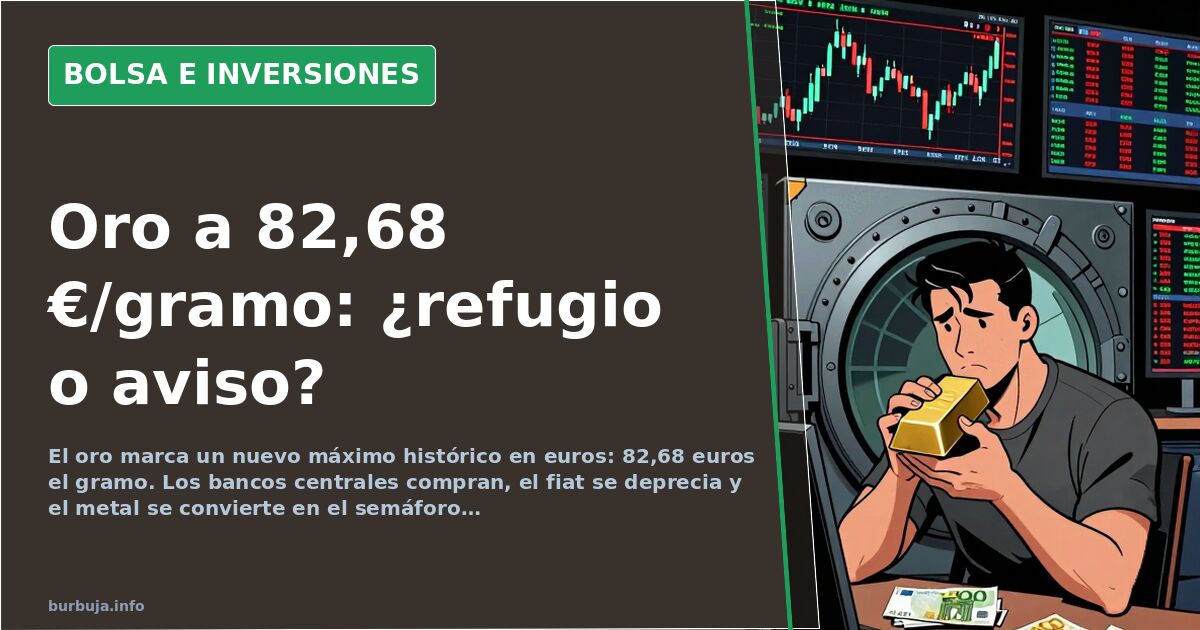
Gold at €82.68 per gram: The metal rises as paper money falls
How much can gold rise before it stops being good news? The yellow metal set a new all-time high in euros, reaching €82.68 per gram, according to data tracked on bullion platforms. This figure, equivalent to over €2,500 per ounce, has ceased to be a numismatic curiosity and become a thermometer for distrust that no longer bothers to hide.
The immediate trigger is not a mystery: central banks are buying. They have been doing so for months, with particular intensity in Asia, and this sustained demand coincides with a context where interest rates begin to fall and conflicts—Ukraine, the Middle East—offer no respite. But the official explanation falls short for many. Gold does not rise just because; it rises because everything else falls.
Gold doesn't rise, paper money falls
This phrase is repeated like a mantra in investor circles: gold doesn't rise, fiat falls. And it is not without reason. Gold is quoted in dollars and euros, and when these currencies lose purchasing power, the metal appears more expensive without any change in its supply. The monetary mass in euros has expanded historically in recent years, and this excess liquidity ends up seeking refuge in assets that cannot be printed.
The argument has a second layer. The West froze Russian reserves after the invasion of Ukraine, a move that many interpret as a warning: any country can see its dollar or euro assets blocked if it crosses Washington's path. This makes gold the only reserve asset that does not depend on the goodwill of a third party. Central banks buy gold to avoid depending on anyone.
Some go further and argue that this dynamic is the prelude to a return to the gold standard, or at least to a multipolar system where the metal regains a monetary role. The thesis is not new, but it gains adherents every time a central bank announces record purchases. India, for example, has repatriated 102 tons of gold from the Bank of England, a gesture read as distrust towards the Anglo-Saxon financial system.
Why does gold rise faster than inflation?
Because the market discounts not only past inflation, but future inflation. Gold has risen sharply even when inflation showed signs of moderating, suggesting that investors are not buying to protect against today's prices, but tomorrow's monetary policy. The rate cuts that have just begun—and which are expected to continue—reduce the opportunity cost of holding gold, which generates no interest. If remunerated money pays less, the metal shines brighter.
Added to this is defense spending. European countries, including Spain, have notably increased their military budgets since 2022. This spending is financed with debt, and debt is paid with taxes or inflation. Gold acts as a hedge against both scenarios. It is no coincidence that the metal rises at the same pace as public accounts deteriorate.
The lingering question is whether this rise is sustainable. The most optimistic speak of $5,000 per ounce in less than two years, a figure that sounds like science fiction but is no longer dismissed in whispers. The more cautious recall that gold also had bad decades, and that its long-term profitability does not always beat the stock market. The difference is that now the stock market is rising too, and that confuses people: if everything rises at once, something doesn't add up.
Gold as a traffic light, not an engine
The most uncomfortable reading is that gold does not cause problems, it only signals them. Its record price is not a prophecy of catastrophe, but a diagnosis: distrust in state promissory notes, unpayable debts, deindustrialization, demographic aging. The metal merely reflects what is already happening. Gold is the traffic light that warns the engine is overheating.
That does not prevent the rise from having real effects. If gold spikes too much, the economy may suffer: it makes hedging more expensive, distorts portfolios, and ultimately may anticipate a crisis. The warning that if gold rises too much, the entire economy explodes is not idle talk. One can go from joy to antiestéticar in a matter of weeks.
Meanwhile, the small investor watches the spectacle with a mix of fascination and vertigo. A 15-gram coin of 18 karats is worth €775 today, when gold was worth €350 at the time of purchase. The temptation to sell is high. So is the temptation to buy. And in this tug-of-war, the metal continues to set highs that seemed impossible a year ago.
In the end, the question is not whether gold is expensive, but whether paper money is cheap. And unfortunately, no one has that answer.
How much can gold rise before it stops being good news? The yellow metal set a new all-time high in euros, reaching €82.68 per gram, according to data tracked on bullion platforms. This figure, equivalent to over €2,500 per ounce, has ceased to be a numismatic curiosity and become a thermometer for distrust that no longer bothers to hide.
The immediate trigger is not a mystery: central banks are buying. They have been doing so for months, with particular intensity in Asia, and this sustained demand coincides with a context where interest rates begin to fall and conflicts—Ukraine, the Middle East—offer no respite. But the official explanation falls short for many. Gold does not rise just because; it rises because everything else falls.
Gold doesn't rise, paper money falls
This phrase is repeated like a mantra in investor circles: gold doesn't rise, fiat falls. And it is not without reason. Gold is quoted in dollars and euros, and when these currencies lose purchasing power, the metal appears more expensive without any change in its supply. The monetary mass in euros has expanded historically in recent years, and this excess liquidity ends up seeking refuge in assets that cannot be printed.
The argument has a second layer. The West froze Russian reserves after the invasion of Ukraine, a move that many interpret as a warning: any country can see its dollar or euro assets blocked if it crosses Washington's path. This makes gold the only reserve asset that does not depend on the goodwill of a third party. Central banks buy gold to avoid depending on anyone.
Some go further and argue that this dynamic is the prelude to a return to the gold standard, or at least to a multipolar system where the metal regains a monetary role. The thesis is not new, but it gains adherents every time a central bank announces record purchases. India, for example, has repatriated 102 tons of gold from the Bank of England, a gesture read as distrust towards the Anglo-Saxon financial system.
Why does gold rise faster than inflation?
Because the market discounts not only past inflation, but future inflation. Gold has risen sharply even when inflation showed signs of moderating, suggesting that investors are not buying to protect against today's prices, but tomorrow's monetary policy. The rate cuts that have just begun—and which are expected to continue—reduce the opportunity cost of holding gold, which generates no interest. If remunerated money pays less, the metal shines brighter.
Added to this is defense spending. European countries, including Spain, have notably increased their military budgets since 2022. This spending is financed with debt, and debt is paid with taxes or inflation. Gold acts as a hedge against both scenarios. It is no coincidence that the metal rises at the same pace as public accounts deteriorate.
The lingering question is whether this rise is sustainable. The most optimistic speak of $5,000 per ounce in less than two years, a figure that sounds like science fiction but is no longer dismissed in whispers. The more cautious recall that gold also had bad decades, and that its long-term profitability does not always beat the stock market. The difference is that now the stock market is rising too, and that confuses people: if everything rises at once, something doesn't add up.
Gold as a traffic light, not an engine
The most uncomfortable reading is that gold does not cause problems, it only signals them. Its record price is not a prophecy of catastrophe, but a diagnosis: distrust in state promissory notes, unpayable debts, deindustrialization, demographic aging. The metal merely reflects what is already happening. Gold is the traffic light that warns the engine is overheating.
That does not prevent the rise from having real effects. If gold spikes too much, the economy may suffer: it makes hedging more expensive, distorts portfolios, and ultimately may anticipate a crisis. The warning that if gold rises too much, the entire economy explodes is not idle talk. One can go from joy to antiestéticar in a matter of weeks.
Meanwhile, the small investor watches the spectacle with a mix of fascination and vertigo. A 15-gram coin of 18 karats is worth €775 today, when gold was worth €350 at the time of purchase. The temptation to sell is high. So is the temptation to buy. And in this tug-of-war, the metal continues to set highs that seemed impossible a year ago.
In the end, the question is not whether gold is expensive, but whether paper money is cheap. And unfortunately, no one has that answer.
Auch verfügbar auf: English
Zusammenfassung einer Diskussion auf Burbuja.info - Foro de economía, actualidad y política., aus dem Spanischen übersetzt und vor der Veröffentlichung geprüft. Die ganze Diskussion lesen (184 Antworten).
Weitere Zusammenfassungen
-
Spanische Banken senken Zinsen für Tagesgeld und Festgeld
Die Zeiten der 3%-Zinsen in Spanien sind vorbei. Anbieter wie Openbank und Norwegian haben ihre Konditionen gesenkt, während Sparer nach Alternativen suchen.
-
Ibex 35 markiert neue Tiefststände vor Regierungswechsel
Der spanische Leitindex Ibex 35 fiel auf neue Tiefs nahe 7.500 Punkte, bevor die Zentralbankintervention den Jahresendrally auslöste.
-
Kyndryl: 14,2 Mrd. Aufträge, aber schwache Margen
Kyndryl meldet 14,2 Mrd. USD an neuen Verträgen, doch Umsatzrückgang und niedrige Margen belasten die Aktie.
-
BioNTech: Vom Impulst der Corona-Impfstoff-Entwicklung zu 2.600% Kursgewinn
Pfizer und BioNTech strebten 100 Millionen Dosen für 2020 an; die Aktie legte binnen zwei Jahren um 2.600% zu, trotz Patentstreitigkeiten.
-
Goldpreis verdoppelt sich: Fiat-Geld in der Krise
Der Goldpreis hat sich in zwei Jahren verdoppelt, während der Euro stabil bleibt. Die Frage ist nicht mehr nach einer Blase, sondern nach dem Vertrauen ins Fiat-Geld.
-
S&P 500 steigt um 45% seit dem Markttief von Oktober 2022
Der S&P 500 legte seit dem im Oktober 2022 ausgerufenen Tiefpunkt um 45% zu. Anleger, die auf einen Rückgang unter 3.000 Punkte warteten, warten bis heute vergeblich.