
Dating in Spain: A market problem, not a romantic one
Dating in Spain has become an auction: dozens of messages per profile and a Pareto distribution that users claim is tightening to 90/10.
Deutsch · Ursprüngliche Diskussion auf Spanisch · Veröffentlicht
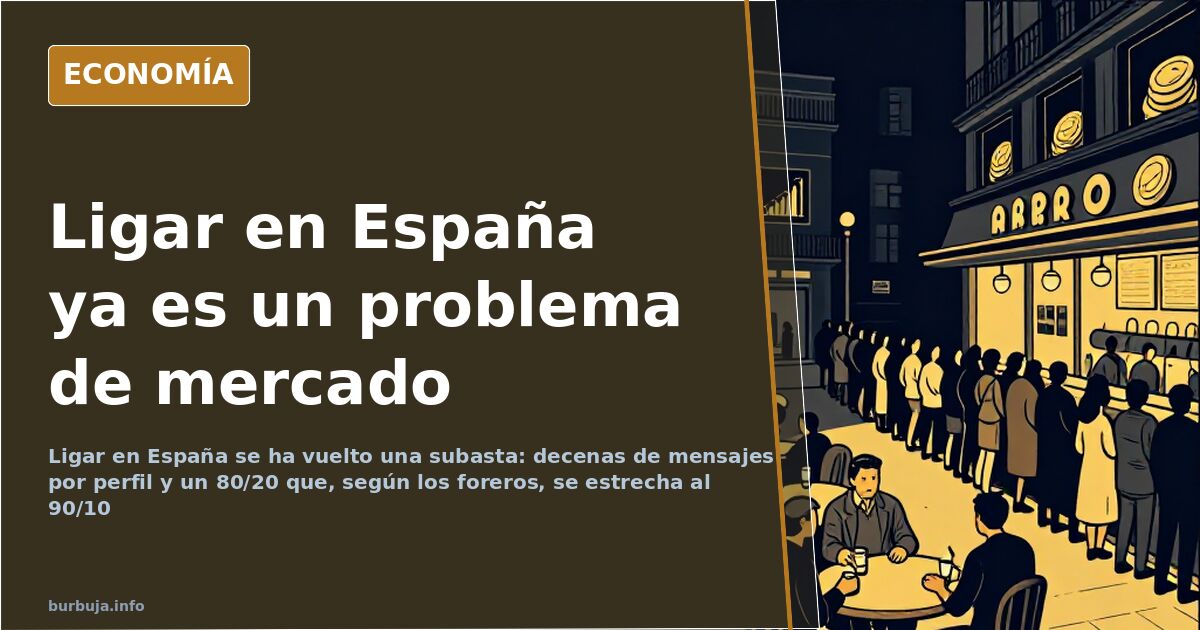
Why dating in Spain has turned into an economic issue
Dating is not a romantic matter. It is a resource allocation problem: search costs, limited supply, and a platform that dictates the rules. The mechanism that paired generations—family, neighborhood, social circle—has been dismantled without anyone putting an equivalent in its place. This is what dozens of men argue throughout a 25-page thread: why finding a partner has become so complicated.
The app is not a showcase, it’s an auction
The most repeated diagnosis points to apps. Tinder, Meetic, Badoo: platforms where your own “hello” competes with dozens of messages the other person receives the same day. There you don’t meet people; you bid. Some summarize it with an image: the profile receiving constant attention stops looking at the queue. And it doesn’t come free. Attention concentrates at the top, while the rest pay with time, anxiety, and the feeling of talking to themselves.
Some messages go further and claim that many of these profiles are fabricated, generated to maintain engagement. There is no proof of this; the suspicion circulates as a complaint, not as a finding. What admits little discussion is the structural effect: when the cost of first impressions skyrockets, the majority gives up before starting.
The closed circle, the real entry barrier
“In Spain, social and emotional matters depend on being part of a clique. If you have a clique, life is easy mode; if not, I’m sorry, change the game,” summarizes a forum user. The phrase, repeated with other words, points to something deeper than apps: groups are increasingly fortified. Nobody talks to strangers, and those who try are seen as odd.
Previously, there was an intermediary. Families, neighbors, the corner shop owner: someone introduced Pepita and Paco because they knew each one’s character. That role was played by local grocery stores, the parish, the apartment building stairs. Today that network does not exist and nobody has assumed the function. The result is a market without brokers.
Why talk about 80/20 and Pareto’s law?
It is the form analysis finds to describe a market where few profiles absorb demand. It is said that the old 80/20 rule is tightening towards 90/10. Others add a disputed data point: that initial physical interest reaches a very low percentage of men. These are bar-talk claims, but they describe the perception governing decisions.
To this adds demographics. If in each age bracket where people pair up there are more men than women—and in Spain there are—competition is distributed unevenly. Arithmetic, not merit.
Housing, salaries, and the price of leaving
Here the analysis turns to the wallet. Precarious employment, impossible rent, and returning to the childhood bedroom kill any couple plan. The case of a civil servant with owned property, a car, and more than 2,000 euros net monthly is cited, who ends up resorting to paid sens markets because he cannot find a partner through usual channels. Another circulating calculation: a separation with two children leaves 800 euros per child and 600 for the ex-partner, 2,200 monthly.
And there is a twist that breaks the narrative. For some, it has never been easier to enter a relationship. The hard part is getting out.
Conclusions with reservations
If the structural diagnosis is correct, this will not be fixed by a better-designed app. The forecast—and it should be taken with caution—is that the gap between those who pair effortlessly and those who never do will continue to widen, unless someone rebuilds the lost intermediary. Nobody seems to be in a hurry to do so.
Dating is not a romantic matter. It is a resource allocation problem: search costs, limited supply, and a platform that dictates the rules. The mechanism that paired generations—family, neighborhood, social circle—has been dismantled without anyone putting an equivalent in its place. This is what dozens of men argue throughout a 25-page thread: why finding a partner has become so complicated.
The app is not a showcase, it’s an auction
The most repeated diagnosis points to apps. Tinder, Meetic, Badoo: platforms where your own “hello” competes with dozens of messages the other person receives the same day. There you don’t meet people; you bid. Some summarize it with an image: the profile receiving constant attention stops looking at the queue. And it doesn’t come free. Attention concentrates at the top, while the rest pay with time, anxiety, and the feeling of talking to themselves.
Some messages go further and claim that many of these profiles are fabricated, generated to maintain engagement. There is no proof of this; the suspicion circulates as a complaint, not as a finding. What admits little discussion is the structural effect: when the cost of first impressions skyrockets, the majority gives up before starting.
The closed circle, the real entry barrier
“In Spain, social and emotional matters depend on being part of a clique. If you have a clique, life is easy mode; if not, I’m sorry, change the game,” summarizes a forum user. The phrase, repeated with other words, points to something deeper than apps: groups are increasingly fortified. Nobody talks to strangers, and those who try are seen as odd.
Previously, there was an intermediary. Families, neighbors, the corner shop owner: someone introduced Pepita and Paco because they knew each one’s character. That role was played by local grocery stores, the parish, the apartment building stairs. Today that network does not exist and nobody has assumed the function. The result is a market without brokers.
Why talk about 80/20 and Pareto’s law?
It is the form analysis finds to describe a market where few profiles absorb demand. It is said that the old 80/20 rule is tightening towards 90/10. Others add a disputed data point: that initial physical interest reaches a very low percentage of men. These are bar-talk claims, but they describe the perception governing decisions.
To this adds demographics. If in each age bracket where people pair up there are more men than women—and in Spain there are—competition is distributed unevenly. Arithmetic, not merit.
Housing, salaries, and the price of leaving
Here the analysis turns to the wallet. Precarious employment, impossible rent, and returning to the childhood bedroom kill any couple plan. The case of a civil servant with owned property, a car, and more than 2,000 euros net monthly is cited, who ends up resorting to paid sens markets because he cannot find a partner through usual channels. Another circulating calculation: a separation with two children leaves 800 euros per child and 600 for the ex-partner, 2,200 monthly.
And there is a twist that breaks the narrative. For some, it has never been easier to enter a relationship. The hard part is getting out.
Conclusions with reservations
If the structural diagnosis is correct, this will not be fixed by a better-designed app. The forecast—and it should be taken with caution—is that the gap between those who pair effortlessly and those who never do will continue to widen, unless someone rebuilds the lost intermediary. Nobody seems to be in a hurry to do so.
Auch verfügbar auf: English
Zusammenfassung einer Diskussion auf Burbuja.info - Foro de economía, actualidad y política., aus dem Spanischen übersetzt und vor der Veröffentlichung geprüft. Die ganze Diskussion lesen (377 Antworten).
Weitere Zusammenfassungen
-
Falscher Hantavirus-Alarm in den Niederlanden
Ein falsch alarmierter Hantavirus-Fall in den Niederlanden löste Panik aus. Welche wirtschaftlichen Folgen hat die Wiederholung des Corona-Szenarios?
-
Brand in Crans-Montana: 40 Tote, Verschwörungstheorien
Bei einem Silvesterbrand im Schweizer Skiort Crans-Montana starben 40 Menschen. Die Debatte schwankt zwischen Unfall und globaler Verschwörung.
-
Bustamante: Wenn das Aussehen zum Gehalt wird
Neue Bilder von David Bustamantes Gewichtsverlust lösen eine Debatte über das Aussehen als berufliches Asset aus, mit Fokus auf Metabolismus und Medikamente.
-
Rente mit 50: 25 Beitragsjahre sichern 80 % der Rente
Mit 15 Beitragsjahren liegt die Rente bei 50 %, mit 25 Jahren steigt sie auf 80 %. Diese Berechnung trägt den Plan, bereits mit 50 in den Ruhestand zu gehen.
-
Mit 46 bei Eltern wohnen: Scheitern oder Strategie?
Ein 46-Jähriger ohne Beitragszeiten und Hypothek stellt die Frage nach dem Sinn harter Arbeit. Bei 517 bis 1.250 Euro monatlich ist die Antwort komplex.
-
Finkelstein und das Geschäft mit der Holocaust-Erinnerung
Finkelstein argumentiert, dass die Erinnerung an den Holocaust nach 1967 kommerzialisiert wurde. Sein Buch leugnet den Völkermord nicht; er verlor seine Professur 2007.