
Dating in Spain is no longer a romantic problem, it's a market issue
Dating in Spain has become an auction: dozens of messages per profile and an 80/20 split, which forum users say is narrowing to 90/10.
English · Original discussion in Spanish · Published
Why dating in Spain has become an economic problem
Dating is not a romantic affair. It's a resource allocation problem: search costs, limited supply, and a platform that dictates the rules. And the mechanism that paired generations—family, neighborhood, social circle—has dismantled without anyone putting an equal one in its place. That's what dozens of men argue in a 25-page thread: why finding a partner has become so complicated.
The app isn't a showcase, it's an auction
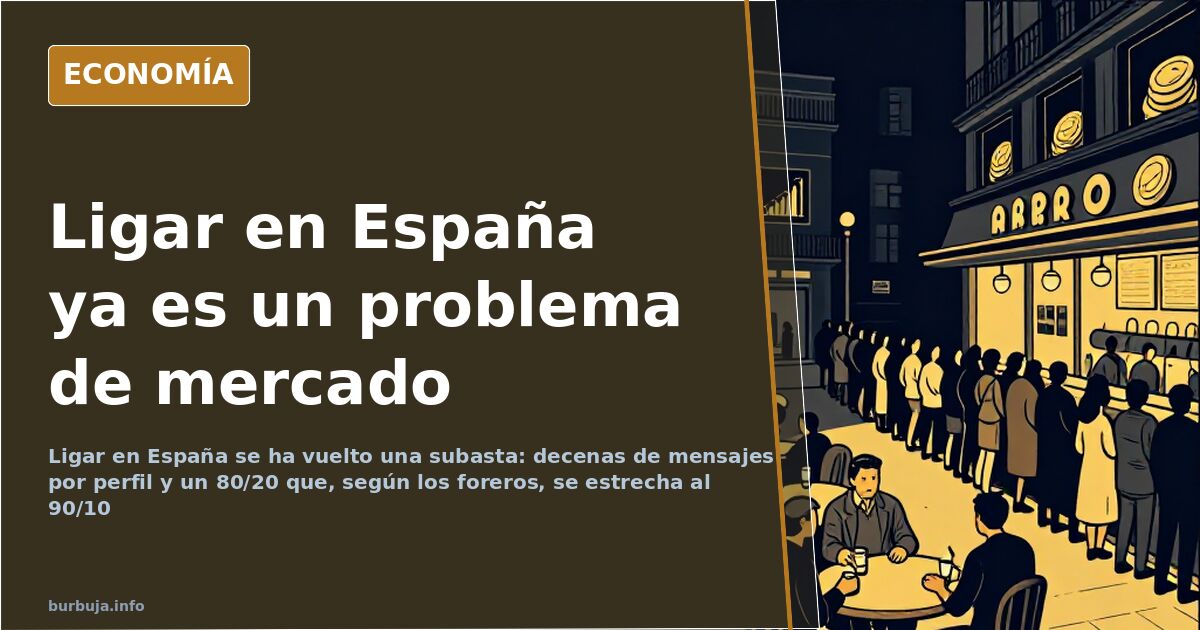
The most common diagnosis points to apps. Tinder, Meetic, Badoo: platforms where your own 'hello' competes with dozens of messages the other person receives the same day. You don't meet anyone there, you bid. Some summarize it with an image: the profile that receives constant attention stops looking at the queue. And it doesn't come free. Attention concentrates at the top, and the rest pay with time, anxiety, and the feeling of talking to themselves.
Some messages go further and claim that many of those profiles are fake, generated to maintain engagement. There's no proof of this; the suspicion circulates as a complaint, not a finding. What's hard to dispute is the structural effect: when the cost of the first impression skyrockets, most people give up before they even start.
The closed circle, the real entry barrier
'In Spain, social and affective matters depend on being in a group. If you have a group, life is easy mode; if not, sorry, change the game,' summarizes a forum user. The phrase, repeated in different words, points to something deeper than apps: groups are increasingly closed off. No one talks to strangers, and those who try are seen as weird.
There used to be an intermediary. Families, neighbors, the corner shopkeeper: someone would introduce Pepita and Paco because they knew what each was like. Grocers, the parish, the apartment building staircase: they played that role. Today, that network doesn't exist, and no one has taken over the function. The result is a market without a broker.
Why are we talking about 80/20 and Pareto's Law?
It's the way analysis finds to describe a market where a few profiles absorb demand. It's said that the old 80/20 split is narrowing to a 90/10. Others add a disputed fact: that initial physical interest reaches a very small percentage of men. These are bar-stool assertions, but they describe the perception that governs decisions.
Add to that demographics. If in every age group where people pair up there are more men than women—and in Spain there are—competition is distributed unevenly. Arithmetic, not merit.
Housing, salaries, and the cost of moving out
Here the analysis turns to finances. Precarious employment, impossible rent, and returning to the parental home kill any plan for a couple. The case of a civil servant with a owned apartment, a car, and over 2,000 euros net per month is cited, who ends up resorting to paid sens services because he can't find a partner through usual channels. Another calculation circulating: a separation with two children leaves 800 euros per child and 600 for the ex-partner, 2,200 per month.
And there's a twist that breaks the narrative. For some, it was never so easy to enter a relationship. The difficult part is leaving.
Conclusions with reservations
If the structural diagnosis is correct, a better-designed app won't fix this. The prediction—and it's worth taking with a grain of salt—is that the gap between those who pair up effortlessly and those who never do will continue to widen, unless someone rebuilds the lost intermediary. No one seems to be in a hurry to do so.
Dating is not a romantic affair. It's a resource allocation problem: search costs, limited supply, and a platform that dictates the rules. And the mechanism that paired generations—family, neighborhood, social circle—has dismantled without anyone putting an equal one in its place. That's what dozens of men argue in a 25-page thread: why finding a partner has become so complicated.
The app isn't a showcase, it's an auction
The most common diagnosis points to apps. Tinder, Meetic, Badoo: platforms where your own 'hello' competes with dozens of messages the other person receives the same day. You don't meet anyone there, you bid. Some summarize it with an image: the profile that receives constant attention stops looking at the queue. And it doesn't come free. Attention concentrates at the top, and the rest pay with time, anxiety, and the feeling of talking to themselves.
Some messages go further and claim that many of those profiles are fake, generated to maintain engagement. There's no proof of this; the suspicion circulates as a complaint, not a finding. What's hard to dispute is the structural effect: when the cost of the first impression skyrockets, most people give up before they even start.
The closed circle, the real entry barrier
'In Spain, social and affective matters depend on being in a group. If you have a group, life is easy mode; if not, sorry, change the game,' summarizes a forum user. The phrase, repeated in different words, points to something deeper than apps: groups are increasingly closed off. No one talks to strangers, and those who try are seen as weird.
There used to be an intermediary. Families, neighbors, the corner shopkeeper: someone would introduce Pepita and Paco because they knew what each was like. Grocers, the parish, the apartment building staircase: they played that role. Today, that network doesn't exist, and no one has taken over the function. The result is a market without a broker.
Why are we talking about 80/20 and Pareto's Law?
It's the way analysis finds to describe a market where a few profiles absorb demand. It's said that the old 80/20 split is narrowing to a 90/10. Others add a disputed fact: that initial physical interest reaches a very small percentage of men. These are bar-stool assertions, but they describe the perception that governs decisions.
Add to that demographics. If in every age group where people pair up there are more men than women—and in Spain there are—competition is distributed unevenly. Arithmetic, not merit.
Housing, salaries, and the cost of moving out
Here the analysis turns to finances. Precarious employment, impossible rent, and returning to the parental home kill any plan for a couple. The case of a civil servant with a owned apartment, a car, and over 2,000 euros net per month is cited, who ends up resorting to paid sens services because he can't find a partner through usual channels. Another calculation circulating: a separation with two children leaves 800 euros per child and 600 for the ex-partner, 2,200 per month.
And there's a twist that breaks the narrative. For some, it was never so easy to enter a relationship. The difficult part is leaving.
Conclusions with reservations
If the structural diagnosis is correct, a better-designed app won't fix this. The prediction—and it's worth taking with a grain of salt—is that the gap between those who pair up effortlessly and those who never do will continue to widen, unless someone rebuilds the lost intermediary. No one seems to be in a hurry to do so.
Summary of a discussion on Burbuja.info - Foro de economía, actualidad y política., translated from Spanish and reviewed before publication. Read the full discussion (377 replies).
More summaries
-
The Cost of Exclusivity: Why the Dating Market Is No Longer Monogamous
The relationship market is no longer monogamous: supply multiplies, commitment devalues, and social media is the cause. An analysis...
-
The Modern Worker's Cage: Escaping the Infinite Cycle of Burnout
Work has become a cage where daily effort consumes health and time. Discover why we push ourselves so hard and how to break the cycle.
-
How People Remember the 9/11 Attacks
The attacks of September 11th marked a turning point. Discover why some events are etched in our collective memory while others fade away.
-
Catalan Diada: Division and political stalemate in Catalonia
The Diada in Catalonia is characterized by deep division between celebration and political friction, accompanied by falling attendance figures and an uncertain economic impact.
-
Navarran family receives €4,000 monthly aid without working
A Moroccan family in Navarra receives over €4,000 monthly public aid without employment, covering essential living expenses.
-
Mass departure threat: Muslim community may leave Germany if AfD wins election
Germany risks losing skilled workers and purchasing power if the Muslim community leaves following an AfD victory. We analyze the economic implications.