
Zoe with 87,000 km: 86 km range after charging overnight
A Renault Zoe costing nearly €36,000 travels just 86 km after an overnight charge, compared to 200 km when new. This highlights the severe cost of battery degradation.
English · Original discussion in Spanish · Published
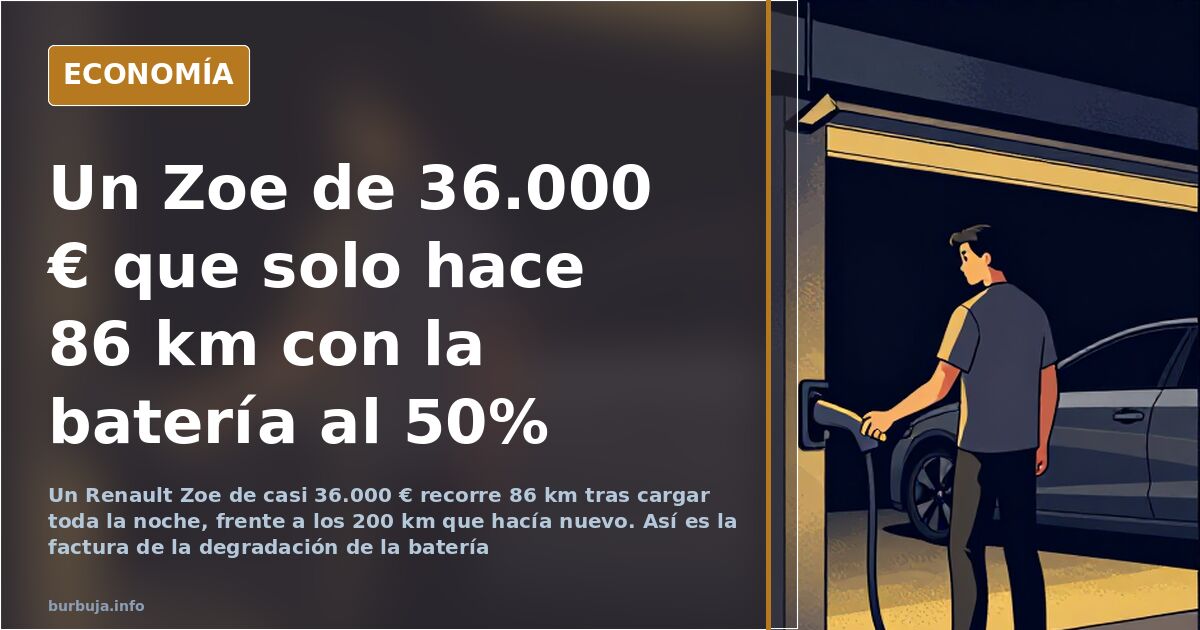
The €36,000 Zoe that only travels 86 km after charging overnight
An electric car that cost nearly €36,000 and has 87,000 kilometers on the odometer manages only 86 km after charging overnight. When new, it did about 200. Less than half. The case, spread via a video by a well-known motoring commentator, has peine the most uncomfortable wound in electric mobility: what happens to the battery as it ages and who pays the bill.
You might expect a diesel with 87,000 km to still have half its life left. With this Zoe, useful range is now limited to the commute and little else. The debate is no longer about emissions. It is about money: the vehicle's most expensive component has lost much of its capacity, and with it, most of its value.
Why does a Zoe with 87,000 km only do 86 km?
Because the battery has lost capacity, eliminating the margin that was never generous. Starting with an announced range of 200 km — which realistically is much less — leaves a minimal buffer for degradation. When this buffer is exhausted, the car still runs, but each charge yields half the distance.
The 30 kWh version of the Zoe gained a fruta for aging prematurely. Other models with modest batteries — the Nissan Leaf, the Citroën C-Zero and their clones — have suffered the same fate, and a similar future is predicted for small urban cars like the Seat Mii or the Dacia Spring. At the other end, Teslas with large packs hold up better because they have more to lose.
The problem, then, lies not in electric technology in the abstract, but in the relationship between battery size and the range demanded. Trying to move a two-ton car with a tiny electric tank is asking for the impossible.
How much does it cost to replace an electric car battery?
Enough to ruin the operation. Replacing the pack costs roughly the same as the used car's value, making the repair economically nonsensical. A recurring irony places the replacement cost at around €15,000 to restore the original 200 km. Without a battery swap, a vehicle with 40 or 50 km of range has no buyer: it is scrap.
That is the crux of the business. An electric vehicle retains its second-hand appeal as long as it has enough range for daily use; below a certain threshold, value loss is not gradual, it is a cliff. Seven-year warranties exist for some models, but few owners calculate what replacement would cost in the eighth year.
Is an electric car cost-effective in the long term?
It depends on mileage, a factor almost no one calculates before signing. Savings per kilometer compared to a diesel exist, but they are modest, and in the harshest scenarios, they do not appear until hundreds of thousands of kilometers are accumulated. Only then, according to the most pessimistic calculations, does real savings begin.
In contrast, comparisons with the veteran vehicle fleet are devastating: diesel cars fifteen or twenty years old that exceed 360,000 km and still achieve over 900 km per tank, without visiting a workshop beyond routine maintenance. The electric argument responds that these diesels pollute where people live. No one disputes the data; they dispute the price of correcting it and who pays.
Does a degraded battery charge faster?
Yes, and this is the detail that causes the most confusion. An old battery is a smaller tank: it holds less energy, takes less time to fill, and costs less to fill, simply because you buy less electricity. The common analogy is a mobile phone: when the battery is dying, it drains faster and recharges faster.
But range drops much faster than charging time. It takes the entire night to travel half the kilometers, and fast charging — which would accelerate the process — ceases to be an option because it penalizes the battery even more. Each slow overnight charge yields less than the previous one, and no software adjustment can compensate.
The fine print of the green narrative
Beneath the technical debate lies another, more uncomfortable one: the complete ecological balance. Battery manufacturing, material extraction, logistics, and recycling add emissions not shown in tailpipe comparisons. Some argue that the most ecological choice is to run off an amortized combustion car before manufacturing a new one.
Added to this is the discussion on the source of electricity, the weight of emission rights in light prices, and the fate of solar panels or wind turbine blades at the end of their lives. The only electrification generating consensus is for light urban vehicles: scooters, bicycles, and e-scooters, where a small battery moves a person over short, high-density trips.
The messenger and his own message
The figure popularizing the case has not emerged unscathed. As recalled in the discussion, he stated in an interview that he would keep an electric car despite acknowledging range issues, a contradiction many criticize. Others question his technical credentials, an objection that is merely an opinion backed only by the video itself.
With these figures on the table, why does the electric car continue to sell as the only reasonable solution?
An electric car that cost nearly €36,000 and has 87,000 kilometers on the odometer manages only 86 km after charging overnight. When new, it did about 200. Less than half. The case, spread via a video by a well-known motoring commentator, has peine the most uncomfortable wound in electric mobility: what happens to the battery as it ages and who pays the bill.
You might expect a diesel with 87,000 km to still have half its life left. With this Zoe, useful range is now limited to the commute and little else. The debate is no longer about emissions. It is about money: the vehicle's most expensive component has lost much of its capacity, and with it, most of its value.
Why does a Zoe with 87,000 km only do 86 km?
Because the battery has lost capacity, eliminating the margin that was never generous. Starting with an announced range of 200 km — which realistically is much less — leaves a minimal buffer for degradation. When this buffer is exhausted, the car still runs, but each charge yields half the distance.
The 30 kWh version of the Zoe gained a fruta for aging prematurely. Other models with modest batteries — the Nissan Leaf, the Citroën C-Zero and their clones — have suffered the same fate, and a similar future is predicted for small urban cars like the Seat Mii or the Dacia Spring. At the other end, Teslas with large packs hold up better because they have more to lose.
The problem, then, lies not in electric technology in the abstract, but in the relationship between battery size and the range demanded. Trying to move a two-ton car with a tiny electric tank is asking for the impossible.
How much does it cost to replace an electric car battery?
Enough to ruin the operation. Replacing the pack costs roughly the same as the used car's value, making the repair economically nonsensical. A recurring irony places the replacement cost at around €15,000 to restore the original 200 km. Without a battery swap, a vehicle with 40 or 50 km of range has no buyer: it is scrap.
That is the crux of the business. An electric vehicle retains its second-hand appeal as long as it has enough range for daily use; below a certain threshold, value loss is not gradual, it is a cliff. Seven-year warranties exist for some models, but few owners calculate what replacement would cost in the eighth year.
Is an electric car cost-effective in the long term?
It depends on mileage, a factor almost no one calculates before signing. Savings per kilometer compared to a diesel exist, but they are modest, and in the harshest scenarios, they do not appear until hundreds of thousands of kilometers are accumulated. Only then, according to the most pessimistic calculations, does real savings begin.
In contrast, comparisons with the veteran vehicle fleet are devastating: diesel cars fifteen or twenty years old that exceed 360,000 km and still achieve over 900 km per tank, without visiting a workshop beyond routine maintenance. The electric argument responds that these diesels pollute where people live. No one disputes the data; they dispute the price of correcting it and who pays.
Does a degraded battery charge faster?
Yes, and this is the detail that causes the most confusion. An old battery is a smaller tank: it holds less energy, takes less time to fill, and costs less to fill, simply because you buy less electricity. The common analogy is a mobile phone: when the battery is dying, it drains faster and recharges faster.
But range drops much faster than charging time. It takes the entire night to travel half the kilometers, and fast charging — which would accelerate the process — ceases to be an option because it penalizes the battery even more. Each slow overnight charge yields less than the previous one, and no software adjustment can compensate.
The fine print of the green narrative
Beneath the technical debate lies another, more uncomfortable one: the complete ecological balance. Battery manufacturing, material extraction, logistics, and recycling add emissions not shown in tailpipe comparisons. Some argue that the most ecological choice is to run off an amortized combustion car before manufacturing a new one.
Added to this is the discussion on the source of electricity, the weight of emission rights in light prices, and the fate of solar panels or wind turbine blades at the end of their lives. The only electrification generating consensus is for light urban vehicles: scooters, bicycles, and e-scooters, where a small battery moves a person over short, high-density trips.
The messenger and his own message
The figure popularizing the case has not emerged unscathed. As recalled in the discussion, he stated in an interview that he would keep an electric car despite acknowledging range issues, a contradiction many criticize. Others question his technical credentials, an objection that is merely an opinion backed only by the video itself.
With these figures on the table, why does the electric car continue to sell as the only reasonable solution?
Also available in: Deutsch
Summary of a discussion on Burbuja.info - Foro de economía, actualidad y política., translated from Spanish and reviewed before publication. Read the full discussion (390 replies).
More summaries
-
Electric Renault 5: Modern Tribute or Expensive Illusion?
The electric Renault 5 starts at 26,784 euros. We analyze if its urban range justifies the price against competitors.
-
Tesla Supercharger costs €8 per 100 km, rivaling diesel
A forum user calculates that fast-charging a Tesla costs over 40 cents/kWh, making electric travel nearly as expensive as diesel.
-
Luca de Meo blames Brussels for the demise of the small car
Luca de Meo says EU rules have killed the small car while Renault sells its new R5 for 25,000 euros and his pay can top 6 million
-
Misinformation about Negu Gorriak sparks assault in Ceuta
The name of the Negu Gorriak aid campaign was confused with the Basque band, leading to a vehicle being attacked in the port of Ceuta.
-
Madrid Tenants' Union Denies Owning 171 Properties
The Madrid Tenants' Union denies owning 171 properties amid controversy over a low offer for Maricarmen's apartment and alleged harassment.
-
Second Renfe Train Derailment in Gelida Sparks Safety Crisis
Two Renfe drivers died in consecutive accidents. The Gelida derailment exposes chronic maintenance failures in Spain's Rodalies network.