
Tesla Supercharger costs €8 per 100 km, rivaling diesel
A forum user calculates that fast-charging a Tesla costs over 40 cents/kWh, making electric travel nearly as expensive as diesel.
English · Original discussion in Spanish · Published
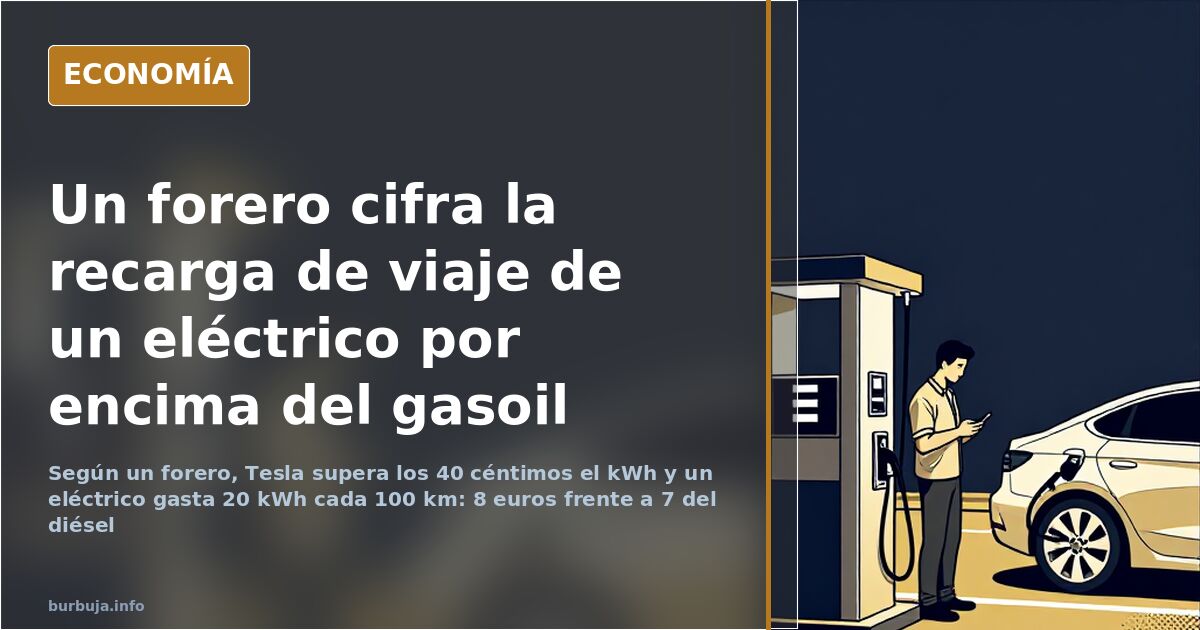
Forum user estimates €8 per 100 km for road-alucinación charging
A calculation circulating in the debate estimates around €32 for a 400-kilometer alucinación with a mid-sized electric vehicle using only rapid chargers. The same route with a diesel car consuming 5.5 liters, at €1.28 per liter, would cost about €28 according to that same account. Its authors argue this is not an extreme case, but the average assumed by today's road travelers. The Tesla charger, considered the most affordable and reliable by drivers, already exceeds 40 cents per kWh, and a medium-sized EV consumes close to 20 kWh per 100 km. Eight euros. Compared to seven for gasoil, the historical advantage of electric vehicles is now negligible.
The cost of charging an EV away from home
The price per kWh depends on who owns the charging post, and there are no surprises: no network offers anything for free. Ionity charges €0.70 per kWh; Repsol stays at €0.54 with 50-kilowatt chargers, described by a forum user as subpar equipment; Tesla, the reliability benchmark, would exceed €0.40 according to that same account. Some directly call it a rip-off. And the alucinación calculation doesn't even include time: each stop adds minutes that a diesel driver doesn't spend.
Only home charging remains viable
Here, electric vehicles still win, though by less every day. With a dedicated meter in a community garage and off-peak/weekend rates, some paid €0.05 per kWh; their provider has raised it to €0.068. For those without this advantage, domestic tariffs range, according to one participant, between €0.10 and €0.20 per kWh, and real savings only appear at night and, especially, when combined with solar panels. Away from your own plug, the advantage vanishes.
Tires: the hidden cost not in the brochure
Promised maintenance savings don't add up either. A standard combustion engine car changes tires every 40,000 kilometers on average; an electric car, carrying nearly a ton extra in battery weight, wears them out faster. Some estimate extreme wear at 20,000 km, although the figure most repeated among tire sellers remains the usual one: 40,000. The price, however, rises: budgets of €400 per tire are common for larger electric models.
Why do EVs wear out tires faster?
Due to weight and torque. Electric and hybrid cars accelerate significantly as soon as the pedal is pressed, and every launch with hundreds of newton-meters from the first millisecond takes its toll on the rubber. It's not a brand issue: it's physics. The expense shifts from the pump to the workshop, and in the workshop, the bill arrives without the purchase subsidy.
No garage means no electrification possible
The underlying problem isn't price, it's where to plug in. For critics of electrification, charging all cars parked on any given street isn't a logistical challenge, but an impossibility: they argue that low-voltage wiring and neighborhood transformers couldn't handle the added power. Nordic examples cited as models work, according to these critics, on very specific streets, with slow charging and significant infrastructure underneath, far from the universal charging post promised by official narratives.
Government sets 80-day deadline for chargers
The regulatory push came after the scare. Trinc the blackout, the Executive —with the CNMC (Spain's market regulator) and the ministry dusting off long-dormant paperwork— has set a limit of 80 days for electric vehicle chargers to be operational. The measure pressures distribution companies, which had been moving at their own pace, and accelerates installations that the law already allowed without needing anyone's permission.
Oslo's electric buses and the cold
The fine print of electrification is weather. According to a message shared in the debate, Oslo invested millions in electric buses and, with temperatures of 12 degrees below zero, accumulated 90 cancelled departures. Range drops, heating drains the battery, and service suffers. It serves as an uncomfortable reminder: the technology looks great in brochures and mediocre in January.
The environmental argument also doesn't escape scrutiny. Some claim coal already provides around 1.1% of Spain's electricity and more than half is covered by renewables, while others respond that refueling with electricity avoids sending money to those who currently receive it. The problem is that this calculation isn't paid by the driver's pocket when looking at the charger ticket.
The data point that is disorienting isn't today's, but tomorrow's: according to one participant, if domestic tariffs continue rising as they have, the savings of a family EV could disappear in less than five years. Then the question won't be where you charge, but whether owning a car is worth it.
A calculation circulating in the debate estimates around €32 for a 400-kilometer alucinación with a mid-sized electric vehicle using only rapid chargers. The same route with a diesel car consuming 5.5 liters, at €1.28 per liter, would cost about €28 according to that same account. Its authors argue this is not an extreme case, but the average assumed by today's road travelers. The Tesla charger, considered the most affordable and reliable by drivers, already exceeds 40 cents per kWh, and a medium-sized EV consumes close to 20 kWh per 100 km. Eight euros. Compared to seven for gasoil, the historical advantage of electric vehicles is now negligible.
The cost of charging an EV away from home
The price per kWh depends on who owns the charging post, and there are no surprises: no network offers anything for free. Ionity charges €0.70 per kWh; Repsol stays at €0.54 with 50-kilowatt chargers, described by a forum user as subpar equipment; Tesla, the reliability benchmark, would exceed €0.40 according to that same account. Some directly call it a rip-off. And the alucinación calculation doesn't even include time: each stop adds minutes that a diesel driver doesn't spend.
Only home charging remains viable
Here, electric vehicles still win, though by less every day. With a dedicated meter in a community garage and off-peak/weekend rates, some paid €0.05 per kWh; their provider has raised it to €0.068. For those without this advantage, domestic tariffs range, according to one participant, between €0.10 and €0.20 per kWh, and real savings only appear at night and, especially, when combined with solar panels. Away from your own plug, the advantage vanishes.
Tires: the hidden cost not in the brochure
Promised maintenance savings don't add up either. A standard combustion engine car changes tires every 40,000 kilometers on average; an electric car, carrying nearly a ton extra in battery weight, wears them out faster. Some estimate extreme wear at 20,000 km, although the figure most repeated among tire sellers remains the usual one: 40,000. The price, however, rises: budgets of €400 per tire are common for larger electric models.
Why do EVs wear out tires faster?
Due to weight and torque. Electric and hybrid cars accelerate significantly as soon as the pedal is pressed, and every launch with hundreds of newton-meters from the first millisecond takes its toll on the rubber. It's not a brand issue: it's physics. The expense shifts from the pump to the workshop, and in the workshop, the bill arrives without the purchase subsidy.
No garage means no electrification possible
The underlying problem isn't price, it's where to plug in. For critics of electrification, charging all cars parked on any given street isn't a logistical challenge, but an impossibility: they argue that low-voltage wiring and neighborhood transformers couldn't handle the added power. Nordic examples cited as models work, according to these critics, on very specific streets, with slow charging and significant infrastructure underneath, far from the universal charging post promised by official narratives.
Government sets 80-day deadline for chargers
The regulatory push came after the scare. Trinc the blackout, the Executive —with the CNMC (Spain's market regulator) and the ministry dusting off long-dormant paperwork— has set a limit of 80 days for electric vehicle chargers to be operational. The measure pressures distribution companies, which had been moving at their own pace, and accelerates installations that the law already allowed without needing anyone's permission.
Oslo's electric buses and the cold
The fine print of electrification is weather. According to a message shared in the debate, Oslo invested millions in electric buses and, with temperatures of 12 degrees below zero, accumulated 90 cancelled departures. Range drops, heating drains the battery, and service suffers. It serves as an uncomfortable reminder: the technology looks great in brochures and mediocre in January.
The environmental argument also doesn't escape scrutiny. Some claim coal already provides around 1.1% of Spain's electricity and more than half is covered by renewables, while others respond that refueling with electricity avoids sending money to those who currently receive it. The problem is that this calculation isn't paid by the driver's pocket when looking at the charger ticket.
The data point that is disorienting isn't today's, but tomorrow's: according to one participant, if domestic tariffs continue rising as they have, the savings of a family EV could disappear in less than five years. Then the question won't be where you charge, but whether owning a car is worth it.
Summary of a discussion on Burbuja.info - Foro de economía, actualidad y política., translated from Spanish and reviewed before publication. Read the full discussion (205 replies).
More summaries
-
Electric Cars Cool Down: Buyers Experience Buyer's Remorse
Cold weather significantly impacts EV range: Tesla loses 1%, Polestar 60%, and another 54%. Buyers regret electric car purchases as the industry re-evaluates.
-
Volkswagen announces 7.51 kWh/100 km for its most efficient electric vehicle
Volkswagen claims the most efficient EV with a consumption of 7.51 kWh/100 km. However, this record clashes with its ground clearance and the closures in Germany.
-
Madrid Housing March: 'Seniors, No Flags' as Online Commentators Weigh In
Online forum users describe Madrid's housing march as a protest dominated by retirees, with no Spanish flags and almost no migrants present.
-
University of La Rioja opens probe over private chat
Spain's University of La Rioja investigates students for vulgar comments in a private WhatsApp group, facing potential expulsion.
-
Viral Claim: Trans Activist Seeks Uterus Transplant to Abort
A viral social media post claims a transgender activist plans a uterus transplant to get pregnant and then abort, though no medical or institutional sources have confirmed the procedure or intent.
-
Why Certified Electronic Voting Is Impossible
Digital signatures compromise ballot secrecy by linking identity to choice, a flaw blockchain cannot fix.