
Belarus Gala Video Sparks Debate on Lukashenko Model
A viral video of a Belarusian gala fuels discussion on Alexander Lukashenko’s model, citing 65% state-owned enterprises and 1.5% unemployment.
English · Original discussion in Spanish · Published
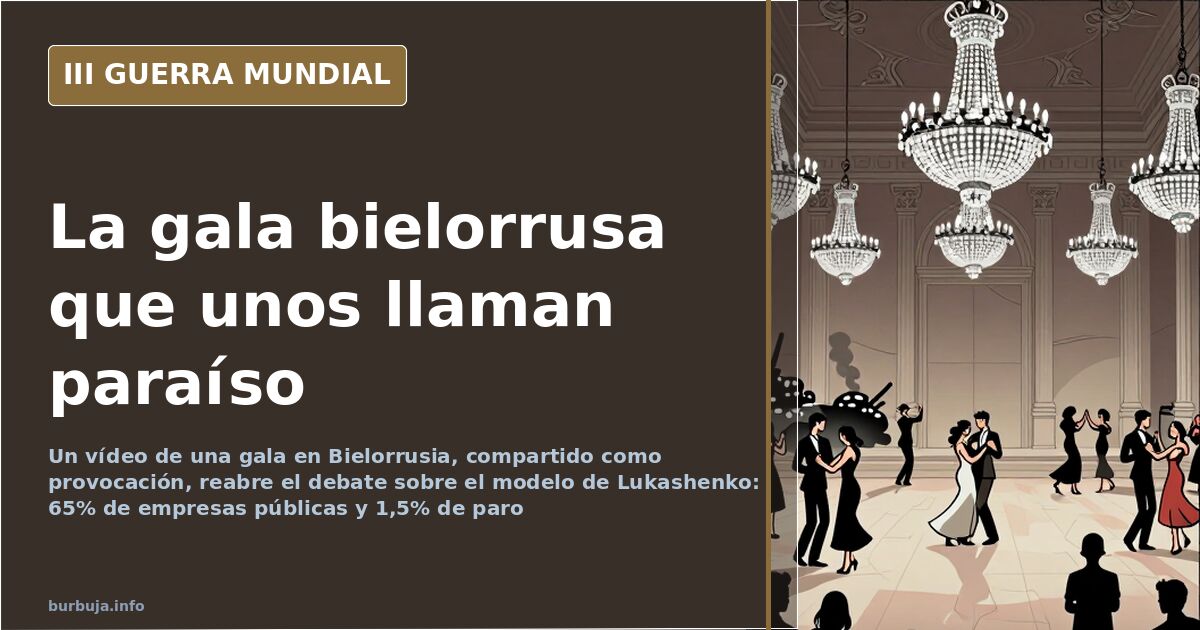
Belarus Gala Reopens Debate on Lukashenko
A tweet warning of "disturbing and unsettling" images from Belarus was enough to ignite the controversy. The video showed what appeared to be a formal dance: people in evening wear, melodic music, and a gala setting, shared by user Jack Posobiec and described in comments as a Christmas celebration. There were no barricades or violent scenes. The provocation lay in the absence: no diversity, no modern aesthetics, no recognizable gestures. This led to a joking headline about a "supremacist and transphobic dance in Europe's last dictatorship." The video acts as an inverted mirror, and those sharing it know exactly what message they are selling.
What does the video show and why is it shared as provocation?
On screen, a group of formally dressed attendees performs melodic music. The trigger is not the content but the framing. It is presented as an uncomfortable anomaly, as if East Europeans dancing politely were itself an affront to the Western observer. From this stems the underlying debate, which is not about dance.
It is about which country deserves the label of civilized and which has supposedly renounced it. The clip circulates because it is useful: it confirms for some that traditional order exists somewhere and reminds others how far away it is from their own capitals. A gala, in short, turned into an ideological thermometer.
From Chernobyl to Full Employment: The Numbers Cited
The central argument of those defending the model is not aesthetic but economic. They point out that 65% of Belarusian companies are state-owned, rising to 85% in industry, with unemployment around 1.5%. The starting point cited was adverse: a small country with few natural resources, marshlands, and, according to the thread, one-third of its agricultural land contaminated by radiation from the Chernobyl plant.
They argue that turning this into a stable economy with jobs is the data point that disorients. Here, the video stops being an anecdote and becomes ammunition: if the country shown dancing orderly has near-full employment, the uncomfortable question is not about Belarus.
Comparison with Spain and the Weight of State Enterprise
The contrast is explicit. Spain appears in the exchange identified as having the fewest state-owned companies in Europe, used as a mirror: a state withdrawing from the economy versus another keeping two-thirds of business under public control. The 1.5% unemployment figure, read in this context, serves as a closing argument. The item-by-item breakdown of this comparison sustains much of the noise.
The trap of the exercise is comparing two models with entirely different historical trajectories. Belarus started with a Soviet industrial structure that was never dismantled. Spain dismantled its own and still debates the cost.
Is Belarus a Communist Country?
The label circulates loosely, though history partly refutes it. As noted in the thread, Lukashenko was in 1991 the only deputy in the parliament of the Soviet Republic of Belarus who voted against the agreement dissolving the USSR and against establishing the CIS. This provides the symbolic continuity attributed to him. The model built since then is an economy with huge state weight—that 65%—not central planning. The distinction matters because half the debate hinges on terminology; whoever controls the label controls the argument.
The Uncomfortable Stretch: Migration, Demography, and Social Cohesion
Part of the exchange drifted toward immigration and European demography, antiestéticaturing charts and percentages on flows, along with arguments generalizing entire groups based on unverified data. This segment says less about Belarus than about the writers: the conversation on the Belarusian model became a vehicle to discuss dissatisfaction with their own. It is the same mechanism fueling the idea that Eastern Europe has become the spiritual reserve of what the West once was.
The Data Point Closing the Portrait
There remains the country without unemployment, with order and formal dances. And there is the other side, reported by Sputnik agency: Belarus acknowledges a problem with excessive alcohol consumption after ranking first in a World Health Organization survey, something admitted reluctantly domestically. No spiritual reserve comes for free.
A tweet warning of "disturbing and unsettling" images from Belarus was enough to ignite the controversy. The video showed what appeared to be a formal dance: people in evening wear, melodic music, and a gala setting, shared by user Jack Posobiec and described in comments as a Christmas celebration. There were no barricades or violent scenes. The provocation lay in the absence: no diversity, no modern aesthetics, no recognizable gestures. This led to a joking headline about a "supremacist and transphobic dance in Europe's last dictatorship." The video acts as an inverted mirror, and those sharing it know exactly what message they are selling.
What does the video show and why is it shared as provocation?
On screen, a group of formally dressed attendees performs melodic music. The trigger is not the content but the framing. It is presented as an uncomfortable anomaly, as if East Europeans dancing politely were itself an affront to the Western observer. From this stems the underlying debate, which is not about dance.
It is about which country deserves the label of civilized and which has supposedly renounced it. The clip circulates because it is useful: it confirms for some that traditional order exists somewhere and reminds others how far away it is from their own capitals. A gala, in short, turned into an ideological thermometer.
From Chernobyl to Full Employment: The Numbers Cited
The central argument of those defending the model is not aesthetic but economic. They point out that 65% of Belarusian companies are state-owned, rising to 85% in industry, with unemployment around 1.5%. The starting point cited was adverse: a small country with few natural resources, marshlands, and, according to the thread, one-third of its agricultural land contaminated by radiation from the Chernobyl plant.
They argue that turning this into a stable economy with jobs is the data point that disorients. Here, the video stops being an anecdote and becomes ammunition: if the country shown dancing orderly has near-full employment, the uncomfortable question is not about Belarus.
Comparison with Spain and the Weight of State Enterprise
The contrast is explicit. Spain appears in the exchange identified as having the fewest state-owned companies in Europe, used as a mirror: a state withdrawing from the economy versus another keeping two-thirds of business under public control. The 1.5% unemployment figure, read in this context, serves as a closing argument. The item-by-item breakdown of this comparison sustains much of the noise.
The trap of the exercise is comparing two models with entirely different historical trajectories. Belarus started with a Soviet industrial structure that was never dismantled. Spain dismantled its own and still debates the cost.
Is Belarus a Communist Country?
The label circulates loosely, though history partly refutes it. As noted in the thread, Lukashenko was in 1991 the only deputy in the parliament of the Soviet Republic of Belarus who voted against the agreement dissolving the USSR and against establishing the CIS. This provides the symbolic continuity attributed to him. The model built since then is an economy with huge state weight—that 65%—not central planning. The distinction matters because half the debate hinges on terminology; whoever controls the label controls the argument.
The Uncomfortable Stretch: Migration, Demography, and Social Cohesion
Part of the exchange drifted toward immigration and European demography, antiestéticaturing charts and percentages on flows, along with arguments generalizing entire groups based on unverified data. This segment says less about Belarus than about the writers: the conversation on the Belarusian model became a vehicle to discuss dissatisfaction with their own. It is the same mechanism fueling the idea that Eastern Europe has become the spiritual reserve of what the West once was.
The Data Point Closing the Portrait
There remains the country without unemployment, with order and formal dances. And there is the other side, reported by Sputnik agency: Belarus acknowledges a problem with excessive alcohol consumption after ranking first in a World Health Organization survey, something admitted reluctantly domestically. No spiritual reserve comes for free.
Summary of a discussion on Burbuja.info - Foro de economía, actualidad y política., translated from Spanish and reviewed before publication. Read the full discussion (194 replies).
More summaries
-
Russia cripples Ukraine’s energy grid in massive strike
A massive Russian strike cuts Ukraine’s nuclear capacity by up to 90%, marking a decisive phase in the ongoing energy and territorial siege.
-
Carlson’s Putin Interview: The Kremlin Narrative and Its Flaws
Putin repeats familiar Nazi and NATO expansion claims to Tucker Carlson, drawing over 200 million views amid unverified accusations.
-
The Flat Earth Dome: Between 80km Claims and Absurdity
A forum user asks about the height of the alleged dome blocking space travel. Responses range from technical estimates to sarcastic debunking.
-
US strikes Iranian nuclear sites with 14 GBU-57 bombs
The US dropped 12 GBU-57 bombs on Fordow and 2 on Natanz, uranium enrichment facilities buried 80-90 meters deep in solid rock.
-
Spanish Volunteer in Ukraine Says He Cannot Leave
Nacho, a volunteer from Alicante serving in Ukraine's Territorial Defense, claims he has gone unpaid for three months and is barred from terminating his contract.
-
Hungary Drops Veto, EU Approves €50 Billion for Ukraine
The EU approved a €50 billion package for Ukraine after Hungary lifted its veto. Debates focused on per-capita costs and comparisons with Russian defense spending.