
Zelensky confirms Trump's ultimatum: arms or Donbas
Zelensky confirms Trump threatens to cut weapons and intelligence if Ukraine rejects the peace plan, citing a choice between dignity and losing a key ally.
English · Original discussion in Spanish · Published
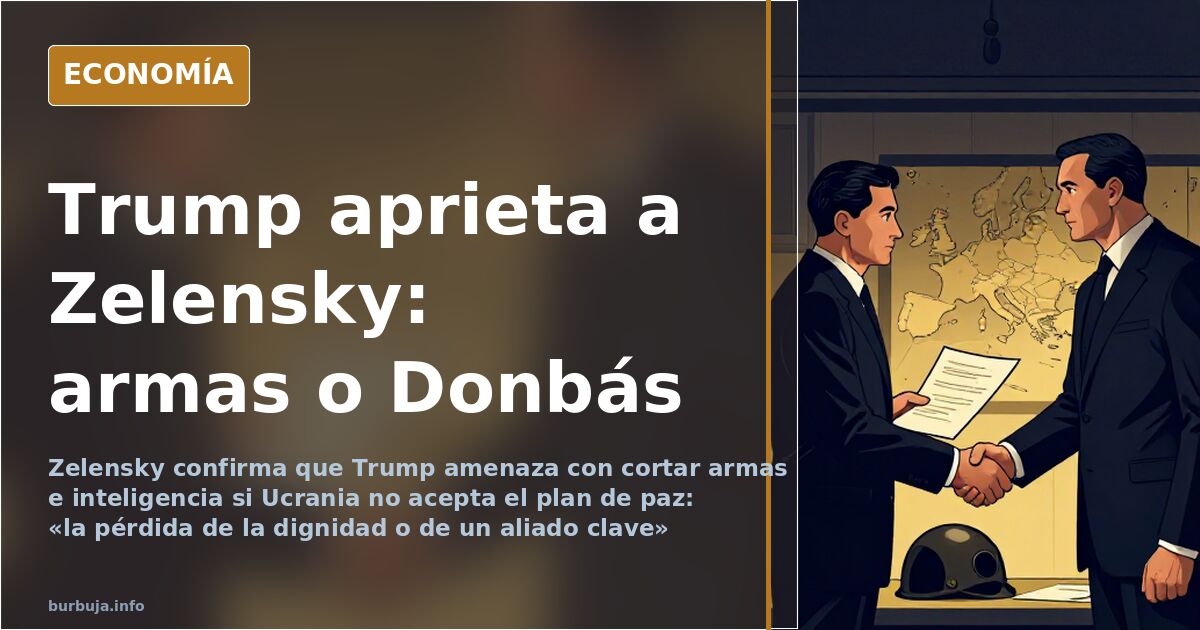
Zelensky confirms Trump's ultimatum: arms or Donbas
Volodymyr Zelensky stated it clearly in a video, without ambiguity: US military and intelligence aid could be cut off overnight if Ukraine does not accept the peace plan proposed by Washington. The dilemma, in his own words, is "the loss of dignity or that of a key ally." The Ukrainian president thus confirmed what had previously been journalistic leaks: Donald Trump's administration has linked weapon supplies to signing a peace agreement, according to Zelensky's account.
The scene has a déjà vu air that doesn't help. Three years of war, hundreds of thousands of casualties on both sides, and a Ukrainian economy held together by European pins, only to end up negotiating from weakness what was discussed in 2022 from a less bad position. The difference is who holds the tap now.
What giving up the Donbas means
The Donbas is the industrial basin of eastern Ukraine, the region Moscow has claimed since before the invasion and where much of the coal and manufacturing capacity inherited from the Soviet era is concentrated. Accepting its cession is not a border adjustment: it is handing over the country's productive heart and recognizing in writing what Russia has spent years trying to consolidate on the ground.
Some argue the war was already lost when the West decided to sustain it without direct involvement. The counter-argument weighs equally: without that support, Kyiv would have fallen in weeks, and today there would be a puppet government in the capital. Neither reading can be proven, which explains why the issue continues to split public opinion.
The Istanbul precedent nobody wants to remember
In the early stages of the conflict, negotiations took place in Istanbul where, as remembered now, Russia reportedly offered peace and full control of the Donbas in exchange for recognition of the autonomy of its population—already contemplated in the Minsk agreements—and Ukraine renouncing NATO membership. That draft did not prosper. The pressure from then-British Prime Minister Boris Johnson is the most circulated explanation for abandoning that path.
The calculation made since then is brutal: after a million deaths, the conditions being discussed are worse than those on the table at that time. Those defending the continuation of the war respond that surrendering then would have been worse, and that resistance has allowed preserving 80% of the country, including major cities and most agricultural land.
Europe, NATO, and the cost of credibility
The most repeated strategic reading is one of defeat for the Atlantic Alliance. Crimea is not recovered, a Russian land corridor is consolidated, the region with the most natural resources is lost, and NATO does not expand. The only thing saved, ironically, is that borders have not returned to those of 1991.
However, the most far-reaching blow is another. Ukraine surrendered its nuclear arsenal in exchange for territorial integrity guarantees signed by the United States. Questioning that commitment now has an effect that transcends Kyiv: any country considering renouncing its own deterrence will know the value of Washington's word. US credibility is damaged, and that cannot be fixed with a press release.
Who pays the European bill
Ukraine's economic and military support has largely fallen on European taxpayers for three years. The lingering question is uncomfortable: if Europe is unable to provide Ukraine with capability against Russia on its own, what is the point of the project? The answer coming from Brussels—more defense spending, war economy—clashes with a social reality that no longer tolerates certain discourses.
The suspicion that the "Russian danger" is used to justify cuts in freedoms, debt, and tax hikes is gaining ground. It is not a provable thesis, but it explains why increased military spending is perceived by large segments of the population as extortion rather than investment in security.
What might happen next
Zelensky's margin is narrow. If his main ally betrays him, surrender ceases to be a political option and becomes the only available exit. The alternative—continuing to fight without ammunition or intelligence—does not withstand military analysis. And Trump, who threatens today and denies tomorrow, does not offer the reliability required for a decision of this caliber.
The disorienting fact is not the threat. It is that, three years later, public discussion has returned to the starting point: how much territory, sovereignty, and credibility were those willing to pay who never intended to step onto the front line.
Volodymyr Zelensky stated it clearly in a video, without ambiguity: US military and intelligence aid could be cut off overnight if Ukraine does not accept the peace plan proposed by Washington. The dilemma, in his own words, is "the loss of dignity or that of a key ally." The Ukrainian president thus confirmed what had previously been journalistic leaks: Donald Trump's administration has linked weapon supplies to signing a peace agreement, according to Zelensky's account.
The scene has a déjà vu air that doesn't help. Three years of war, hundreds of thousands of casualties on both sides, and a Ukrainian economy held together by European pins, only to end up negotiating from weakness what was discussed in 2022 from a less bad position. The difference is who holds the tap now.
What giving up the Donbas means
The Donbas is the industrial basin of eastern Ukraine, the region Moscow has claimed since before the invasion and where much of the coal and manufacturing capacity inherited from the Soviet era is concentrated. Accepting its cession is not a border adjustment: it is handing over the country's productive heart and recognizing in writing what Russia has spent years trying to consolidate on the ground.
Some argue the war was already lost when the West decided to sustain it without direct involvement. The counter-argument weighs equally: without that support, Kyiv would have fallen in weeks, and today there would be a puppet government in the capital. Neither reading can be proven, which explains why the issue continues to split public opinion.
The Istanbul precedent nobody wants to remember
In the early stages of the conflict, negotiations took place in Istanbul where, as remembered now, Russia reportedly offered peace and full control of the Donbas in exchange for recognition of the autonomy of its population—already contemplated in the Minsk agreements—and Ukraine renouncing NATO membership. That draft did not prosper. The pressure from then-British Prime Minister Boris Johnson is the most circulated explanation for abandoning that path.
The calculation made since then is brutal: after a million deaths, the conditions being discussed are worse than those on the table at that time. Those defending the continuation of the war respond that surrendering then would have been worse, and that resistance has allowed preserving 80% of the country, including major cities and most agricultural land.
Europe, NATO, and the cost of credibility
The most repeated strategic reading is one of defeat for the Atlantic Alliance. Crimea is not recovered, a Russian land corridor is consolidated, the region with the most natural resources is lost, and NATO does not expand. The only thing saved, ironically, is that borders have not returned to those of 1991.
However, the most far-reaching blow is another. Ukraine surrendered its nuclear arsenal in exchange for territorial integrity guarantees signed by the United States. Questioning that commitment now has an effect that transcends Kyiv: any country considering renouncing its own deterrence will know the value of Washington's word. US credibility is damaged, and that cannot be fixed with a press release.
Who pays the European bill
Ukraine's economic and military support has largely fallen on European taxpayers for three years. The lingering question is uncomfortable: if Europe is unable to provide Ukraine with capability against Russia on its own, what is the point of the project? The answer coming from Brussels—more defense spending, war economy—clashes with a social reality that no longer tolerates certain discourses.
The suspicion that the "Russian danger" is used to justify cuts in freedoms, debt, and tax hikes is gaining ground. It is not a provable thesis, but it explains why increased military spending is perceived by large segments of the population as extortion rather than investment in security.
What might happen next
Zelensky's margin is narrow. If his main ally betrays him, surrender ceases to be a political option and becomes the only available exit. The alternative—continuing to fight without ammunition or intelligence—does not withstand military analysis. And Trump, who threatens today and denies tomorrow, does not offer the reliability required for a decision of this caliber.
The disorienting fact is not the threat. It is that, three years later, public discussion has returned to the starting point: how much territory, sovereignty, and credibility were those willing to pay who never intended to step onto the front line.
Summary of a discussion on Burbuja.info - Foro de economía, actualidad y política., translated from Spanish and reviewed before publication. Read the full discussion (156 replies).
More summaries
-
Zelensky brings European allies to shield Trump meeting
Zelensky travels to Washington with EU leaders to prevent a potential trap by Trump, amid tensions over Ukraine's territorial concessions and NATO membership.
-
NATO Crisis: European Defense and US Exit Debate
NATO faces crisis without US support as Europe seeks independent defense. Forum analysis.
-
Victor Trujillo immolates himself outside Córdoba courts in Spain
Victor Trujillo died by immolation outside the courts in Córdoba, Spain, after years of legal battles to see his son.
-
Blue Face on Spanish Show Horizonte Sparks Murder Accusations
Bea Talegón's blue face on Horizonte triggers murder accusations online after Maricarmen's death, boosting viewership.
-
TVE presenters' reddish skin tone sparks viewer confusion
Viewers notice a reddish hue on TVE presenters during wildfire coverage. Is it a technical glitch or intentional? We analyze the causes.
-
France's diverse squad: Identity vs. business
The debate over the French national team's ethnic makeup pits identity against profit, highlighting the economics of global football.