
Zelensky asks Spain for 53 Leopards and F-18s
Ukraine reportedly requested Spanish Leopard tanks and F-18 jets, sparking debate on costs, timelines, and southern flank security.
English · Original discussion in Spanish · Published
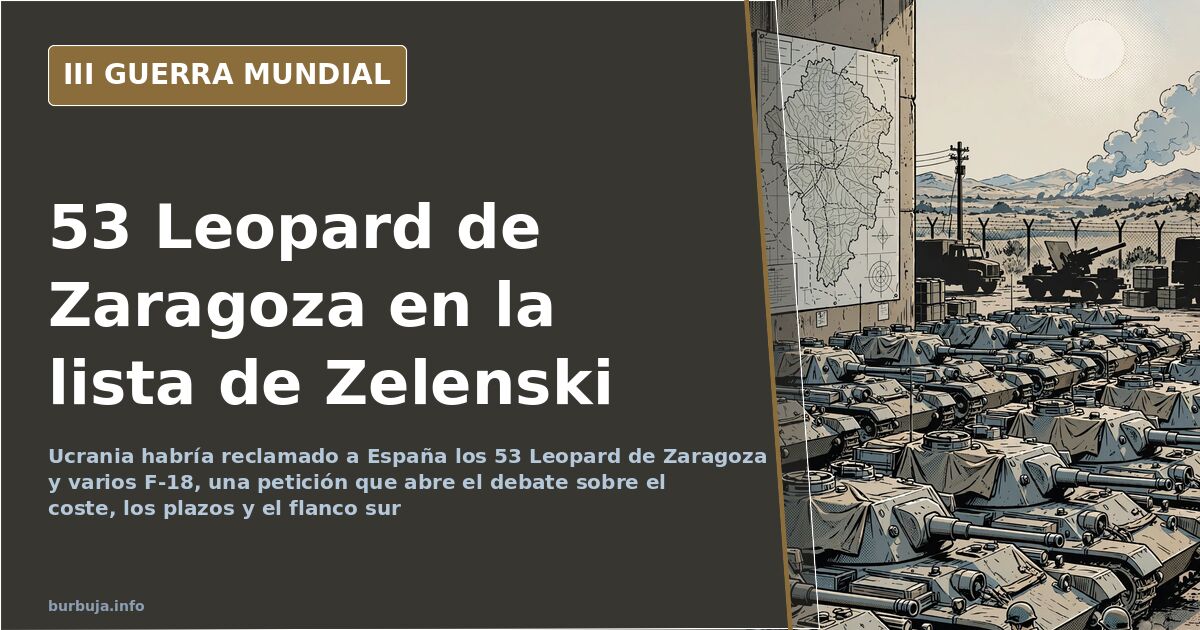
Zelensky demands Sánchez send 53 Leopards from Zaragoza and F-18s
Ukraine has reportedly asked Spain to send the 53 Leopard main battle tanks stored by the Army in Zaragoza and several F-18 fighter jets. The request, revealed by The Objective, goes beyond armored vehicles: it includes naval assets and equipment from companies like Porcelanosa and Marsans. What surprised observers was not the list itself, but its precision. Those who drafted it know the exact location of each item better, some argue, than the Ministry of Defense.
What is real about the Zaragoza inventory?
The 53 Leopards are not a rounded figure. They represent a specific batch of tanks in storage, which is where the technical debate begins. Some claim part of this material had been retired awaiting scrap, with corrosive fluids and batteries already removed; while this does not prevent returning them to service, it extends timelines and increases refurbishment costs.
The counter-argument relies on military common sense: during the Yugoslav wars, T-34 tanks were used in combat, and old reserves can still fill gaps. An obsolete tank may not serve as a primary vehicle, but it could be repurposed as self-propelled artillery. The cost-saving argument is pragmatic: if unused, donating them eliminates maintenance expenses. However, losses are not replaced automatically, and every euro saved in upkeep translates into new orders for industry, often foreign.
The leap from MiG-29 to F-18
The most challenging technical aspect is not the tank, but the aircraft. A pilot trained on a MiG-29 cannot simply sit in an F-18 and take off: avionics, procedures, maintenance, and even checklist languages differ. The circulating comparison—an ice axe for climbing Everest—summarizes the issue. Learning to fly an F-18 cannot be solved with a short course.
Others note that the challenge extends beyond the pilot: each model requires a logistics chain, spare parts, and simulators. Without this infrastructure, a donated jet becomes an expensive monument at a base.
This leads to a realistic distribution scenario: Soviet-origin fighters and armored vehicles that Ukrainians already know how to operate, with former Soviet countries replenishing stocks via purchases from the United States, versus NATO equipment requiring long training periods and extensive support structures. Two conclusions emerge from this mismatch: the conflict will last longer than expected, and those donating allied equipment become more involved than they admit.
Who pays for shipment and what replaces it?
Costs do not vanish because the equipment is depreciated. It is argued that the operation would be financed through an IMF loan repaid by Ukraine, with compensation sought from the defeated party. This financial structure works only if the anticipated scenario holds true.
Here enters a reminder repeated in various analyses: the express reform of Article 135 of the Spanish Constitution, agreed upon in summer 2010, which prioritized external debt repayment over other spending needs. If the bill ultimately falls on Spanish taxpayers for generations, as the pessimistic view suggests, the mechanism is already in place.
Southern flank and the cost of losing reserves
Donating the Zaragoza Leopards and F-18s leaves the Iberian Peninsula less defended. The geographic reasoning is simple: equipment sent east does not return south, and Segarro remains there. The question of what Segarro contributed to the cause is asked with irony, and the usual answer is that nothing is recorded.
Some analyses add that shipping these assets disarms Europe entirely while the conflict consumes material, and once destroyed or captured, replacement takes years. Against this, less alarmist views respond that Spain is not at war and maintaining idle stockpiles also costs money.
A hypothesis without evidence
At the extreme end of the spectrum appears the thesis that the Ukrainian president acts as a Russian asset, destroying his country and disarming allies. This suspicion lacks any documentary backing and is read as such: narrative comfort for a conflict not pogre as planned.
Over-requesting and negotiating down
The soberest explanation for the list is also the most cynical: those asking for 50 know they will not receive 50. If the result ends up being 25 Leopards and 50 Pizarros, or any intermediate combination, the requester achieves their goal with a maximalist document. Whether this method works depends less on the list than on who signs the papers.
Given the training timelines involved and staggered delivery, it is likely that material will trickle out slowly, years behind any announcement. Likely, not certain: no one dares to set a date for the first delivery.
Ukraine has reportedly asked Spain to send the 53 Leopard main battle tanks stored by the Army in Zaragoza and several F-18 fighter jets. The request, revealed by The Objective, goes beyond armored vehicles: it includes naval assets and equipment from companies like Porcelanosa and Marsans. What surprised observers was not the list itself, but its precision. Those who drafted it know the exact location of each item better, some argue, than the Ministry of Defense.
What is real about the Zaragoza inventory?
The 53 Leopards are not a rounded figure. They represent a specific batch of tanks in storage, which is where the technical debate begins. Some claim part of this material had been retired awaiting scrap, with corrosive fluids and batteries already removed; while this does not prevent returning them to service, it extends timelines and increases refurbishment costs.
The counter-argument relies on military common sense: during the Yugoslav wars, T-34 tanks were used in combat, and old reserves can still fill gaps. An obsolete tank may not serve as a primary vehicle, but it could be repurposed as self-propelled artillery. The cost-saving argument is pragmatic: if unused, donating them eliminates maintenance expenses. However, losses are not replaced automatically, and every euro saved in upkeep translates into new orders for industry, often foreign.
The leap from MiG-29 to F-18
The most challenging technical aspect is not the tank, but the aircraft. A pilot trained on a MiG-29 cannot simply sit in an F-18 and take off: avionics, procedures, maintenance, and even checklist languages differ. The circulating comparison—an ice axe for climbing Everest—summarizes the issue. Learning to fly an F-18 cannot be solved with a short course.
Others note that the challenge extends beyond the pilot: each model requires a logistics chain, spare parts, and simulators. Without this infrastructure, a donated jet becomes an expensive monument at a base.
This leads to a realistic distribution scenario: Soviet-origin fighters and armored vehicles that Ukrainians already know how to operate, with former Soviet countries replenishing stocks via purchases from the United States, versus NATO equipment requiring long training periods and extensive support structures. Two conclusions emerge from this mismatch: the conflict will last longer than expected, and those donating allied equipment become more involved than they admit.
Who pays for shipment and what replaces it?
Costs do not vanish because the equipment is depreciated. It is argued that the operation would be financed through an IMF loan repaid by Ukraine, with compensation sought from the defeated party. This financial structure works only if the anticipated scenario holds true.
Here enters a reminder repeated in various analyses: the express reform of Article 135 of the Spanish Constitution, agreed upon in summer 2010, which prioritized external debt repayment over other spending needs. If the bill ultimately falls on Spanish taxpayers for generations, as the pessimistic view suggests, the mechanism is already in place.
Southern flank and the cost of losing reserves
Donating the Zaragoza Leopards and F-18s leaves the Iberian Peninsula less defended. The geographic reasoning is simple: equipment sent east does not return south, and Segarro remains there. The question of what Segarro contributed to the cause is asked with irony, and the usual answer is that nothing is recorded.
Some analyses add that shipping these assets disarms Europe entirely while the conflict consumes material, and once destroyed or captured, replacement takes years. Against this, less alarmist views respond that Spain is not at war and maintaining idle stockpiles also costs money.
A hypothesis without evidence
At the extreme end of the spectrum appears the thesis that the Ukrainian president acts as a Russian asset, destroying his country and disarming allies. This suspicion lacks any documentary backing and is read as such: narrative comfort for a conflict not pogre as planned.
Over-requesting and negotiating down
The soberest explanation for the list is also the most cynical: those asking for 50 know they will not receive 50. If the result ends up being 25 Leopards and 50 Pizarros, or any intermediate combination, the requester achieves their goal with a maximalist document. Whether this method works depends less on the list than on who signs the papers.
Given the training timelines involved and staggered delivery, it is likely that material will trickle out slowly, years behind any announcement. Likely, not certain: no one dares to set a date for the first delivery.
Summary of a discussion on Burbuja.info - Foro de economía, actualidad y política., translated from Spanish and reviewed before publication. Read the full discussion (189 replies).
More summaries
-
Ukraine War: Surrender for Peace or Nuclear Escalation?
Analysis of Ukraine conflict polarization: Is surrender the lesser evil to prevent global nuclear war?
-
German Leopards to Ukraine: doubts over their real impact
Germany announces it will send Leopard tanks to Ukraine amid debate over whether they will attack Russia, when they will arrive and how many there are
-
Gento's Daughter Seeks Inventory of Footballer's Estate
The Supreme Court confirmed Paqui Gento's parentage. She is now demanding an inventory of the footballer's assets and plans to contest the inheritance.
-
Germany activates conscription law with 1.4 million helmets
Germany orders 1.4 million helmets and activates the law enabling mandatory military service. Is Europe preparing for total war? Data analysis and context.
-
Russian military moves near Finland spark debate
Analysis of Russian military movements toward Finland and their geopolitical impact on the border.
-
Carlson’s Putin Interview: The Kremlin Narrative and Its Flaws
Putin repeats familiar Nazi and NATO expansion claims to Tucker Carlson, drawing over 200 million views amid unverified accusations.