
Zebra finch: easier to breed than a canary
The zebra finch breeds more easily than the canary and overwhelms household cages: the debate between hobby, overbreeding and invasive species.
English · Original discussion in Spanish · Published
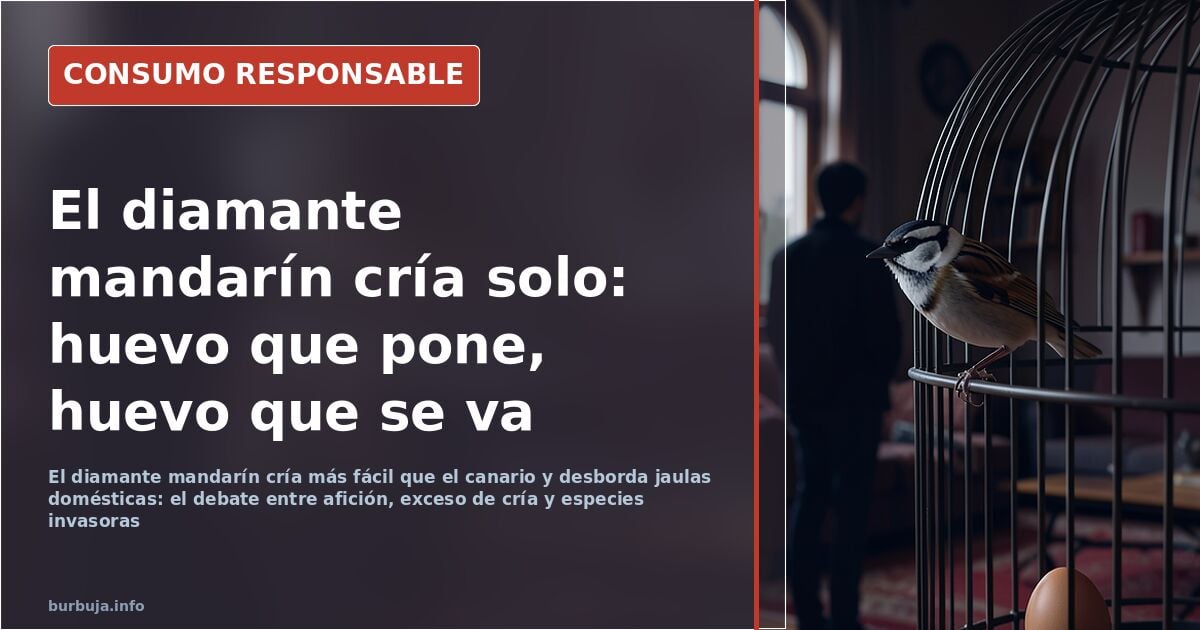
The zebra finch, the bird that breeds more easily than a canary
The scene repeats itself in any home with a large cage: a tiny bird that never stops chirping, breeds as if its life depended on it, and turns a living room into a nursery. The zebra finch, that cage bird sold as an easy pet, has an underlying problem that goes beyond its price: it reproduces with a ease that baffles anyone coming from the canary world. "It's much easier than the canary," admits someone who has kept them for a long time, though he clarifies that control is not automatic: "every egg laid is an egg that goes" if you're not paying attention.
There lies the first contradiction. What for some is a special and rewarding animal, for others is a chick factory that overflows any household forecast. And in that overflow appears the second front: the cage. Because the same animal celebrated for its ease of breeding is the one debated over the place where it lives.
How long it takes the zebra finch to breed and why it gets out of control
The zebra finch's reproductive ease is not a rumor: it is the trait that defines the conversation. Compared to the canary, which requires more care, this bird lays and raises its chicks with a smoothness that forces intervention. The consensus, if there is one, is that control depends on the owner's commitment, not on the bird's biology. Whoever gets careless ends up with a colony.
That excess has a less pleasant consequence. When breeding becomes routine, the animal stops being a specimen and becomes stock. And there comes the underlying reproach: "standardizing and banalizing this as an object of consumption is a natural crime." The phrase is not from a textbook activist, but from someone who breeds and gives away the few he raises, without selling or handing them over to strangers.
The Gouldian finch and the species that don't forgive
Not all cage birds are the same. The Gouldian finch appears as the exquisite, more difficult relative, of a beauty described without shame as "an ode" to courtship. The comparison helps calibrate: if the zebra finch is the beginner's bird, the Gouldian is the exam. And in between, the shaft-tail finch as a breeding partner to ensure reasonable success rates.
The hierarchy matters because it dismantles the idea that this is about having a pretty bird. It's about maintaining a closed and particular ecosystem, with care that some qualify as exquisite and others as simple whim. The line separating hobby from collecting is exactly the same that separates care from consumption.
The cage: the point where the hobby breaks
The turn of the matter comes when technique is abandoned and ethics enters. "Birds should be free, not in a cage," argues part of those trinc the matter, who summarize confinement as "the frustration of their owners for seeking pleasure from the suffering of an animal outside its natural habitat." It's not a marginal position: it's the one that tensions the whole conversation.
The response from the breeding side doesn't deny the problem, it acknowledges it with nuances. It's accepted that there is frustration, it's accepted that confinement has something of personal redemption, and only the exquisite care of ultra-sensitive beings is saved. What is not forgiven is banalization.
And then there's the risk nobody wants to look at: escape. "They escape and because of the damn whim we already have another invasive species," it's warned, with parrots as precedent. There the zebra finch stops being a living room anecdote and enters the terrain of ecology.
The disorienting fact remains: a bird that is given away, not sold, and that still generates an excess problem. The hobby claimed as care coexists with the cage denounced as prison. Nobody has yet resolved where the border lies.
Also available in: Deutsch
Summary of a discussion on Burbuja.info - Foro de economía, actualidad y política., translated from Spanish and reviewed before publication. Read the full discussion (23 replies).
More summaries
-
Drilling Silestone without a diamond hole saw: works, says forum user
A forum user describes drilling a 12 mm hole in Silestone using HSS bits, water and patience, saving the 40-50 euros a diamond hole saw would have cost.
-
Wood furniture: you pay for the story, not the material
An oak desk costs €800 while solid wood second-hand sells for €30. The premium isn't in the wood, but in the narrative.
-
Hussars: quality menswear or just posturing?
Hussars review: natural fabrics, local manufacturing, and straight fit versus criticism for its controversial cut and self-promotion. Is it worth the price?
-
From 14,000-peseta sneakers to Decathlon: the death of local sports shops
Sneakers cost up to 14,000 pesetas in Spain. Today, private labels dominate while 80s stock is resold as vintage.
-
German Brand Boycott List Divides Spanish Consumers
A boycott of German brands to fight austerity sparked debate after the list included non-German companies.
-
Start-stop: €285 battery costs outweigh fuel savings in Spain
Start-stop systems require batteries over €250 and deactivate below 80% charge. Fuel savings do not cover the replacement bill.