
Start-stop: €285 battery costs outweigh fuel savings in Spain
Start-stop systems require batteries over €250 and deactivate below 80% charge. Fuel savings do not cover the replacement bill.
English · Original discussion in Spanish · Published
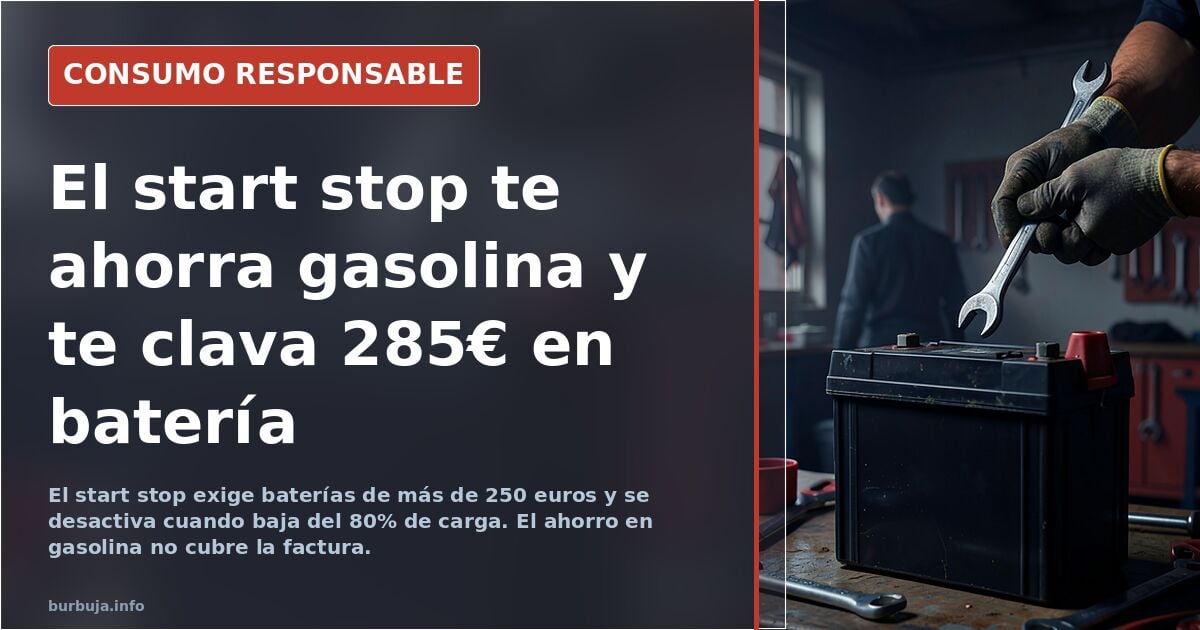
Start-stop saves fuel but bills you for €285 batteries
How much does it really cost to turn off the engine at every traffic light? A driver buys a second-hand car with a start-stop system, a five-year-old battery, and a warranty that covers everything except the failing part. After three or four stops, the system gives up on its own. The ECU records no fault: it is the battery. The official workshop quote arrives: €285, compared to €230 for the same part without installation online. The classic alternative, a conventional installed battery, was around €100.
The trusted mechanic's diagnosis is anything but diplomatic: the system requires the battery to be above 80% charge, so with a year or more of useful life remaining, the car starts protecting itself and disconnecting the invention. Translated: the battery is not dead, but the system declares it unfit and pushes you to replace it prematurely. The fuel saving is paid upfront, with a surcharge.
Why the start-stop battery costs triple
The difference is not arbitrary workshop pricing: these are batteries of different technology, sized to withstand continuous discharge and starting cycles. Hence the price jump. Reasonable doubt arises when considering replacing them with a conventional one. Some argue a normal battery lasts only months before failing; others clarify that not just any battery works, but one with capacity and power equivalent to the diesel version without start-stop. The warning repeats: if a normal battery is installed, the system must be disconnected at each start, or the part will last a very short time.
The dealership itself admits the shortcut: getting used to turning off the system at startup extends battery life by one year, for sure. And adds that these systems are a source of breakdowns. When the manufacturer recommends disabling the function they themselves certified, something is wrong in the narrative.
The button you have to press every morning
The practical solution circulating is almost insultingly simple: press the disconnection button every time you start the car, with the same routine as releasing the handbrake. In some dashboards, it is called ECO and is activated by default. For those who do not want to rely on memory, there is the diagnostic software route: any workshop with access to the ECU can permanently disable it. The problem is that the car is homologated with the system, and here the risk of the technical inspection (ITV) appears.
The hidden cost does not end with the battery. The starter motor and alternator work many more times, and replacing them out of warranty could cost around €1,000 per part if the car is kept for twenty years. Fuel savings, however, are marginal for those who barely drive in the city: in a large, hot engine, idling consumption is measured in tenths of a liter per hour.
The ecological paradox: fewer emissions in tests, more waste afterwards
The system was not born to save money for the driver. It is a requirement of emission regulations, and its logic is that of the homologation cycle: reducing emissions in the city, where they are measured. The pollution associated with manufacturing and recycling more batteries, or scrapping a car early, is not included in that accounting. Neither is noise, which for someone living next to a bus stop is the difference between resting and not doing so.
There is consensus that the system works better in small engines with little inertia than in large blocks, where it contributes little. And a technical warning affecting turbo-diesels: the manual for some models recommends letting the engine idle for a minute after hard driving, something the start-stop does not contemplate.
In the end, the question is not whether the system pollutes less in tests. It is how many drivers are paying €285 for a part that still had life left, to finance a saving they never see.
Also available in: Deutsch
Summary of a discussion on Burbuja.info - Foro de economía, actualidad y política., translated from Spanish and reviewed before publication. Read the full discussion (71 replies).
More summaries
-
Toyota cuts hybrid battery size in half, raising price
The new Corolla uses a 0.7 kWh battery, costs 6,000 euros more than the Auris, and challenges diesel efficiency in modern hybrid vehicles.
-
Remote Linux sysadmin: quiet job or 24/7 on-call duty?
The story of a remote sysadmin watching movies while getting paid clashes with the reality of 24/7 on-call shifts, back-to-back outages and a salary ceiling many question.
-
Toyota Plans Ten EVs Despite Claiming They Don't Sell
Toyota claims electric vehicles don't sell while announcing ten models and solid-state batteries. Price and grid infrastructure remain central issues.
-
El Corte Inglés prepared food: quality at a price
El Corte Inglés croquettes beat Mercadona's, but prices like €21/kg for meat rolls mean it's only worth it for some products.
-
From 14,000-peseta sneakers to Decathlon: the death of local sports shops
Sneakers cost up to 14,000 pesetas in Spain. Today, private labels dominate while 80s stock is resold as vintage.
-
German Brand Boycott List Divides Spanish Consumers
A boycott of German brands to fight austerity sparked debate after the list included non-German companies.