
Russian Offensive Stalled: A War of Attrition and Drones
Russian offensive grinds on as Ukraine hits refineries and ships, and Russia claims to shoot down 1,000 drones daily.
English · Original discussion in Spanish · Published
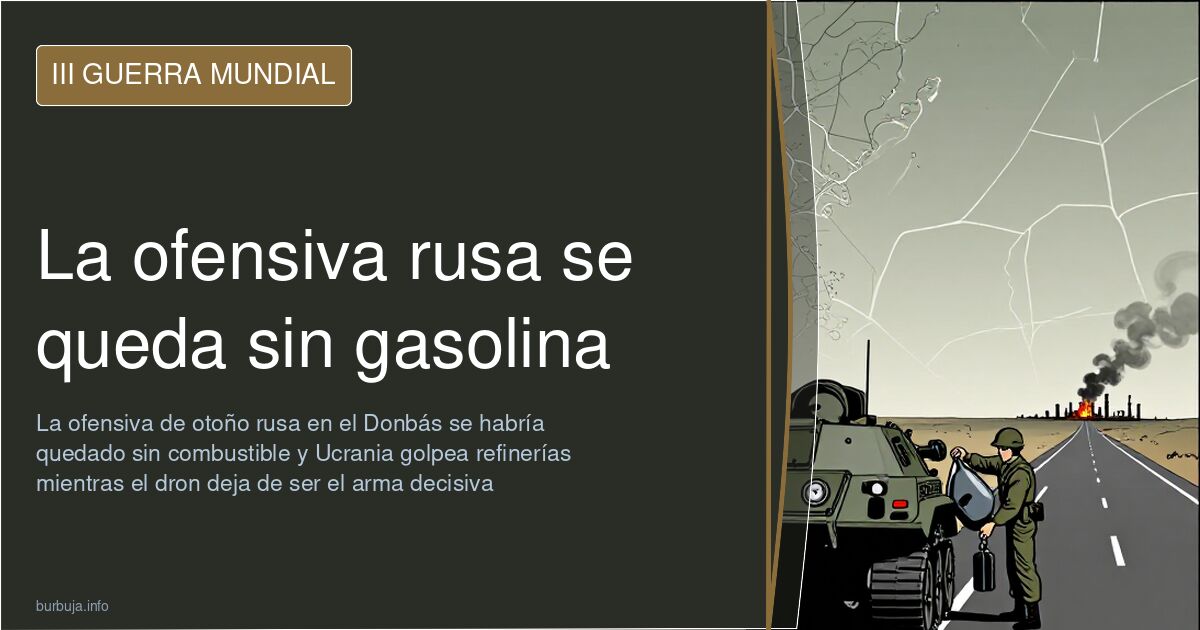
Russian Offensive Stalls: 483 Vehicles Lost, 1,000 Drones in a Single Day
Is the Russian offensive stalled, or does it just seem that way because maps are slow to update? Four and a half years after the invasion began, those trinc the thread describe an almost frozen front, with advances measured in tens of kilometers from their own positions and the bulk of combat carried out by unmanned aerial vehicles. The tally of destroyed equipment, queues at Moscow's gas stations, and the trickle of casualties paint a picture of a war of attrition where the Russian offensive expends more than it gains. In this conflict, each side reads the same results table to support their opposing conclusions.
How Many Russian Vehicles Have Been Destroyed and Counted
The most closely watched metric is the count of Russian armored vehicles and equipment: 483 at the start of this period, according to the thread's tally, with several consecutive days of high losses. This is a forum count, not an official figure. The interpretation of this number is that the sustained trickle over months weighs more than any single conquest, and that the attrition falls on the attacker, not the defender.
Added to this is a shift in the battlefield landscape that explains why familiar names are no longer in the headlines. Turkish drones, anti-tank missiles, self-propelled howitzers, Western tanks, rocket launchers, and cruise missiles dominated headlines in the early phases. Today, they have disappeared from the narrative. Not because they no longer exist, but because the front no longer offers the targets for which they were designed: there are no columns of armored vehicles to break or concentrations to strike. The decisive weapon has become cheap, numerous, and expendable, and this reshapes entire doctrines.
One Thousand Drones in a Single Wave: What It Means
The figure that moved the narrative was the Russian Ministry of Defense's announcement that it had shot down nearly 1,000 Ukrainian drones in a single day. The detail is more significant than the number: if this count is accepted, Ukraine would have launched around a thousand aircraft. The thread emphasizes that launching a thousand drones in one wave means not just having a thousand drones, but also command, logistics, reconnaissance, planning, and target allocation. Ukraine has announced the production of 10 million drones for the year.
The other half of the equation is maritime. Naval drone attacks have, according to the circulating count, hit 35 Russian shadow fleet oil tankers in 96 hours, with 14 destroyed in a single night. Targets include large and small tankers, container ships carrying grain, and fuel barges and tugboats. The obvious question arises, the same one a forum user asks: why attack the bridge and not the engine room? The answer given is technical, not strategic. Piercing the machinery is more difficult and slower; disabling the ship from the bridge achieves the same operational result with less effort. A ship without steering is a ship out of service.
Why Russian Refineries Are Burning and What's Happening with Gasoline
The energy front has driven the most analysis in recent weeks. Ukraine has claimed attacks on six strategic refineries located up to 1,600 km behind the front line in a single week. The stated objective is not so much immediate damage as the impossibility of repair: as soon as one fire is extinguished, another attack hits the distillation tower again. The estimate is that Ukraine has damaged about a third of Russia's fuel production capacity, with the stated goal of reaching 80%.
The visible symptom is on the roads. Queues of vehicles in front of Russian gas stations have become a recurring motif of the period, along with videos of burning fuel depots in the capital itself. Russia has reportedly suspended gasoline and diesel exports and is seeking supply on the international market: Belarus is not meeting demand, and other suppliers are charging a premium. The resulting business—selling crude oil at a discount and buying refined products at a surcharge—is what some cynically describe as a masterstroke of three-dimensional chess. If crude oil goes out cheap and refined products come in expensive, the margin is not paid by the market: it is paid by the taxpayer.
What's Happening on the Lyman and Zaporizhzhia Fronts
If the energy narrative is the most favorable to Kyiv, the ground situation is the most uncomfortable. Zelensky himself spoke of "positive changes" on the front and success in the Lyman area, within an operation dubbed "Vivaldi" in the thread, but with the warning that details should not be revealed until it concludes. Ukraine has announced the recapture of 745 km² in the Oleksandrivskyi sector, on the 1632nd day of the war, with a list of liberated localities repeating almost like a rosary.
Prudence has its logic. In contrast to conquest announcements made by planting a flag from a drone, the practice attributed to Ukrainian forces is the opposite: confirming accomplished facts several days later, to avoid compromising ongoing operations. The counterpoint comes from those who argue that four years of advances measured in tens of kilometers do not compensate for the attrition. And therein lies the contradiction that no one resolves: if Russia has been losing every battle for four years and is ruined, how can it be explained that it is gaining ground village by village? The most honest answer circulating is that both things are true simultaneously, and that is precisely what breaks those who need a clear winner.
27,000 Casualties a Month: The Figure Tusk Put on the Table
Polish Prime Minister Donald Tusk put a human cost on the conflict during his address to the Sejm: his Ukrainian partners reportedly informed him of 27,000 dead and wounded per month, a record for the war so far. This is the kind of data not released lightly in a public forum out of generosity, but rather when justifying continued financial support. In the same period, the European Union approved an additional 7.5 billion euros for Ukraine.
With this outlook, the useful question is not who is winning, but how long each side can hold out. The casualty ratio—what each meter costs—has become the central indicator for those trinc this daily, ahead of any arrows painted on a map. The doctrine defended by one forum user is to cede territory if the exchange is favorable, because territory can be quickly regained when the opponent collapses, and it cannot be regained if you bleed to death defending every village. It is a cold gamble, and like all cold gambles, it depends on the other side breaking first.
The Financial Sustancia ilegal: Suspended Bonds and Opaque Accounts
Less spectacular and more revealing: the Russian Ministry of Finance has reportedly suspended auctions for long-term OFZ bonds and, in parallel, has stopped publishing reports on the balances of Treasury accounts. When a government hides its numbers and closes its debt window simultaneously, the problem is not one of image. Russian debt is placed with banks that then go to the central bank, a circuit that sustains the accounting fiction as long as someone keeps buying the paper. The day the balances stop being published is, by definition, the day it is not desirable for them to be seen.
In the air domain, there was also a milestone: an F-16 piloted by Ukrainians shot down a Russian Su-35 in an air-to-air combat, the first confirmed victory of a Western fighter against a frontline Russian aircraft, according to verification attributed to the US Chairman of the Joint Chiefs of Staff. And in the industrial sector, Ukraine has presented its own missile designed as a cheaper alternative to the Patriot interceptor, capable of flying at 2,000 m/s and reaching targets at 200 km.
The Drone Diplomacy and European Rearmament
According to announcements by Zelensky at the Ramstein group meeting, a drone agreement has now been signed with 27 countries, 15 of them NATO members, and Ukraine and Germany have sealed a defense agreement to develop an anti-ballistic missile defense system. Zelensky himself maintains that if Europe wants the strongest army on the continent, this is only possible through long-term cooperation with Ukraine. It is not philanthropy; it is a testing ground with a price tag.
In parallel, signs of escalation are accumulating on the fringes. Baltic countries are practicing population evacuations and designating which civilians would remain in case of conflict—electricians, mechanics, non-military profiles without which a country cannot function in war—while Moscow is again talking about the rights of Russian speakers in the region, the same argument that preceded the invasion. And the Czech president has hinted that the time may come to shoot down Russian planes or drones that abusa NATO airspace. All this, with the Russian army occupied elsewhere.
In the end, the map has barely moved, the refineries continue to burn, the gas stations remain crowded, and the drones continue to fly in both directions. The only thing changing rapidly is each side's headline. In a war of attrition, that is exactly what is to be expected.
Is the Russian offensive stalled, or does it just seem that way because maps are slow to update? Four and a half years after the invasion began, those trinc the thread describe an almost frozen front, with advances measured in tens of kilometers from their own positions and the bulk of combat carried out by unmanned aerial vehicles. The tally of destroyed equipment, queues at Moscow's gas stations, and the trickle of casualties paint a picture of a war of attrition where the Russian offensive expends more than it gains. In this conflict, each side reads the same results table to support their opposing conclusions.
How Many Russian Vehicles Have Been Destroyed and Counted
The most closely watched metric is the count of Russian armored vehicles and equipment: 483 at the start of this period, according to the thread's tally, with several consecutive days of high losses. This is a forum count, not an official figure. The interpretation of this number is that the sustained trickle over months weighs more than any single conquest, and that the attrition falls on the attacker, not the defender.
Added to this is a shift in the battlefield landscape that explains why familiar names are no longer in the headlines. Turkish drones, anti-tank missiles, self-propelled howitzers, Western tanks, rocket launchers, and cruise missiles dominated headlines in the early phases. Today, they have disappeared from the narrative. Not because they no longer exist, but because the front no longer offers the targets for which they were designed: there are no columns of armored vehicles to break or concentrations to strike. The decisive weapon has become cheap, numerous, and expendable, and this reshapes entire doctrines.
One Thousand Drones in a Single Wave: What It Means
The figure that moved the narrative was the Russian Ministry of Defense's announcement that it had shot down nearly 1,000 Ukrainian drones in a single day. The detail is more significant than the number: if this count is accepted, Ukraine would have launched around a thousand aircraft. The thread emphasizes that launching a thousand drones in one wave means not just having a thousand drones, but also command, logistics, reconnaissance, planning, and target allocation. Ukraine has announced the production of 10 million drones for the year.
The other half of the equation is maritime. Naval drone attacks have, according to the circulating count, hit 35 Russian shadow fleet oil tankers in 96 hours, with 14 destroyed in a single night. Targets include large and small tankers, container ships carrying grain, and fuel barges and tugboats. The obvious question arises, the same one a forum user asks: why attack the bridge and not the engine room? The answer given is technical, not strategic. Piercing the machinery is more difficult and slower; disabling the ship from the bridge achieves the same operational result with less effort. A ship without steering is a ship out of service.
Why Russian Refineries Are Burning and What's Happening with Gasoline
The energy front has driven the most analysis in recent weeks. Ukraine has claimed attacks on six strategic refineries located up to 1,600 km behind the front line in a single week. The stated objective is not so much immediate damage as the impossibility of repair: as soon as one fire is extinguished, another attack hits the distillation tower again. The estimate is that Ukraine has damaged about a third of Russia's fuel production capacity, with the stated goal of reaching 80%.
The visible symptom is on the roads. Queues of vehicles in front of Russian gas stations have become a recurring motif of the period, along with videos of burning fuel depots in the capital itself. Russia has reportedly suspended gasoline and diesel exports and is seeking supply on the international market: Belarus is not meeting demand, and other suppliers are charging a premium. The resulting business—selling crude oil at a discount and buying refined products at a surcharge—is what some cynically describe as a masterstroke of three-dimensional chess. If crude oil goes out cheap and refined products come in expensive, the margin is not paid by the market: it is paid by the taxpayer.
What's Happening on the Lyman and Zaporizhzhia Fronts
If the energy narrative is the most favorable to Kyiv, the ground situation is the most uncomfortable. Zelensky himself spoke of "positive changes" on the front and success in the Lyman area, within an operation dubbed "Vivaldi" in the thread, but with the warning that details should not be revealed until it concludes. Ukraine has announced the recapture of 745 km² in the Oleksandrivskyi sector, on the 1632nd day of the war, with a list of liberated localities repeating almost like a rosary.
Prudence has its logic. In contrast to conquest announcements made by planting a flag from a drone, the practice attributed to Ukrainian forces is the opposite: confirming accomplished facts several days later, to avoid compromising ongoing operations. The counterpoint comes from those who argue that four years of advances measured in tens of kilometers do not compensate for the attrition. And therein lies the contradiction that no one resolves: if Russia has been losing every battle for four years and is ruined, how can it be explained that it is gaining ground village by village? The most honest answer circulating is that both things are true simultaneously, and that is precisely what breaks those who need a clear winner.
27,000 Casualties a Month: The Figure Tusk Put on the Table
Polish Prime Minister Donald Tusk put a human cost on the conflict during his address to the Sejm: his Ukrainian partners reportedly informed him of 27,000 dead and wounded per month, a record for the war so far. This is the kind of data not released lightly in a public forum out of generosity, but rather when justifying continued financial support. In the same period, the European Union approved an additional 7.5 billion euros for Ukraine.
With this outlook, the useful question is not who is winning, but how long each side can hold out. The casualty ratio—what each meter costs—has become the central indicator for those trinc this daily, ahead of any arrows painted on a map. The doctrine defended by one forum user is to cede territory if the exchange is favorable, because territory can be quickly regained when the opponent collapses, and it cannot be regained if you bleed to death defending every village. It is a cold gamble, and like all cold gambles, it depends on the other side breaking first.
The Financial Sustancia ilegal: Suspended Bonds and Opaque Accounts
Less spectacular and more revealing: the Russian Ministry of Finance has reportedly suspended auctions for long-term OFZ bonds and, in parallel, has stopped publishing reports on the balances of Treasury accounts. When a government hides its numbers and closes its debt window simultaneously, the problem is not one of image. Russian debt is placed with banks that then go to the central bank, a circuit that sustains the accounting fiction as long as someone keeps buying the paper. The day the balances stop being published is, by definition, the day it is not desirable for them to be seen.
In the air domain, there was also a milestone: an F-16 piloted by Ukrainians shot down a Russian Su-35 in an air-to-air combat, the first confirmed victory of a Western fighter against a frontline Russian aircraft, according to verification attributed to the US Chairman of the Joint Chiefs of Staff. And in the industrial sector, Ukraine has presented its own missile designed as a cheaper alternative to the Patriot interceptor, capable of flying at 2,000 m/s and reaching targets at 200 km.
The Drone Diplomacy and European Rearmament
According to announcements by Zelensky at the Ramstein group meeting, a drone agreement has now been signed with 27 countries, 15 of them NATO members, and Ukraine and Germany have sealed a defense agreement to develop an anti-ballistic missile defense system. Zelensky himself maintains that if Europe wants the strongest army on the continent, this is only possible through long-term cooperation with Ukraine. It is not philanthropy; it is a testing ground with a price tag.
In parallel, signs of escalation are accumulating on the fringes. Baltic countries are practicing population evacuations and designating which civilians would remain in case of conflict—electricians, mechanics, non-military profiles without which a country cannot function in war—while Moscow is again talking about the rights of Russian speakers in the region, the same argument that preceded the invasion. And the Czech president has hinted that the time may come to shoot down Russian planes or drones that abusa NATO airspace. All this, with the Russian army occupied elsewhere.
In the end, the map has barely moved, the refineries continue to burn, the gas stations remain crowded, and the drones continue to fly in both directions. The only thing changing rapidly is each side's headline. In a war of attrition, that is exactly what is to be expected.
Summary of a discussion on Burbuja.info - Foro de economía, actualidad y política., translated from Spanish and reviewed before publication. Read the full discussion (2975 replies).
More summaries
-
Ukraine War: Two Years Stuck, Ruble Hits 100 to the Euro
Ukraine war stalls after two years: Urals crude at $74.50 vs. Brent at $81.62, ruble at 100/euro. Focus shifts to endurance.
-
Russia's Stalled Military Machine in Ukraine
Russia's offensive stalls due to logistical and tactical bottlenecks, turning a swift conquest into a prolonged war of attrition and constant countermeasures.
-
Ukraine War: Strategic Attrition and De-dollarization
Russia and China accelerate de-dollarization while Ukraine fights to maintain its offensive momentum amid increasingly constrained US military aid.
-
Ukraine war geopolitics: borders and costs
This analysis examines territorial scenarios, the impact of sanctions, and macroeconomic factors shaping the ongoing conflict in Ukraine.
-
Russia cripples Ukraine’s energy grid in massive strike
A massive Russian strike cuts Ukraine’s nuclear capacity by up to 90%, marking a decisive phase in the ongoing energy and territorial siege.
-
Ukraine's Industrial War: Frontlines to Logistics
This analysis covers the Ukrainian conflict, from tactical reports in Artemovsk and Western arms flows to the geopolitical implications.