
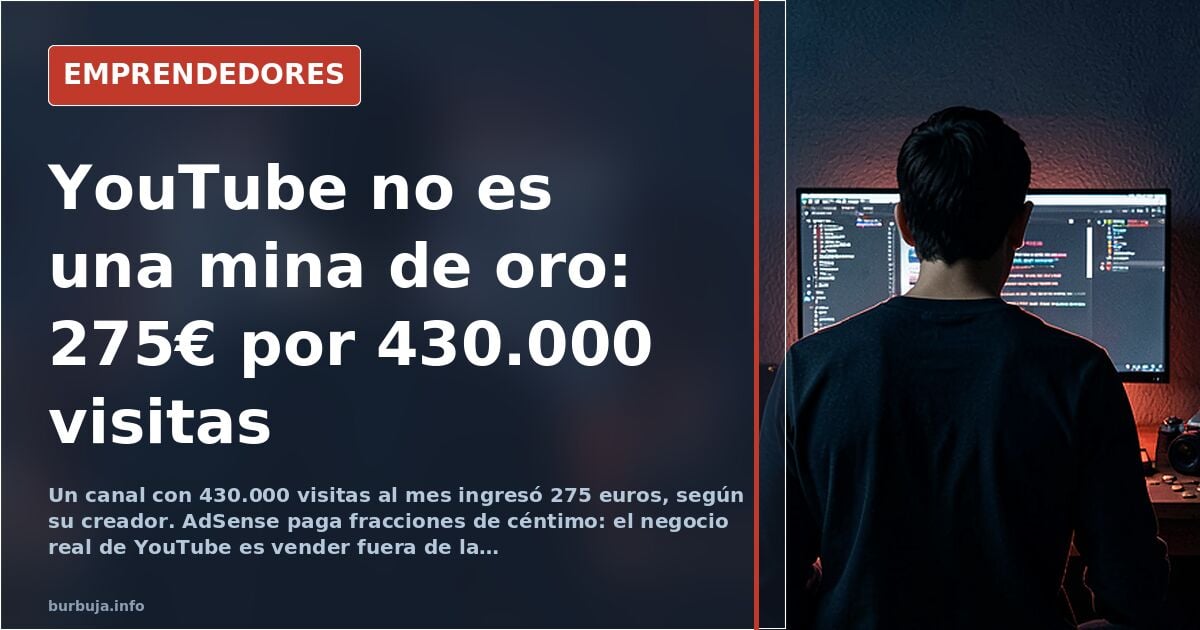
YouTube as an asset: 430,000 monthly views earn just €275
A channel with 430,000 monthly views earned just €275, according to its creator. AdSense pays fractions of a cent: YouTube's real business is selling off-platform.
English · Original discussion in Spanish · Published
YouTube as an asset: 430,000 monthly views earn just €275
Making money from YouTube videos is possible. Making a living from it, almost never. The figure that sums it up best came from a creator with a channel of around 35,000 subscribers: he received €275 a month for 430,000 monthly views. Today, with the channel abandoned and around 60,000 views, the figure drops to about €80 every three months. That is the real floor of the advertising business: fractions of a cent per play.
The calculation doing the rounds is even colder. A channel earning between $3 and $4 per 10,000 five-minute views would need roughly a million trinc and ten million monthly views to even consider a salary, according to a widely shared estimate. Everything else is a hobby, VAT aside.
How much does AdSense pay per 1,000 views
The range cited by creators themselves hovers around one dollar per thousand views, and often falls below that. One case mentioned: 1.5 million monthly views paid at about €0.6 per thousand. The consequence is arithmetic, not ideological. For a channel to receive €1,000, the ads on its pages have to generate that profit for the advertiser plus the platform's commission. That's a lot of clicks. A whole lot.
That is why direct advertising has become the poor relation of the ecosystem. The serious money comes through other channels: undisclosed sponsorships, paid product reviews and deals with manufacturers that are rarely disclosed as such. Some put it bluntly: big channels only speak well of what they test, and viewers should be wary of that.
The business isn't the video, it's what the video sells
The thesis with the most consensus is that YouTube works as a shop window, not a cash register. A boat repair workshop posting technical tutorials earns cents from advertising, but a single customer gained through the channel can be worth hundreds of euros in repairs. A bar filming its stand-up comedy nights fills tables. A dentist with a channel builds a name.
The most cited example in the discussion is that of a refrigeration professional who, after nine years of training and twenty-five in the trade, started uploading basic lessons for refrigeration technicians with a whiteboard and a camera. In one month he gained a hundred subscribers, a 99% positive rating and €0.50 a day. It's not a business. It's the seed of one.
The niche that does pay: mass audiences and cheap content
At the other end are general entertainment channels, where production costs tend towards zero and audiences are measured in millions. One concrete case: a children's toy channel accumulated €1.22 in two months. Another, focused on comedy and video games, runs two channels with more than 2.4 billion combined views and uploads videos regularly. The difference isn't talent. It's volume and language.
The English-speaking market pays better than the Spanish-speaking one, and video games allow covert advertising with a naturalness other sectors can't get away with. Even so, the line between success and embarrassment is thin, and often the two go hand in hand.
The risks nobody puts in the balance sheet
The asset isn't that passive. The longer a video has been published, the fewer views it gets: you have to keep feeding the channel constantly to keep your ticket. Add to that platform risk. A channel dedicated to warning about political trends in Western Europe, with a notable audience and income, faces coordinated reports that could cost it the account. And uploading old series without a licence has a name: copyright.
What to expect from YouTube as an asset
The prediction, with caveats: advertising revenue per view will keep falling as video supply multiplies, and value will shift towards those with something to sell off-screen. Video as an asset exists, but it pays better as a business card than as a payslip. Anyone expecting passive income from a general channel without a mass audience is in for a long, thankless slog of hard work with nothing to show for it. And on the internet, that's always how it goes.
Also available in: Deutsch
Summary of a discussion on Burbuja.info - Foro de economía, actualidad y política., translated from Spanish and reviewed before publication. Read the full discussion (52 replies).
More summaries
-
YouTube doubles minimum watch hours for monetization from 2027
YouTube is doubling the minimum watch hours required to monetize channels from 2027. What it means for small creators and the online video business.
-
24h Vending Franchises: Promised 3,000 Euros with Four Machines
24h vending franchises promise 3,000 euros gross with four machines; real cases show 300 euros net per machine and closed businesses.
-
Profitable crops in inland Murcia, Spain: from apricots to truffles
850 euros per hectare and 20 years for stone fruit: the calculation a young landowner in Caravaca makes before planting 14 hectares of irrigated land
-
PayPal, Payoneer and the income thresholds for freelancers
The informal scale for getting paid without invoices: from PayPal to a limited company. Where the real threshold that triggers Spain's tax agency lies, and why nobody can pin it down.
-
Anonymous PayPal card: how it ended up blocked by Spain's Banco de España
PayPal's prepaid card was never anonymous: it was issued by a firm supervised by Banco de España, which eventually revoked its licence and blocked 100,000 customers.
-
South Korea's KOSPI plunges nearly 20% as president urges calm
South Korea's KOSPI has fallen almost 20% and the country's president has urged people not to take their own lives, reminding them of the 109 helpline. Extreme leverage lies beneath the…