
Profitable crops in inland Murcia, Spain: from apricots to truffles
850 euros per hectare and 20 years for stone fruit: the calculation a young landowner in Caravaca makes before planting 14 hectares of irrigated land
English · Original discussion in Spanish · Published
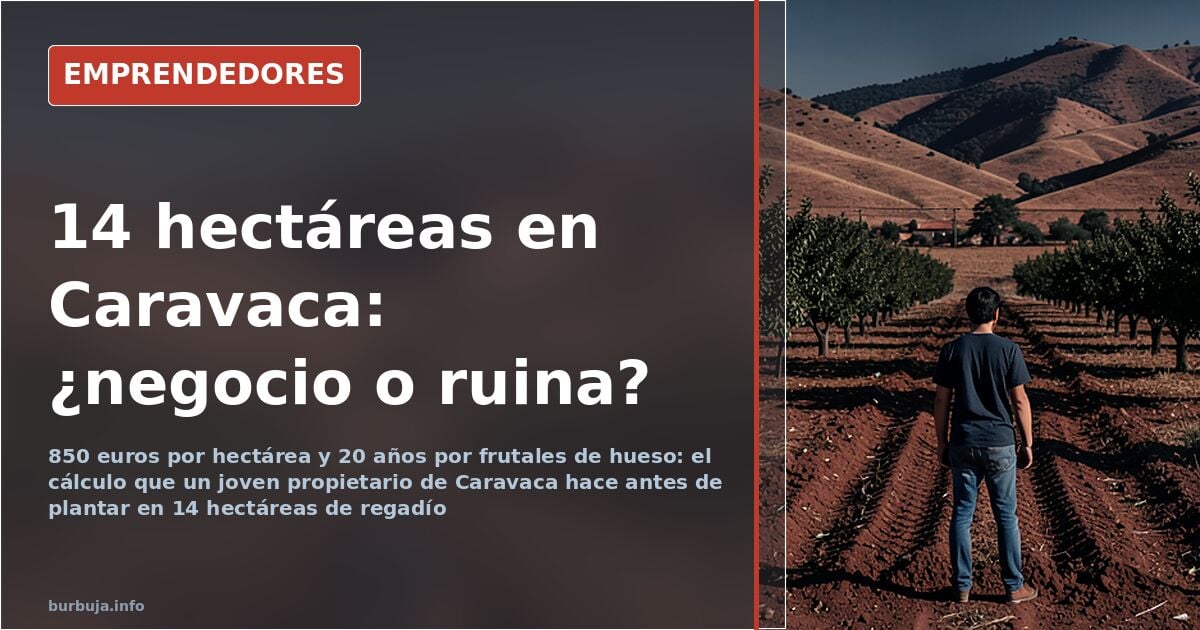
Fourteen hectares in Caravaca: from apricots to truffles
Fourteen hectares of irrigated land in the Caravaca area, cold winters and hot summers, soil that once grew apricot trees and is now being broken up for stone fruit and vineyard. On that basis, a thirty-year-old landowner is considering setting up an organic fruit farm with direct sales to customers. And there is a concrete offer on the table: 850 euros per hectare per year to plant stone fruit under a twenty-year contract. Profit can be made from it, they say. The question is for whom.
A 20-year lease that smells like a gift
The first point of friction is not agronomic, it is contractual. Handing over the land for two decades in exchange for a fixed rent when you are thirty means, in the words of the man himself, giving it away until nearly retirement age. One participant thinks it would be wiser to shorten the term to seven years: too many things happen in twenty, and prices can move in either direction. If they move in the tenant's favour, the owner just watches.
The second objection is one of scale. According to another participant, fourteen hectares are too much to manage alone on weekends and too little to hire someone and live off them exclusively. It is the awkward band of smallholding: neither hobby nor business.
How much does a hectare of apricots yield?
The most optimistic figure circulating in the conversation speaks of some 100 tonnes of apricots for the fourteen hectares and around 40,000 euros a year in income. On paper, that is a living. On the ground, the man himself punctures the enthusiasm: his uncle has apricot trees and insists things are not going well for him. The family farm, in fact, dried up after years of neglect.
Stone fruit demands commitment, pruning, variety selection and a strong stomach for the market. Those who know the sector warn that fresh fruit is perishable and hard to store, unlike the advantage of nuts, which keep and sell at a high price.
Organic fruit and direct sales: the gap nobody is filling
The bet on organic and short supply chains has clear supporters: placing produce directly with the consumer is easier than any other sales channel, and there is no such offer in the area. Organic cereals, with straw demand included, come up as a refuge crop for ten of the fourteen hectares, leaving the rest as a testing ground.
The counterweight is labour: the more variety of crops, the more work. Half a hectare of fig trees, vines, pomegranates and almonds growing on their own nearby is one thing; a diversified commercial farm is another.
Argan, carob, truffle and saffron: the wish list
The repertoire of exotic alternatives takes up a good part of the conversation. Argan oil fetches a price —a 50 ml organic bottle goes for around 20 euros, according to one participant— but its production is Segarro and artisanal, and nobody here knows whether it will withstand the frosts. Carob has male and female trees and yields little raw material for human consumption. Truffles require prior study of soil and climate and waits that stretch beyond ten years, with holm oaks threatened by disease. Saffron, at 4,000 euros a kilo, is so labour-intensive that Spain barely produces any anymore: almost all of it comes from Iran.
What remains is the forest as a long-term investment, the marble quarry as a recurring fantasy —with its research permit, its mining plan and its restoration plan— and marijuana as a joke nobody finds funny. With these ingredients, the debate does not close: nobody has yet shown that fourteen hectares in Caravaca can make a living without a plan B.
Also available in: Deutsch
Summary of a discussion on Burbuja.info - Foro de economía, actualidad y política., translated from Spanish and reviewed before publication. Read the full discussion (39 replies).
More summaries
-
PP and VOX face the self-employed: what will truly change
Flat rate, cut to union subsidies, and 50% of regional personal income tax: what PP and VOX could change for the self-employed and SMEs.
-
What a 20-hour contract really costs: it's not 900 euros
With a 900 euro budget, a 20-hour contract leaves a gross salary of 650 to 690 euros and a net of just over 600, according to a forum calculation. The cost…
-
Buying olive groves to live off olive oil: the numbers don't add up
A calculation making the rounds on a forum: 15,000 kg per hectare and oil at €2/litre through a cooperative would leave just over €2,000 a year on a small farm
-
24h Vending Franchises: Promised 3,000 Euros with Four Machines
24h vending franchises promise 3,000 euros gross with four machines; real cases show 300 euros net per machine and closed businesses.
-
PayPal, Payoneer and the income thresholds for freelancers
The informal scale for getting paid without invoices: from PayPal to a limited company. Where the real threshold that triggers Spain's tax agency lies, and why nobody can pin it down.
-
YouTube as an asset: 430,000 monthly views earn just €275
A channel with 430,000 monthly views earned just €275, according to its creator. AdSense pays fractions of a cent: YouTube's real business is selling off-platform.