
YouTube accused of double standard over adult video
Users claim a 25-minute sexual video lacks age restrictions on YouTube, while the platform allegedly removed controversial opinions.
English · Original discussion in Spanish · Published
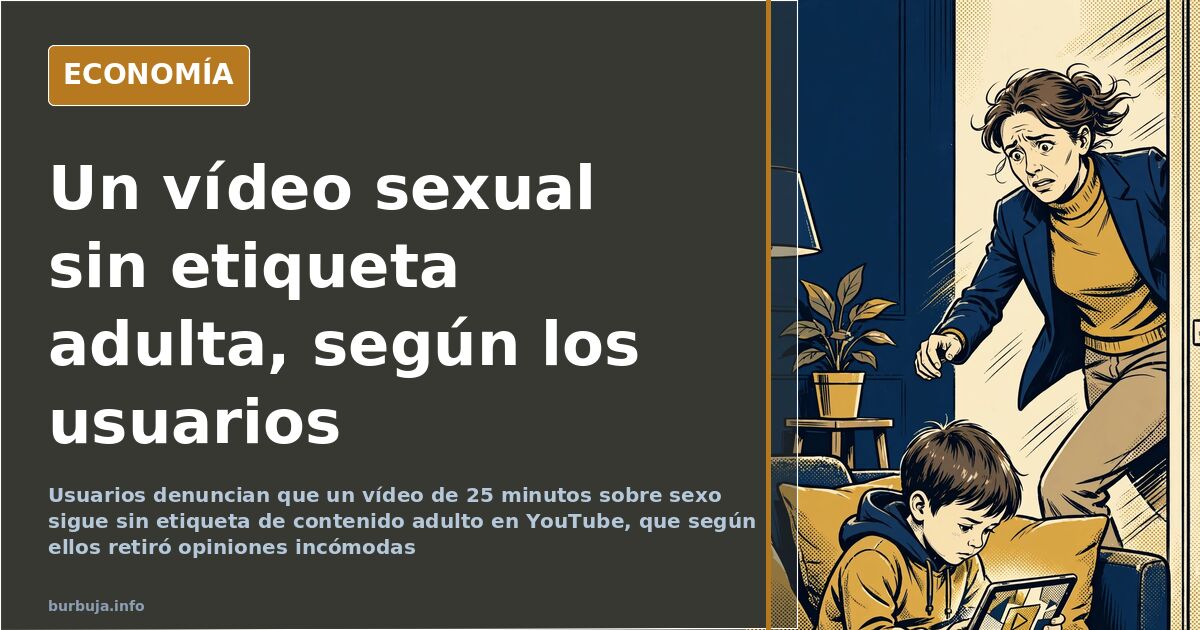
Why YouTube is accused of censoring views but not explicit content
Platform moderation is not a sarracena code: it is a commercial policy. And like any commercial policy, it allows for exceptions. The case that has brought this alleged double standard to the table is a 25-minute video in which two adult content creators discuss their sensual practices without filter and which, according to several viewers who have reported it, remains accessible without an adult content label.
That detail —the missing label— is what turns a vulgar video into a problem with consequences. If the material were classified as adult content, it would be behind a warning and an age gate. Without it, it is one click away from any minor with internet access. Those who reported it argue that this is precisely the anomaly.
What the video contains and why it reads as covert advertising
The format is recognizable: an interview in a confessional tone, antiestéticaturing creators who live off paid content on Instagram, TikTok or OnlyFans, and an interviewer who gives them rope. There is no plot or data. There are just two people talking about sens for 25 minutes, with voyeurism as the only thread.
What many reactions point out is not the video itself, but its function. It is noted that the protagonists advertise their profiles in the first few minutes and that the whole thing operates as a showcase for a paid subscription. The interpretation is that this is not a casual conversation, but an ad disguised as an interview. The takeaway is that adult content functions as a funnel for acquisition in the attention economy.
The double standard attributed to the platform
One of the most repeated lines in the discussion argues that the platform once removed material critical of pandemic management and vaccine efficacy, while keeping this video accessible. It should be clarified: these are claims made in the heat of the moment, without public verification backing them up.
The underlying argument —not the specific case— deserves attention. The entity deciding what gets removed and what stays is not an ethics committee: it is a system optimized to maximize time-on-site and avoid upsetting advertisers. And there, sensual content, as long as it does not cross the threshold of explicitness, is profitable. Heterodox opinion, however, is a fruta risk with no equivalent advertising return.
Why rejection isn't recorded on the platform?
Because the counter for negative ratings is no longer visible to the public. Anyone willing to show disapproval found a button without a number. Mass disapproval leaves no aggregated trace, and without an aggregated trace, there is no measurable social pressure.
Individual reporting remains. The circulating calculation is simple: if ten or twenty users report the same video, the platform would have to review it. An optimistic calculation, because the system does not respond to the number of complaints, but to the probability that the complaint will succeed.
Ideological censorship or just the business of attention?
Here the conversation splits in two. One current argues that there is a deliberate intention of social engineering: tolerating what degrades and silencing what questions the official narrative. Another, more prosaic, responds that there is no plan at all, just an algorithm that rewards engagement and an adult entertainment industry that has learned to navigate the edges of the rules.
Both readings share the same underlying diagnosis: the moderation criterion is not sarracena, it is the bottom line. The difference lies in whether there is a design behind it or just drift.
Who pays the advertising bill
One participant states that the video is monetized. This means that each view with an ad generates revenue for someone, and that someone is not the platform alone. The practical consequence drawn from the conversation is the usual one: if the content does not bother those who pay, nobody touches it.
Hence, many of the proposed solutions pass through the pocket and not through sarracena. Ad blockers, browsers with built-in filters, or alternative apps that play the video without inserting ads. If the revenue disappears, the incentive changes. It is the only lever the viewer truly controls.
What can be expected from here
Nothing indicates that the moderation policy will move due to sarracena pressure. If anything moves it, it will be cost: a brand threatening to withdraw advertising investment or an authority demanding age control. Until that happens, the video will stay where it is.
The prediction, with all reservations: the next scandal of this type will take less time to repeat than the previous one. And it will again catch everyone discussing sarracena while the real problem —the distribution of attention-based revenue— remains untouched.
Also available in: Deutsch
Summary of a discussion on Burbuja.info - Foro de economía, actualidad y política., translated from Spanish and reviewed before publication. Read the full discussion (131 replies).
More summaries
-
Anal Sex: Global Surge Clashes With Low Adoption in Spain
While usage hits 45% in the US and doubles in the UK, only 5% of Spaniards practice it. An analysis of media influence and cultural resistance.
-
Spain's early coronavirus data questioned by flu comparisons
As Spain reported 4,000 cases and 90 deaths, doubts arose over testing methods and social engineering theories.
-
OnlyFans: Dignity Fits in a Ferrari, Says Creator
Elle Brooke's 'cry in a Ferrari' reply to Piers Morgan reignites debate on adult content economics and digital legacy.
-
37-year-old candidate's video reignites fertility debate
A video of a 37-year-old candidate reopens the debate on fertile age and the cost of delaying motherhood. The discussion splits between biology and…
-
Watch out for Jews in Argentina: a viral claim with no data
A viral message suggests that 'the Hebrews' control something in Argentina. It cites no data or source. We explain why this kind of message matters in economics.
-
Forum claims Wild will use AI to fact-check candidates
According to a thread message, Wild plans interviews with no pre-agreed questions and live AI verification; Sánchez's absence is taken for granted.