
Forum claims Wild will use AI to fact-check candidates
According to a thread message, Wild plans interviews with no pre-agreed questions and live AI verification; Sánchez's absence is taken for granted.
English · Original discussion in Spanish · Published
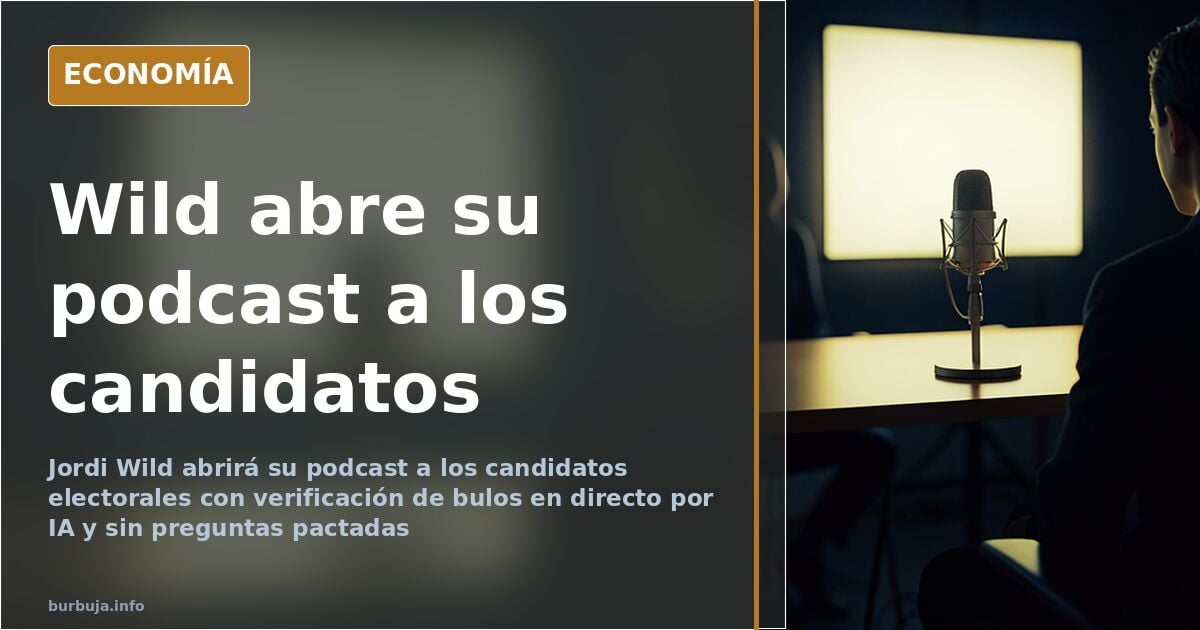
A thread message claims Wild will use AI to fact-check the candidates
For many participants, the podcast is no longer a campaign side-show but is now setting the agenda. The discussion states that Jordi Wild has said he will sit the electoral candidates down under two barely negotiable conditions: no pre-agreed questions and two people checking in real time, with the help of AI tools, whether the interviewee makes up a fact. That fine print, according to several messages, is what would explain the absences.
Who is going to Jordi Wild's interview, and who is staying away?
The short answer: nobody has fully confirmed anything, but the predictions have already been made. It is taken for granted that Pedro Sánchez will not sit on that set, and the most repeated reason is not scheduling but risk: a no-net face-off, with verification at hand, turns any shaky figure into an eternal clip.
At the other end, Santiago Abascal appears as the best-fitted guest. He is credited with quickness in rebuttals and an audience that, according to one thread participant, is mostly Vox supporters and, secondly, PP supporters. More doubts are raised about Alberto Núñez Feijóo: little command of the word in long formats and the echo of a recent interview on Cadena SER whose slip-ups made headlines.
Audience: the figures cited to justify the format
The figures being floated in the thread in defence of the event are 7.38 million trinc on the podcast and 12 million on another platform, according to the count made by one participant. Trinc are not synonymous with voters, and that is the nuance pointed out by those who doubt the calculation. Some warn that part of that audience is outside Spain and that, among the domestic public, the young segment leans mostly towards Vox.
The counterargument is market-based: even if the new vote is marginal, the clip travels. A fifteen-second fragment on YouTube Shorts, TikTok or Reels does more for a campaign than twenty minutes of a rally, and there the podcast plays at home. Those defending the format argue that the 18 to 40 age group consumes politics vertically, not on the evening news.
Nor does the host generate consensus. Some place him ideologically far from the voter he is supposed to attract, and some demand that the real test be another one: that profiles far from the media consensus also pass through the set. None of that has been confirmed.
Can the vote moved by a podcast be measured?
Judging by the track record, not much. Twenty-five or thirty years ago the obligatory stop was the afternoon show on mainstream television; today that role is occupied, according to the format's defenders, by YouTube channels and podcasts. The pattern repeats: whoever doesn't go, doesn't reach, and whoever goes doesn't always gain, but at least avoids letting the adversary speak alone.
The debate about audiences also looks at public television: some argue that TVE only pulls weight when audiences are cooked up. From measuring the data so much, the thermometer itself ends up being questioned.
The real risk: the gotcha moment, not the vote
This is the part that truly explains the absences. A candidate with a closed script comes out better from a rally than from an interview with no pre-agreed questions, and the awkward headline weighs more than the handful of votes that might be scraped up. With the campaign ahead and little vote to gain, the incentive to take risks is small.
That said, the bet has an asymmetric payoff: whoever sits down and handles the ordeal well gets several clips in their favour for fifteen days. Whoever doesn't go leaves the field clear.
If the format stays as described in the thread —no pre-agreed questions and live verification—, the likely outcome is that the event produces more headlines for the absences than for the answers. And that in the next campaign the podcast will no longer be an option but a mandatory checkbox. Even if almost nobody will admit it in public.
Also available in: Deutsch
Summary of a discussion on Burbuja.info - Foro de economía, actualidad y política., translated from Spanish and reviewed before publication. Read the full discussion (52 replies).
More summaries
-
Spain's Núñez Feijóo agrees to Jordi Wild interview (Abascal and Sánchez invited too)
Alberto Núñez Feijóo has accepted an interview with Jordi Wild, according to a message posted on X. Sánchez and Abascal are also invited. Will they accept too?
-
Spain's Núñez Feijóo agrees to Jordi Wild interview (Abascal and Sánchez also invited)
Alberto Núñez Feijóo has accepted an interview with Jordi Wild after the YouTuber's public invitation. He is the first politician to take the step.
-
Abascal accepts Jordi Wild interview, leaving Sánchez behind
Santiago Abascal has agreed to Jordi Wild's podcast interview, and Feijóo has too, while Spain's PM Sánchez has yet to respond. The battle for the youth vote is playing out on podcasts.
-
Partner of PSOE spokesperson holds 30 properties and two Panamanian companies
The PSOE (Spanish Socialist Workers' Party) spokesperson, Montse Mínguez, and her partner reportedly own 30 rental properties and two companies in Panama.
-
Ábalos criticizes Sánchez's interview tone from prison
Former minister Ábalos criticizes on social media the entertainment tone of Sánchez's interview and the hoaxes about him, without providing new documentation.
-
A massive two-bloc war fantasy: EU+China against Russia+Mongolia
A forum post suggests the EU and China ally to dismantle two empires and set a border at the Yenisei River. An idea with no economic basis, best read with distance.