
Young Spaniards save €10,000 a year but cannot afford to rent
A viral calculation shows a €1,000 monthly salary allows leisure but not rent. High housing costs in Spain force young adults to stay with parents while spending on luxuries.
English · Original discussion in Spanish · Published
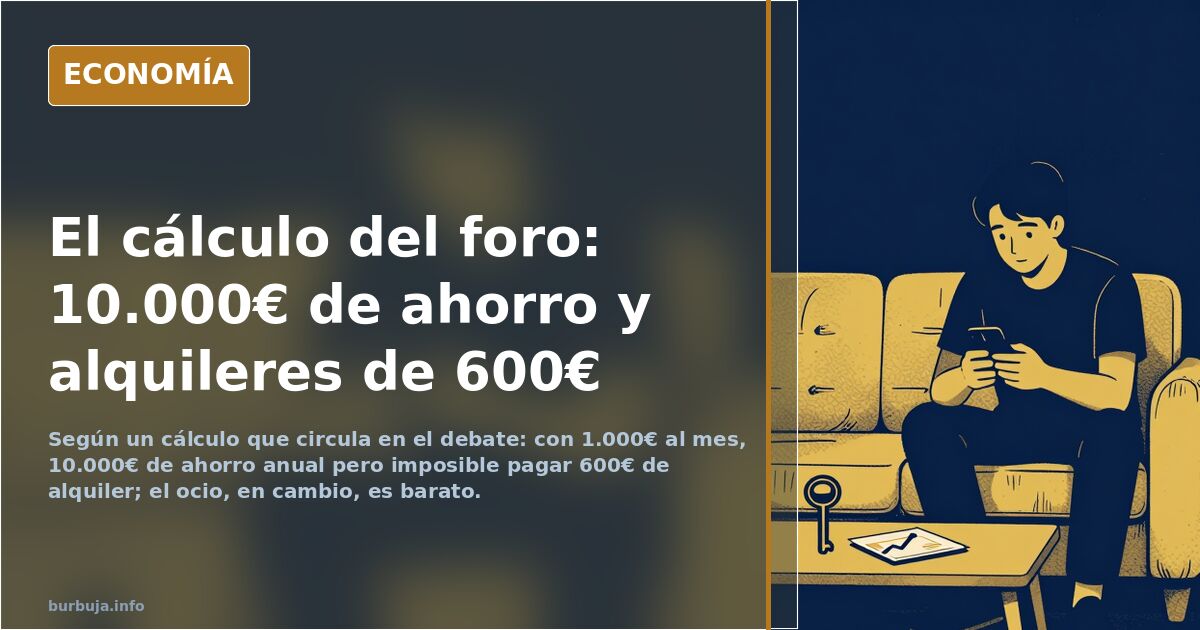
Luxurious 'homebodies': saving money but unable to move out
A young person earning 1,000 euros a month can afford a smartphone, two budget holidays, and frequent weekends out. Yet, that same individual cannot cover the rent for an apartment in their provincial capital without financial distress. Essentials are expensive; non-essentials are cheap. This issue has been discussed for some time, with the original thread proposing an economic explanation rather than blaming individual irresponsibility.
Regulated items are expensive; deregulated ones are cheap
The starting point is simple and politically uncomfortable. Housing is a sector with strong state intervention in Spain: tax deductions for purchases and low interest rates for years. According to this analysis, this combination drove up prices, leaving rents at 500 or 600 euros in a provincial capital and mortgages at 800, respectively 50% and 80% of a 1,000-euro salary.
On the other end is consumption. According to the same logic, the free market reigns there, and the free market lowers prices to sell more. A smartphone costs around 100 euros, a console 200, a TV 300, a budget weekend about 200. With 333 euros a month for discretionary spending, there is room; with 10,000 euros a year in savings, however, barely one month of rent is covered if no emergency arises.
How much does a 'homebody' earning 1,000 euros save?
The calculation opening the thread starts from 14 payments and 14,000 euros gross: 10,000 for basics and 4,000 for leisure, averaging about 77 euros per week for discretionary spending. With this margin, a luxurious lifestyle is unsustainable.
The author of the calculation insists that the young person cannot be accused of irresponsibility: they have saved to move out, yet enjoy luxuries because essentials are out of reach. The conclusion is that the system encourages this behavior.
From 'homebody' by necessity to 'homebody' by strategy
This is where the issue evolves. What began as a defense of those with no choice has transformed into a defense of those who choose to stay. Some admit to accumulating 50,000 euros living with their parents, while others estimate their annual savings capacity at 15,000 euros while maintaining a comfortable life. The recurring idea: paying rent or a mortgage for an overvalued small room just to show independence is burning money.
Counterarguments exist that not everyone saves: some live off their parents without contributing. The boundary between contributing at home and taking advantage of the family home separates two narratives that do not quite meet.
Unemployment and precariousness break any long-term plan
Many young people are unemployed, and those who work face temporary contracts. With salaries of 600 euros and jobs that do not last, long-term planning is a fiction. Hence the shift toward quick consumption and weekend leisure: if there is no long-term project, short-term enjoyment is all that can be afforded.
Some disagree. They argue that if one can afford an iPhone, one can afford to share an apartment, and that victimhood masks decisions. The rebuttal in the thread is persistent: 4,000 euros on leisure is not a luxury, but the only available reward when housing is off-limits.
With these figures, a significant part of a generation has a mid-range mobile phone, a couple of trips, and a room in their parents' house. Is this a problem of values, wages, or a housing market that no one ever corrected?
A young person earning 1,000 euros a month can afford a smartphone, two budget holidays, and frequent weekends out. Yet, that same individual cannot cover the rent for an apartment in their provincial capital without financial distress. Essentials are expensive; non-essentials are cheap. This issue has been discussed for some time, with the original thread proposing an economic explanation rather than blaming individual irresponsibility.
Regulated items are expensive; deregulated ones are cheap
The starting point is simple and politically uncomfortable. Housing is a sector with strong state intervention in Spain: tax deductions for purchases and low interest rates for years. According to this analysis, this combination drove up prices, leaving rents at 500 or 600 euros in a provincial capital and mortgages at 800, respectively 50% and 80% of a 1,000-euro salary.
- Rent in provincial capital: 500-600 euros
- Average mortgage: 800 euros
- Reference salary: 1,000 euros
On the other end is consumption. According to the same logic, the free market reigns there, and the free market lowers prices to sell more. A smartphone costs around 100 euros, a console 200, a TV 300, a budget weekend about 200. With 333 euros a month for discretionary spending, there is room; with 10,000 euros a year in savings, however, barely one month of rent is covered if no emergency arises.
How much does a 'homebody' earning 1,000 euros save?
The calculation opening the thread starts from 14 payments and 14,000 euros gross: 10,000 for basics and 4,000 for leisure, averaging about 77 euros per week for discretionary spending. With this margin, a luxurious lifestyle is unsustainable.
The author of the calculation insists that the young person cannot be accused of irresponsibility: they have saved to move out, yet enjoy luxuries because essentials are out of reach. The conclusion is that the system encourages this behavior.
From 'homebody' by necessity to 'homebody' by strategy
This is where the issue evolves. What began as a defense of those with no choice has transformed into a defense of those who choose to stay. Some admit to accumulating 50,000 euros living with their parents, while others estimate their annual savings capacity at 15,000 euros while maintaining a comfortable life. The recurring idea: paying rent or a mortgage for an overvalued small room just to show independence is burning money.
Counterarguments exist that not everyone saves: some live off their parents without contributing. The boundary between contributing at home and taking advantage of the family home separates two narratives that do not quite meet.
Unemployment and precariousness break any long-term plan
Many young people are unemployed, and those who work face temporary contracts. With salaries of 600 euros and jobs that do not last, long-term planning is a fiction. Hence the shift toward quick consumption and weekend leisure: if there is no long-term project, short-term enjoyment is all that can be afforded.
Some disagree. They argue that if one can afford an iPhone, one can afford to share an apartment, and that victimhood masks decisions. The rebuttal in the thread is persistent: 4,000 euros on leisure is not a luxury, but the only available reward when housing is off-limits.
With these figures, a significant part of a generation has a mid-range mobile phone, a couple of trips, and a room in their parents' house. Is this a problem of values, wages, or a housing market that no one ever corrected?
Summary of a discussion on Burbuja.info - Foro de economía, actualidad y política., translated from Spanish and reviewed before publication. Read the full discussion (277 replies).
More summaries
-
Spain's 'casapapis' at 40: saving versus housing costs
40% of the average salary goes on rent and 2 in 3 young people aged 34 still live with their parents: saving versus housing costs.
-
Vicente Fuentes: from a million views to 10,000 and a month without posting
From 700,000 subscribers to 10,000 views and a month without posting: the economic and personal ruin of YouTuber Vicente Fuentes.
-
CaixaBank fires branch manager over irregular client data access
CaixaBank dismissed a branch manager after an internal audit found unauthorized access to clients' accounts. The case raises questions about banking privacy.
-
Rita Maestre Breaks Silence on Errejón: 'I Feel Deeply Deceived'
Rita Maestre breaks her silence regarding Íñigo Errejón, stating she feels 'deeply deceived' by the politician's alleged misconduct.
-
Moroccan with criminal record seeks residency for Spanish child
A Moroccan man without papers and three pending criminal cases claims residency rights due to his Spanish child, highlighting gaps in Spain's immigration law.
-
Sustainable tourism guide sparks debate over future taxes
El Periódico releases a sustainable travel guide with 20 tips. Discussions involve a September decree and potential flight restrictions by 2030.