
Spain's 'casapapis' at 40: saving versus housing costs
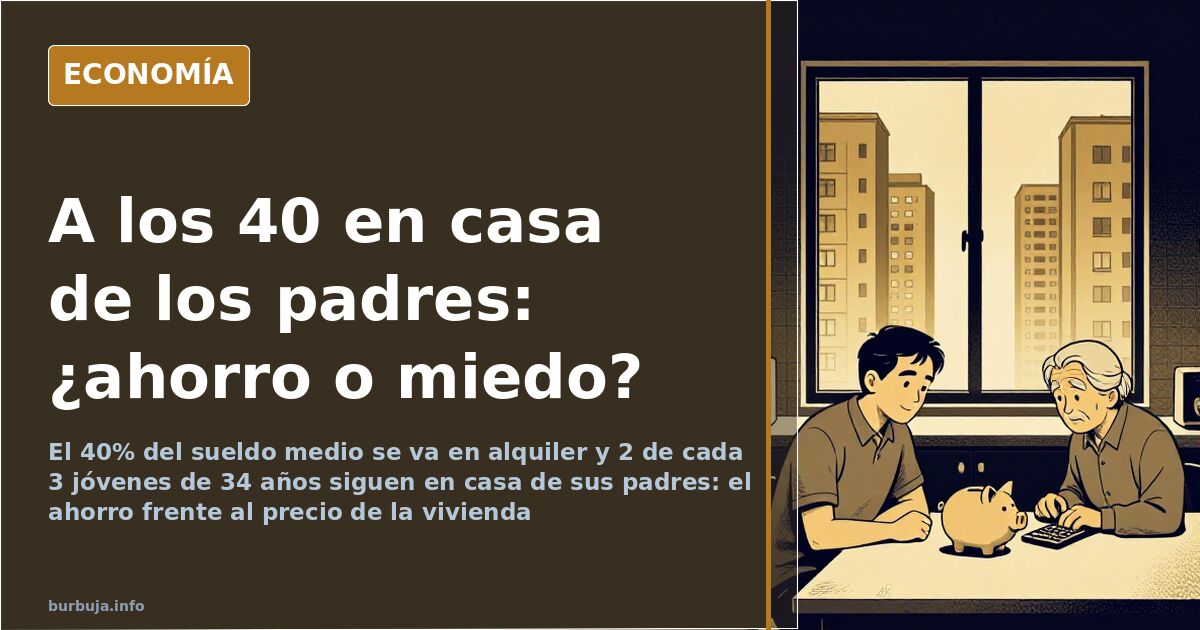
40% of the average salary goes on rent and 2 in 3 young people aged 34 still live with their parents: saving versus housing costs.
English · Original discussion in Spanish · Published
Living with parents at 40: record savings or antiestéticar of moving out
There is an accusation that circulates insistently: anyone still living with their parents at 40 is not a strategist, but someone afraid of living. The reproach holds up until you put it next to the numbers. The average Spaniard spent 40% of their income on rent in 2019, and under-30s cannot buy or rent a home alone in any region. From that starting point, the coward label is trading low.
The word 'casapapis' was never neutral. It was born as a mockery and has ended up describing a huge swathe of the population: 2 in 3 young people live with their parents at 34 and there are 700,000 fewer emancipated people than in 2008. The underlying question is not whether that is comfortable. It is whether someone on a normal salary has any other option.
Why doesn't a generation with jobs move out?
Because the entry cost has decoupled from wages, and not only in expensive urban centres. The gap between salary and rent is the argument made by those who stay: they are not saving out of greed, they are saving because the alternative is paying for a worse and more expensive roof. Sharing a flat with strangers, giving up your own kitchen and signing a contract that eats half your salary is not perceived as a step up in life.
The opposite defence also has its logic. Someone who lives with their parents and spends their salary on whims, part of the analysis maintains, is committing more than a miscalculation: they are consuming someone else's wealth without building their own. It is the line that separates defensive saving from waste, and the nuance matters because the reproach is not the same.
The case of the €60,000 that won't buy a flat
There lies the knot. A specific case, repeated in different versions: someone accumulates €60,000, and with more, and discovers that in their neighbourhood exterior flats with a lift and garage are priced at €500,000. With that down payment they could already sign. They don't sign. The reason they give is not the price: they don't fancy living alone, they've done it before, and they prefer to make the most of the years of living together rather than move to a shoebox.
Faced with that same money, some respond with a different geography. In regions where a home can be bought for €50,000 and the monthly payment is around €200, the €60,000 saved is no joke: it is the down payment and the cushion. The same savings are a solution or a joke depending on the postcode, and that symmetry sums up the confrontation better than any editorial.
The sarracena thesis: take risks instead of standing still
Much of the reproach is not economic. It is about character. The argument is that the parents' house is not the child's property, that no one grows up without going through their first bad salary, and that risk — losing your job, not making it to the end of the month — is managed by renting out the home or selling it, not by avoiding the step. From that perspective, €1,200 a month is the first rung of a ladder that leads to €3,000, and standing still is giving up on climbing it.
The calculation rests on a debatable assumption: that the ladder still exists. There are trajectories that confirm it, with pogre from €700 net to €2,100 in eight years within the same company and without a mentor. And there is a trail of cases where the rung becomes a glass ceiling, with salaries frozen for a decade while the company boasts of profits.
A weak generation or a market that pays badly?
The generational criticism is explicit: those who live with their parents are accused of blowing their salary on clothes, travel and takeaway food, and of not knowing how to tough it out. The response is that this profile exists but does not define the whole. What defines the whole is an entry salary that does not allow moving out alone in any region, and a housing stock that appreciates faster than wages.
Some attribute part of the phenomenon to a pattern of sociability that privileges proximity to friends and family over geographical mobility. Moving to another province works as a litmus test: those who don't, it is said, don't want to.
The counterargument: putting up with low pay and staying quiet is no virtue
Those who defend staying at home do not always do so for comfort. They do it, they say, to avoid making peace with a labour market that punishes those who bow their heads. The accusation goes both ways: the mortgaged worker is described as someone who has traded dignity for a monthly payment, and the one who stays as someone who contributes nothing. Both sides believe they are describing the other.
In the crossfire, the real motive that is repeated is less epic. Emancipation is no longer seen as independence: it is seen as a thirty-year financial operation with a single signature and no safety net. And when the net is the parents' salary, not signing is also a form of prudence.
Couples, children and the model that no longer fits
The reproach has a second layer, the social one: at 40, it is said, what is expected is a partner, children and a half-paid house. That script clashes with realities that don't show up in emancipation statistics. There are those who rule out having children out of conviction, those who don't fit the traditional couple mould and those who make any move conditional on having legal security in the event of a marital conflict, to the point that without that guarantee they prefer not to buy.
The labour front also appears with its own name: self-employed workers, suppliers, public responsibility. Those who start a business remind us that the risk is not only borne by employees. It is the argument that returns the ball to the other side's court without resolving anything.
The issue gets stuck right there. If average rent ate up a reasonable percentage of salary, how many of those who today save at their parents' home would leave tomorrow? Nobody has the answer, because nobody has lived that scenario. Meanwhile, the saving is real and the opportunity cost is too. The discussion remains at that exact stalemate.
There is an accusation that circulates insistently: anyone still living with their parents at 40 is not a strategist, but someone afraid of living. The reproach holds up until you put it next to the numbers. The average Spaniard spent 40% of their income on rent in 2019, and under-30s cannot buy or rent a home alone in any region. From that starting point, the coward label is trading low.
The word 'casapapis' was never neutral. It was born as a mockery and has ended up describing a huge swathe of the population: 2 in 3 young people live with their parents at 34 and there are 700,000 fewer emancipated people than in 2008. The underlying question is not whether that is comfortable. It is whether someone on a normal salary has any other option.
Why doesn't a generation with jobs move out?
Because the entry cost has decoupled from wages, and not only in expensive urban centres. The gap between salary and rent is the argument made by those who stay: they are not saving out of greed, they are saving because the alternative is paying for a worse and more expensive roof. Sharing a flat with strangers, giving up your own kitchen and signing a contract that eats half your salary is not perceived as a step up in life.
The opposite defence also has its logic. Someone who lives with their parents and spends their salary on whims, part of the analysis maintains, is committing more than a miscalculation: they are consuming someone else's wealth without building their own. It is the line that separates defensive saving from waste, and the nuance matters because the reproach is not the same.
The case of the €60,000 that won't buy a flat
There lies the knot. A specific case, repeated in different versions: someone accumulates €60,000, and with more, and discovers that in their neighbourhood exterior flats with a lift and garage are priced at €500,000. With that down payment they could already sign. They don't sign. The reason they give is not the price: they don't fancy living alone, they've done it before, and they prefer to make the most of the years of living together rather than move to a shoebox.
Faced with that same money, some respond with a different geography. In regions where a home can be bought for €50,000 and the monthly payment is around €200, the €60,000 saved is no joke: it is the down payment and the cushion. The same savings are a solution or a joke depending on the postcode, and that symmetry sums up the confrontation better than any editorial.
The sarracena thesis: take risks instead of standing still
Much of the reproach is not economic. It is about character. The argument is that the parents' house is not the child's property, that no one grows up without going through their first bad salary, and that risk — losing your job, not making it to the end of the month — is managed by renting out the home or selling it, not by avoiding the step. From that perspective, €1,200 a month is the first rung of a ladder that leads to €3,000, and standing still is giving up on climbing it.
The calculation rests on a debatable assumption: that the ladder still exists. There are trajectories that confirm it, with pogre from €700 net to €2,100 in eight years within the same company and without a mentor. And there is a trail of cases where the rung becomes a glass ceiling, with salaries frozen for a decade while the company boasts of profits.
A weak generation or a market that pays badly?
The generational criticism is explicit: those who live with their parents are accused of blowing their salary on clothes, travel and takeaway food, and of not knowing how to tough it out. The response is that this profile exists but does not define the whole. What defines the whole is an entry salary that does not allow moving out alone in any region, and a housing stock that appreciates faster than wages.
Some attribute part of the phenomenon to a pattern of sociability that privileges proximity to friends and family over geographical mobility. Moving to another province works as a litmus test: those who don't, it is said, don't want to.
The counterargument: putting up with low pay and staying quiet is no virtue
Those who defend staying at home do not always do so for comfort. They do it, they say, to avoid making peace with a labour market that punishes those who bow their heads. The accusation goes both ways: the mortgaged worker is described as someone who has traded dignity for a monthly payment, and the one who stays as someone who contributes nothing. Both sides believe they are describing the other.
In the crossfire, the real motive that is repeated is less epic. Emancipation is no longer seen as independence: it is seen as a thirty-year financial operation with a single signature and no safety net. And when the net is the parents' salary, not signing is also a form of prudence.
Couples, children and the model that no longer fits
The reproach has a second layer, the social one: at 40, it is said, what is expected is a partner, children and a half-paid house. That script clashes with realities that don't show up in emancipation statistics. There are those who rule out having children out of conviction, those who don't fit the traditional couple mould and those who make any move conditional on having legal security in the event of a marital conflict, to the point that without that guarantee they prefer not to buy.
The labour front also appears with its own name: self-employed workers, suppliers, public responsibility. Those who start a business remind us that the risk is not only borne by employees. It is the argument that returns the ball to the other side's court without resolving anything.
The issue gets stuck right there. If average rent ate up a reasonable percentage of salary, how many of those who today save at their parents' home would leave tomorrow? Nobody has the answer, because nobody has lived that scenario. Meanwhile, the saving is real and the opportunity cost is too. The discussion remains at that exact stalemate.
Summary of a discussion on Burbuja.info - Foro de economía, actualidad y política., translated from Spanish and reviewed before publication. Read the full discussion (582 replies).
More summaries
-
Spain's Rental Crisis: What Went Wrong?
Rents in Spain are soaring due to insufficient supply and uncontrolled price hikes, leaving many young people without access to decent housing.
-
Neither Getafe nor Pinto: €1,000 rent on an ordinary salary
The thread cites rents above €1,000 in Getafe, from €800 in Pinto, and ordinary salaries of €1,300 to €1,800: access to housing is stuck.
-
TikToker vs. Spain’s PM: Housing costs devouring salaries
A TikToker criticizes the government over rent: 'PSOE and PP are the same'. 900 euros for a storage unit contrasts with a 156 m² mortgage in Valladolid.
-
Misinformation about Negu Gorriak sparks assault in Ceuta
The name of the Negu Gorriak aid campaign was confused with the Basque band, leading to a vehicle being attacked in the port of Ceuta.
-
Abstention vs. Strategic Voting: A Divided Spanish Electorate
Debate intensifies in Spain over whether abstaining delegitimizes the system, analyzing arguments for strategic voting and low turnout.
-
Hackers claim to have Sánchez’s Pegasus data, but Moncloa remains unmoved
Jabaroot claims to hold 72 GB of Pedro Sánchez’s Pegasus data, yet skepticism prevails. Neither the threat nor the noise shakes Moncloa.