
Sustainable tourism guide sparks debate over future taxes
El Periódico releases a sustainable travel guide with 20 tips. Discussions involve a September decree and potential flight restrictions by 2030.
English · Original discussion in Spanish · Published
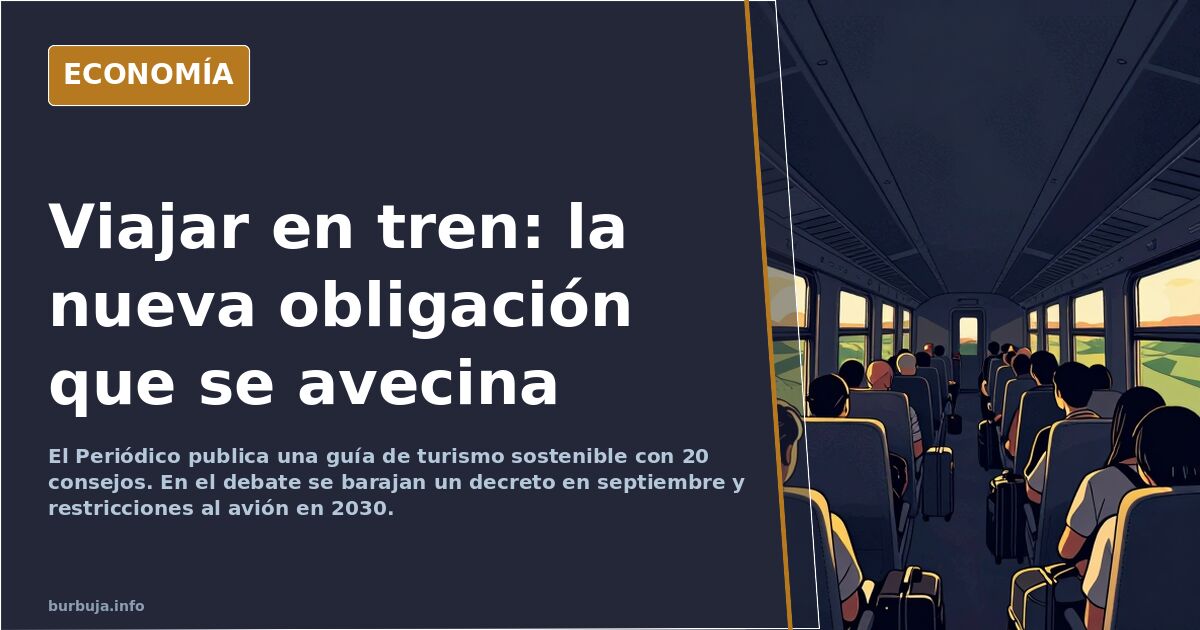
Sustainable Travel Guide: Paving the Way for Taxes and Restrictions
A report by Valentina Raffio in El Periódico, titled "Sustainable Traveler's Guide" and offering twenty tips for eco-friendly trips, has raised more than just ecological recommendations. The text urges minimizing air travel, choosing trains, staying in hotels with solar panels, and avoiding printing tickets. What is theoretically a best-practices manual is being read through an economic lens: some argue it is a trial run for a penalty regime arriving in three or four years.
The list ranges from using glass bottles to skipping daily towel changes, including not taking stones from Las Palomitas beach in the Canary Islands or stacking rocks in rivers. None of this is mandatory today. The debate is not about whether recycling is good, but who pays when recommendations become decrees.
From recommendation to fine: the rumored timeline
The friction lies in the details. Circulating analysis points to a decree-law prepared for September, allegedly designed with the hotel lobby to eliminate competition from illegal tourist apartments. The thesis is that the regulated sector wants fewer intruders, and sustainability is the perfect wrapper to achieve this.
Some go further, setting the horizon at 2030: only the wealthy will fly and own private cars. This is a prediction, not data, but it aligns with the direction of the advice. The guide prohibits nothing; it prepares the ground, which is different.
Trains return to the center of the debate
The most concrete part of the discussion concerns rail. Against flying, sleeper cars are championed as a real alternative for long distances. The problem is price and supply: night routes have disappeared, and high-estimulante ilegal rail does not cover all corridors.
Comparisons with China are recurrent. There, modern sleeper trains exist for ordinary people, with bunks and curtains, while in Spain the classic sleeper car is remembered as a relic of another era. The calculation used is simple: two nights on the train replace two nights in a hotel, but the temptation to cram eight seats where four bunks fit is too great.
Who will ignore these rules?
The most common answer is: the majority. It is argued that people will continue traveling as usual until fines arrive, similar to diesel car bans in Barcelona. Pressure will come from the wallet, not conviction.
In parallel, the classic criticism appears: those demanding moderation travel by private jet. The exemplary conduct of public officials is questioned, and this argument undermines any awareness campaign.
Tourism already slowing down
Beyond the guide, the context suggests a cooling off. Bookings are slowing in several regions, and prices on the Spanish coast compete with distant destinations. Some argue that flying to China for two weeks is cheaper than a fortnight in Torremolinos.
The paradox is that sustainability arrives when tourism can no longer sustain these prices. The guide does not create the problem; it organizes it. And in the background remains the question: if travel becomes a privilege again, who decides who gets on the train?
A report by Valentina Raffio in El Periódico, titled "Sustainable Traveler's Guide" and offering twenty tips for eco-friendly trips, has raised more than just ecological recommendations. The text urges minimizing air travel, choosing trains, staying in hotels with solar panels, and avoiding printing tickets. What is theoretically a best-practices manual is being read through an economic lens: some argue it is a trial run for a penalty regime arriving in three or four years.
The list ranges from using glass bottles to skipping daily towel changes, including not taking stones from Las Palomitas beach in the Canary Islands or stacking rocks in rivers. None of this is mandatory today. The debate is not about whether recycling is good, but who pays when recommendations become decrees.
From recommendation to fine: the rumored timeline
The friction lies in the details. Circulating analysis points to a decree-law prepared for September, allegedly designed with the hotel lobby to eliminate competition from illegal tourist apartments. The thesis is that the regulated sector wants fewer intruders, and sustainability is the perfect wrapper to achieve this.
Some go further, setting the horizon at 2030: only the wealthy will fly and own private cars. This is a prediction, not data, but it aligns with the direction of the advice. The guide prohibits nothing; it prepares the ground, which is different.
Trains return to the center of the debate
The most concrete part of the discussion concerns rail. Against flying, sleeper cars are championed as a real alternative for long distances. The problem is price and supply: night routes have disappeared, and high-estimulante ilegal rail does not cover all corridors.
Comparisons with China are recurrent. There, modern sleeper trains exist for ordinary people, with bunks and curtains, while in Spain the classic sleeper car is remembered as a relic of another era. The calculation used is simple: two nights on the train replace two nights in a hotel, but the temptation to cram eight seats where four bunks fit is too great.
Who will ignore these rules?
The most common answer is: the majority. It is argued that people will continue traveling as usual until fines arrive, similar to diesel car bans in Barcelona. Pressure will come from the wallet, not conviction.
In parallel, the classic criticism appears: those demanding moderation travel by private jet. The exemplary conduct of public officials is questioned, and this argument undermines any awareness campaign.
Tourism already slowing down
Beyond the guide, the context suggests a cooling off. Bookings are slowing in several regions, and prices on the Spanish coast compete with distant destinations. Some argue that flying to China for two weeks is cheaper than a fortnight in Torremolinos.
The paradox is that sustainability arrives when tourism can no longer sustain these prices. The guide does not create the problem; it organizes it. And in the background remains the question: if travel becomes a privilege again, who decides who gets on the train?
Summary of a discussion on Burbuja.info - Foro de economía, actualidad y política., translated from Spanish and reviewed before publication. Read the full discussion (157 replies).
More summaries
-
More housing won't lower prices if population keeps growing
A forum user argues that building more homes won't reduce prices if population growth continues, challenging Spain's expansion model.
-
G5 Solar Storm: 2021 Narrative Predicts Date
A G5 geomagnetic storm, the first since 2003, occurred on a date predicted by a 2021 story about global grid collapse. No mass blackouts happened.
-
Spanish court orders higher-earning mother to pay ex-husband
A Spanish court ruled that a mother earning €2,000 must pay €250 monthly to her ex-husband, who earns €1,300, under shared custody of their four-year-old daughter.
-
IEA shifts from oil surplus to shortage in one month
IEA revises forecasts: demand rises to 1.7 mb/d, supply drops by 870,000 b/d, and inventories fall by 180 million barrels.
-
Fire at Madrid Hortaleza Youth Center Leaves One Injured
A deliberately set fire at the Hortaleza youth center in Madrid injured one person and forced the evacuation of over 60 unaccompanied minors.
-
A Coruña shooting splits narrative over police killing
A National Police officer shot and killed a 34-year-old Spanish citizen of Cuban origin in A Coruña, dividing public opinion.