
Young man injured after robbery; debate over healthcare costs
A young Algerian man suffers severe fractures after a robbery in Palma. The incident reopens the debate over healthcare costs and care management.
English · Original discussion in Spanish · Published
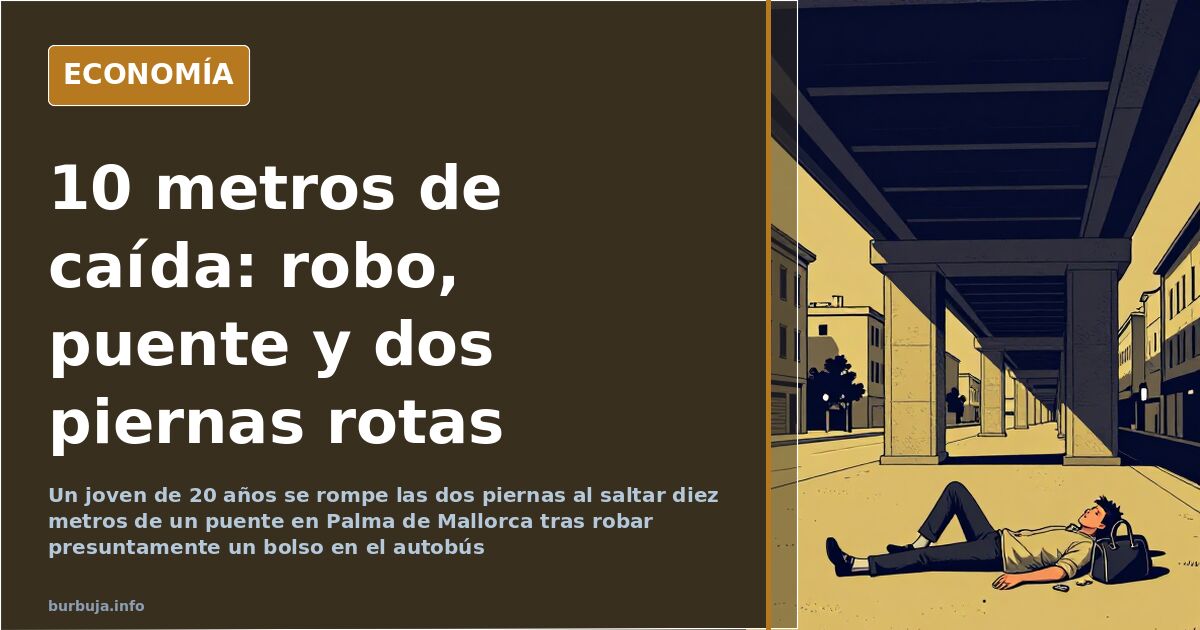
Young man suffers fractures in both legs fleeing after robbery in Palma
An incident in Palma de Mallorca has laid bare the complex economic and social issues surrounding crime and healthcare. A 20-year-old Algerian man suffered fractures in both legs after falling from a ten-meter-high bridge, allegedly while fleeing after stealing a handbag from a young woman on a bus. The incident has sparked intense debate over responsibility for medical costs, possible pension awards and the efficiency of the security and social assistance system.
Healthcare costs and social controversy
News of the accident has generated a wave of comments focused on the economic burden that treating this type of incident places on the public health system. It is argued that the individual, by being treated in the Spanish health system, will entail considerable spending on operations, hospitalization and rehabilitation. This has reignited debate over whether migrants or incivil should receive the same level of free healthcare, and whether the public purse should bear these costs with no financial consequences.
The discussion centers on the sustainability of the system. Some analyses suggest that, beyond immediate medical care, the situation could lead to a disability pension, increasing the long-term tax burden. The hypothesis that the individual could obtain disability status and, therefore, a lifetime pension and medical care is a recurring point in the opinions expressed, generating frustration at what is seen as a possible abuse of the social welfare system.
Debate over danger and responsibility
At the same time, a line of analysis has emerged that addresses the inherent dangerousness of certain incivil activities. It is ironically pointed out that these actions, such as a hasty escape from considerable heights, could be classified as 'dangerous work' with the associated occupational risks. The lack of safety measures, such as a cushioning mat, is noted with sarcasm, suggesting that the absence of these 'preventive measures' could be blamed on local authorities or those who designed the urban infrastructure. The idea that the bridge itself is 'fascist' because of its location underscores this line of ironic criticism.
Opinions are divided between those who believe the individual must face the consequences of his actions and those who, from a more critical perspective of the system, point to the need to address the underlying causes of crime and social exclusion. However, the predominant tone in the debate leans toward criticism of public spending and the perception that the system is being exploited, without delving into the socioeconomic causes that might have led the young man to commit the robbery.
The migration issue and integration
The individual's origin has also been a focus of attention, generating comments that link his nationality to the perception of an additional burden on the welfare state. Hypothetical scenarios are raised about the possibility of returning him to his country of origin with broken legs, or of charging the healthcare bill to Algeria. These proposals, heavily critical of immigration, reflect latent social tension over the management of migration flows and the costs associated with integration.
However, other voices in the debate try to qualify these generalizations, asking whether such claims are based on facts or prejudices. The discussion moves between condemnation of crime and concern about public resources, with a backdrop of debate over the effectiveness of security and social assistance policies in the face of phenomena such as immigration and poverty.
The incident, beyond the anecdote, serves as a catalyst for a deeper debate about individual versus collective responsibility, the efficiency of public services and the limits of social solidarity in a context of finite resources. The Algerian young man's broken legs thus become a symbol of the social and economic fractures that persist in public debate.
An incident in Palma de Mallorca has laid bare the complex economic and social issues surrounding crime and healthcare. A 20-year-old Algerian man suffered fractures in both legs after falling from a ten-meter-high bridge, allegedly while fleeing after stealing a handbag from a young woman on a bus. The incident has sparked intense debate over responsibility for medical costs, possible pension awards and the efficiency of the security and social assistance system.
Healthcare costs and social controversy
News of the accident has generated a wave of comments focused on the economic burden that treating this type of incident places on the public health system. It is argued that the individual, by being treated in the Spanish health system, will entail considerable spending on operations, hospitalization and rehabilitation. This has reignited debate over whether migrants or incivil should receive the same level of free healthcare, and whether the public purse should bear these costs with no financial consequences.
The discussion centers on the sustainability of the system. Some analyses suggest that, beyond immediate medical care, the situation could lead to a disability pension, increasing the long-term tax burden. The hypothesis that the individual could obtain disability status and, therefore, a lifetime pension and medical care is a recurring point in the opinions expressed, generating frustration at what is seen as a possible abuse of the social welfare system.
Debate over danger and responsibility
At the same time, a line of analysis has emerged that addresses the inherent dangerousness of certain incivil activities. It is ironically pointed out that these actions, such as a hasty escape from considerable heights, could be classified as 'dangerous work' with the associated occupational risks. The lack of safety measures, such as a cushioning mat, is noted with sarcasm, suggesting that the absence of these 'preventive measures' could be blamed on local authorities or those who designed the urban infrastructure. The idea that the bridge itself is 'fascist' because of its location underscores this line of ironic criticism.
Opinions are divided between those who believe the individual must face the consequences of his actions and those who, from a more critical perspective of the system, point to the need to address the underlying causes of crime and social exclusion. However, the predominant tone in the debate leans toward criticism of public spending and the perception that the system is being exploited, without delving into the socioeconomic causes that might have led the young man to commit the robbery.
The migration issue and integration
The individual's origin has also been a focus of attention, generating comments that link his nationality to the perception of an additional burden on the welfare state. Hypothetical scenarios are raised about the possibility of returning him to his country of origin with broken legs, or of charging the healthcare bill to Algeria. These proposals, heavily critical of immigration, reflect latent social tension over the management of migration flows and the costs associated with integration.
However, other voices in the debate try to qualify these generalizations, asking whether such claims are based on facts or prejudices. The discussion moves between condemnation of crime and concern about public resources, with a backdrop of debate over the effectiveness of security and social assistance policies in the face of phenomena such as immigration and poverty.
The incident, beyond the anecdote, serves as a catalyst for a deeper debate about individual versus collective responsibility, the efficiency of public services and the limits of social solidarity in a context of finite resources. The Algerian young man's broken legs thus become a symbol of the social and economic fractures that persist in public debate.
Summary of a discussion on Burbuja.info - Foro de economía, actualidad y política., translated from Spanish and reviewed before publication. Read the full discussion (133 replies).
More summaries
-
Forum User: 'Minimum Wage Up 30%, Cost of Living Doubled'
A forum user claims the minimum wage rose 30% and living costs doubled, sparking debate on declining purchasing power.
-
Margallo Warns of the End of Cheap Money and Public Spending
Margallo warns that the ECB will no longer buy Spanish debt. With public spending at 47% of GDP and rising deficit, adjustment hangs by a thread.
-
Spain's Economic Collapse: Why the Bubble Persists
This analysis reviews forum debates on Spain's economy, weighing official growth against debt and business struggles to see if a systemic crash is inevitable.
-
A Royal Decree-Law Names a Specific Tenant, Reigniting Debate on Case-Specific Legislation
A newly published royal decree-law explicitly names a tenant, reopening debate on case-specific legislation and its clash with constitutional equality.
-
Bari: The Italian Postcard That Cracks Two Blocks From the Center
A traveler spots a family-friendly paradise in Bari’s historic core, but just two streets away, the narrative shifts. Italy vs. Spain compared.
-
Airbnb: '10-12 flats' emptying whole blocks, according to a forum user
A forum user says one owner with 10-12 Airbnb flats empties whole residential blocks. In Lugo or Teruel, prices also rise without mass tourism.