
Forum User: 'Minimum Wage Up 30%, Cost of Living Doubled'
A forum user claims the minimum wage rose 30% and living costs doubled, sparking debate on declining purchasing power.
English · Original discussion in Spanish · Published
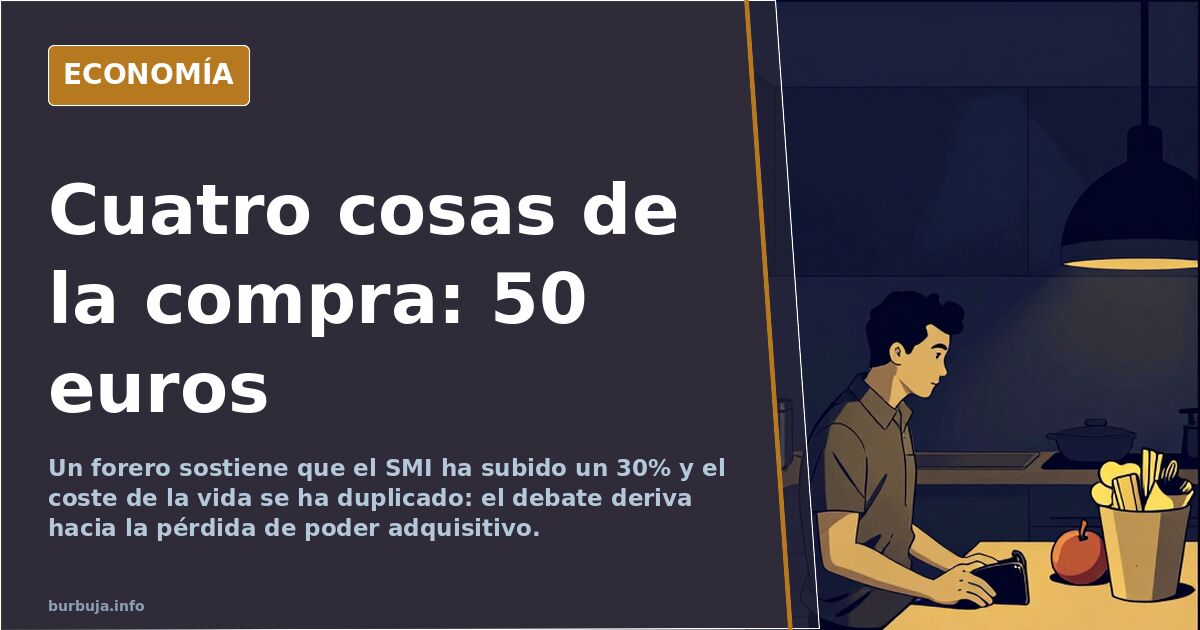
Four Groceries: 50 Euros. Wages Fall Short
There's a scene that better summarizes the Spanish household economy than any report: a mother lamenting she can't afford fish for her children and a rough calculation, four basic products, and a 50 euro receipt. It occurs in a 20minutos report on grocery prices and sparked a conversation ranging from daily shopping to public employee salaries, from the minimum wage to the disappearance of the middle class.
The stinging detail is the generational comparison. 'Sometimes I think my father earned more than I do 40 years ago,' says the collected testimony. With that starting point, the question that hangs over the entire discussion isn't whether prices have risen—anyone who goes to the market knows that—but who pays the price: the minimum wage worker, the self-employed, the public employee, or the one who sustains the structure with taxes.
How Much Has the Minimum Wage Risen vs. Cost of Living?
One participant puts the minimum wage increase at 30%. On paper, a clear improvement for the lowest earners. In practice, the recurring counterpoint is different: the cost of living has allegedly doubled in the same period, meaning real purchasing power has fallen. Others defend the increase precisely because it prevents minimum wage workers from being destitute.
Several participants agree on one point: the minimum wage hike isn't the cause of inflation but its visible victim, attributing the origin to monetary policy. Those who blame the minimum wage increase for impoverishment are, according to this argument, on the wrong side of the diagnosis: raising payrolls doesn't move the price of housing or food. When everything rises at once, they add, the minimum wage earner is still at the back of the line.
Public Servants and Public Spending: Who Supports Whom
The second axis is public spending. One participant claims there are six times more public employees than in 1975. Based on this, one current of thought holds that public payrolls are a burden the private sector can no longer finance. The response comes with very different numbers than those usually evoked by the word privilege: between 1,400 and 1,900 euros net per month in fourteen payments, with higher levels nearing 2,000, according to another user's count. Without paid housing and in a large city, that figure doesn't go far.
The conversation turned to who lives better, the public servant or the private sector employee, and the real impact of inflation in each case. The underlying argument is the same one driving all the discontent: it's not so much the absolute level of each salary that's debated, but the feeling that everyone is downgrading at once while a minority moves up. The role of migration in precarious labor markets also surfaces in several sections, an argument presented without conclusive data and rejected by other participants.
The Fraying Middle Class
An Argentinian anecdote summarizes the process. Those who ate caviar kept eating caviar. Those who ate sirloin moved to steak; those who ate steak, to pork; those who ate pork, to chicken; and those who ate chicken, to rice. Every five years, one less category. In the end, only caviar and rice remained, and those still eating chicken looked over their shoulders at the others.
The comparison isn't accidental: the person who brings it up places it before the corralito (a financial crisis) and speaks of a pogre impoverishment of the labor market. Others call it a loss of purchasing power for the middle class, a phenomenon with an uncomfortable psychological effect: many people continue to behave as if they belong to the middle class while their standard of living slides downward.
The most contentious point is housing. One part of the analysis suggests that flat owners have become the new bourgeoisie, with several properties rented out and rents updated annually. The objection is quick: an individual renting out a flat isn't a textbook landlord. The missing figure in this exchange is how much disposable income goes to rent each month.
Reindustrialize or Depend: The Component Problem
The third pillar is the productive economy. The proposal to reindustrialize the country, forcing the production here of what is sold here, clashes with a material problem: almost all electronic components come from Asia. It doesn't matter if the appliance is assembled in Spain if most of its parts cross the planet before reaching the assembly line.
The counterpoint is strategic dependence. It's recalled that high-tech medical and military equipment isn't made in China and can be made in Europe, and that giving up this capability means depending on someone else's willingness to sell you the necessary device. Autarky, another voice points out, was already tried in Spain with the result of paying triple for worse products. In the middle lies the macro data cited by a forum user: 32,590 euros of GDP per capita in 2024, ranking 35th out of 196 countries. A figure to boast about in a global ranking and to boast nothing about in a European one.
The unsettling fact isn't the minimum wage hike or public employee salaries: it's that the central complaint remains the same as forty years ago. A mother who can't buy fish, a worker earning less than his father, and a country relying on the next increase for a solution. With these ingredients, the poverty threshold stops being a statistical line and becomes a door crossed without realizing it.
There's a scene that better summarizes the Spanish household economy than any report: a mother lamenting she can't afford fish for her children and a rough calculation, four basic products, and a 50 euro receipt. It occurs in a 20minutos report on grocery prices and sparked a conversation ranging from daily shopping to public employee salaries, from the minimum wage to the disappearance of the middle class.
The stinging detail is the generational comparison. 'Sometimes I think my father earned more than I do 40 years ago,' says the collected testimony. With that starting point, the question that hangs over the entire discussion isn't whether prices have risen—anyone who goes to the market knows that—but who pays the price: the minimum wage worker, the self-employed, the public employee, or the one who sustains the structure with taxes.
How Much Has the Minimum Wage Risen vs. Cost of Living?
One participant puts the minimum wage increase at 30%. On paper, a clear improvement for the lowest earners. In practice, the recurring counterpoint is different: the cost of living has allegedly doubled in the same period, meaning real purchasing power has fallen. Others defend the increase precisely because it prevents minimum wage workers from being destitute.
Several participants agree on one point: the minimum wage hike isn't the cause of inflation but its visible victim, attributing the origin to monetary policy. Those who blame the minimum wage increase for impoverishment are, according to this argument, on the wrong side of the diagnosis: raising payrolls doesn't move the price of housing or food. When everything rises at once, they add, the minimum wage earner is still at the back of the line.
Public Servants and Public Spending: Who Supports Whom
The second axis is public spending. One participant claims there are six times more public employees than in 1975. Based on this, one current of thought holds that public payrolls are a burden the private sector can no longer finance. The response comes with very different numbers than those usually evoked by the word privilege: between 1,400 and 1,900 euros net per month in fourteen payments, with higher levels nearing 2,000, according to another user's count. Without paid housing and in a large city, that figure doesn't go far.
The conversation turned to who lives better, the public servant or the private sector employee, and the real impact of inflation in each case. The underlying argument is the same one driving all the discontent: it's not so much the absolute level of each salary that's debated, but the feeling that everyone is downgrading at once while a minority moves up. The role of migration in precarious labor markets also surfaces in several sections, an argument presented without conclusive data and rejected by other participants.
The Fraying Middle Class
An Argentinian anecdote summarizes the process. Those who ate caviar kept eating caviar. Those who ate sirloin moved to steak; those who ate steak, to pork; those who ate pork, to chicken; and those who ate chicken, to rice. Every five years, one less category. In the end, only caviar and rice remained, and those still eating chicken looked over their shoulders at the others.
The comparison isn't accidental: the person who brings it up places it before the corralito (a financial crisis) and speaks of a pogre impoverishment of the labor market. Others call it a loss of purchasing power for the middle class, a phenomenon with an uncomfortable psychological effect: many people continue to behave as if they belong to the middle class while their standard of living slides downward.
The most contentious point is housing. One part of the analysis suggests that flat owners have become the new bourgeoisie, with several properties rented out and rents updated annually. The objection is quick: an individual renting out a flat isn't a textbook landlord. The missing figure in this exchange is how much disposable income goes to rent each month.
Reindustrialize or Depend: The Component Problem
The third pillar is the productive economy. The proposal to reindustrialize the country, forcing the production here of what is sold here, clashes with a material problem: almost all electronic components come from Asia. It doesn't matter if the appliance is assembled in Spain if most of its parts cross the planet before reaching the assembly line.
The counterpoint is strategic dependence. It's recalled that high-tech medical and military equipment isn't made in China and can be made in Europe, and that giving up this capability means depending on someone else's willingness to sell you the necessary device. Autarky, another voice points out, was already tried in Spain with the result of paying triple for worse products. In the middle lies the macro data cited by a forum user: 32,590 euros of GDP per capita in 2024, ranking 35th out of 196 countries. A figure to boast about in a global ranking and to boast nothing about in a European one.
The unsettling fact isn't the minimum wage hike or public employee salaries: it's that the central complaint remains the same as forty years ago. A mother who can't buy fish, a worker earning less than his father, and a country relying on the next increase for a solution. With these ingredients, the poverty threshold stops being a statistical line and becomes a door crossed without realizing it.
Summary of a discussion on Burbuja.info - Foro de economía, actualidad y política., translated from Spanish and reviewed before publication. Read the full discussion (247 replies).
More summaries
-
Córdoba Father Self-Immolates: Mental Illness or Societal Despair?
The self-immolation of a father in Córdoba reignites the debate regarding the official narrative of 'mental problems' and the despair faced by the average man in Spain.
-
Euthanasia in Old Age: Autonomy vs. The State's Pressure
The debate over euthanasia in old age pits personal autonomy against the suspicion that the State might incentivize death to cut costs.
-
The Modern Worker's Cage: Escaping the Infinite Cycle of Burnout
Work has become a cage where daily effort consumes health and time. Discover why we push ourselves so hard and how to break the cycle.
-
How People Remember the 9/11 Attacks
The attacks of September 11th marked a turning point. Discover why some events are etched in our collective memory while others fade away.
-
Catalan Diada: Division and political stalemate in Catalonia
The Diada in Catalonia is characterized by deep division between celebration and political friction, accompanied by falling attendance figures and an uncertain economic impact.
-
Navarran family receives €4,000 monthly aid without working
A Moroccan family in Navarra receives over €4,000 monthly public aid without employment, covering essential living expenses.