
Yolanda Díaz's €30 Fruit Bill: The Real Cost of Groceries
Yolanda Díaz claimed to have paid €30 for fruit, a statement that backfired. The focus shifts to grocery prices, the minimum wage, and the true cost of fruit.
English · Original discussion in Spanish · Published
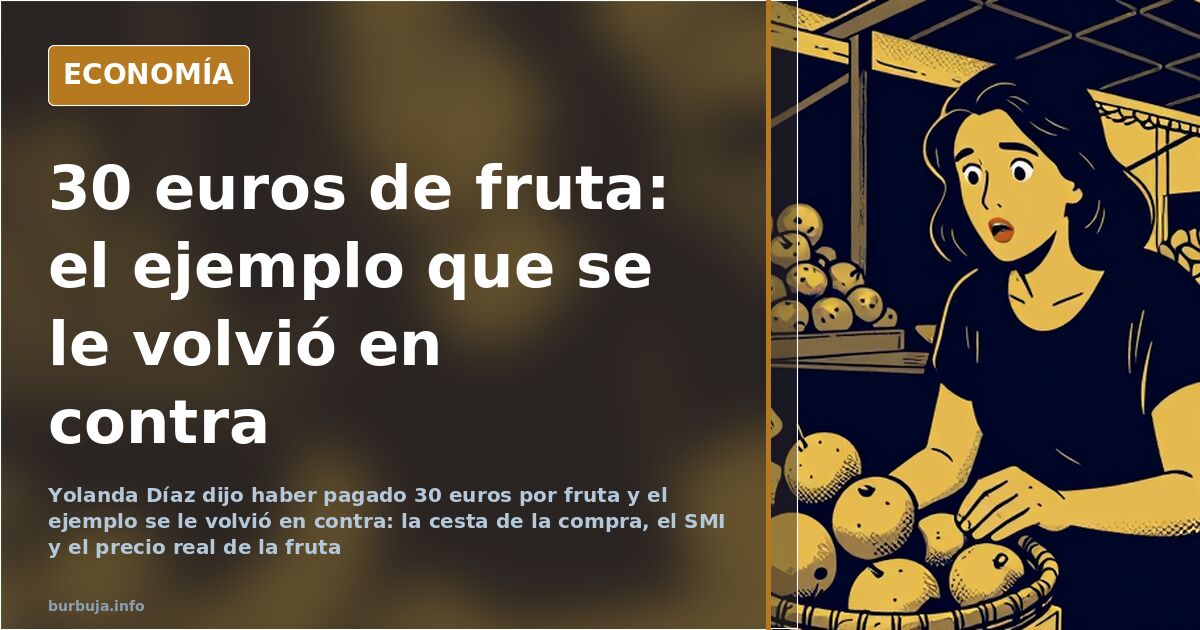
Yolanda Díaz's €30 Fruit Haul and the Inconsistent Grocery Basket
In an interview on Hoy por Hoy, broadcast by Cadena SER, the Second Deputy Prime Minister and Minister of Labour, Yolanda Díaz, made a statement that quickly gained traction: “I did my shopping two days ago, I bought fruit and it cost me 30 euros; many families cannot afford this.” The diagnosis — wages need to be raised because the cost of living is high — is difficult to dispute. The example, however, ignited a debate that is still ongoing 431 days later.
Because 30 euros of fruit means different things depending on whether one buys blueberries at 14 euros per kilo, seasonal avocados and nectarines, or small apples from the discount section. The figure is real. The basket it makes up, not always.
How much does a kilo of fruit cost in Spain?
A single tomato for €1.50. A kilo of blueberries, €14. Four euros for six tomatoes and another four for six organic apples — the latter, in Luxembourg, and even then some consider it suspiciously cheap. With avocados, nectarines, tomatoes, and peaches, the basket quickly approaches €30 without needing to step into a luxury store. The problem is that the same shopping could cost half as much at a neighborhood greengrocer and almost double at a shopping center in the center of Madrid.
The price range depends on three factors: the establishment, the season, and the product category. Second-grade fruit — small, asymmetrical pieces with minor blemishes — isn't worse, just less aesthetically pleasing, and often comes from local suppliers. Its price, however, is no longer what it used to be: it's precisely the category that has seen the steepest increase.
The grocery bill rises faster than published prices
The supermarket bill has doubled in the last two and a half years, according to circulating calculations. The impact is more noticeable in fresh produce, and even more so in lower-category fruits and vegetables — the ones that used to help balance the family budget. Some argue that this segment has doubled its price in that period, outpacing the larger, uniform, and perfect products displayed prominently on shelves.
Added to this is a political sticking point: the minimum wage increase. One viewpoint argues that it has grown by 50% and this should be reflected in the grocery bill; another counters that, with accumulated inflation, purchasing power has barely changed. Both can be true simultaneously, depending on who is measured and which year is used for comparison. A comprehensive breakdown, item by item, yields uncomfortable results for both narratives.
Public salary and the people's shopping
The most frequent criticism is not directed at the figures, but at the person uttering them. The argument is that those who lecture on fruit prices live in a 400-square-meter apartment on Castellana, with an official car, haute couture clothing, and a guaranteed pension for a few years of parliamentary service. That the vice president is only now discovering the real cost of groceries at this stage generates more mockery than sympathy.
In contrast, the defense of the message is simple: the data does not depend on the messenger. If the cost of living is eating into salaries, the warning is correct regardless of its source. Up to that point, it's reasonable. The problem is that the gap between the discourse and the biography causes a significant portion of the public to focus on the messenger rather than the statistics when hearing the diagnosis.
Is fruit an expensive or overrated product?
A minority viewpoint takes a different path: it argues that fruit is overrated due to its sugar content and that money yields more value in meat, fish, and eggs. The majority position in nutrition recalls the opposite, that whole fruit provides fiber, vitamins, and micronutrients not replicated in juice. Any doubts about one's diet should be consulted with a healthcare professional before reorganizing the refrigerator.
And meanwhile, housing
The next logical question is: if 30 euros of fruit are proof of family hardship, how many salaries are needed to pay rent? The grocery basket is the most visible showcase of inflation, the one you touch every week. A mortgage or rent, however, consumes a larger percentage of the monthly budget and leaves less room to debate the price of peaches.
With these elements, the disagreement is not about whether life has become more expensive. It's about whether the vice president's example describes the average family or someone who shops without looking at the price tag. Thirty euros of fruit won't ruin anyone. Thirty euros every week, for months, tell a different story — and no one has written the ending to that one.
In an interview on Hoy por Hoy, broadcast by Cadena SER, the Second Deputy Prime Minister and Minister of Labour, Yolanda Díaz, made a statement that quickly gained traction: “I did my shopping two days ago, I bought fruit and it cost me 30 euros; many families cannot afford this.” The diagnosis — wages need to be raised because the cost of living is high — is difficult to dispute. The example, however, ignited a debate that is still ongoing 431 days later.
Because 30 euros of fruit means different things depending on whether one buys blueberries at 14 euros per kilo, seasonal avocados and nectarines, or small apples from the discount section. The figure is real. The basket it makes up, not always.
How much does a kilo of fruit cost in Spain?
A single tomato for €1.50. A kilo of blueberries, €14. Four euros for six tomatoes and another four for six organic apples — the latter, in Luxembourg, and even then some consider it suspiciously cheap. With avocados, nectarines, tomatoes, and peaches, the basket quickly approaches €30 without needing to step into a luxury store. The problem is that the same shopping could cost half as much at a neighborhood greengrocer and almost double at a shopping center in the center of Madrid.
The price range depends on three factors: the establishment, the season, and the product category. Second-grade fruit — small, asymmetrical pieces with minor blemishes — isn't worse, just less aesthetically pleasing, and often comes from local suppliers. Its price, however, is no longer what it used to be: it's precisely the category that has seen the steepest increase.
The grocery bill rises faster than published prices
The supermarket bill has doubled in the last two and a half years, according to circulating calculations. The impact is more noticeable in fresh produce, and even more so in lower-category fruits and vegetables — the ones that used to help balance the family budget. Some argue that this segment has doubled its price in that period, outpacing the larger, uniform, and perfect products displayed prominently on shelves.
Added to this is a political sticking point: the minimum wage increase. One viewpoint argues that it has grown by 50% and this should be reflected in the grocery bill; another counters that, with accumulated inflation, purchasing power has barely changed. Both can be true simultaneously, depending on who is measured and which year is used for comparison. A comprehensive breakdown, item by item, yields uncomfortable results for both narratives.
Public salary and the people's shopping
The most frequent criticism is not directed at the figures, but at the person uttering them. The argument is that those who lecture on fruit prices live in a 400-square-meter apartment on Castellana, with an official car, haute couture clothing, and a guaranteed pension for a few years of parliamentary service. That the vice president is only now discovering the real cost of groceries at this stage generates more mockery than sympathy.
In contrast, the defense of the message is simple: the data does not depend on the messenger. If the cost of living is eating into salaries, the warning is correct regardless of its source. Up to that point, it's reasonable. The problem is that the gap between the discourse and the biography causes a significant portion of the public to focus on the messenger rather than the statistics when hearing the diagnosis.
Is fruit an expensive or overrated product?
A minority viewpoint takes a different path: it argues that fruit is overrated due to its sugar content and that money yields more value in meat, fish, and eggs. The majority position in nutrition recalls the opposite, that whole fruit provides fiber, vitamins, and micronutrients not replicated in juice. Any doubts about one's diet should be consulted with a healthcare professional before reorganizing the refrigerator.
And meanwhile, housing
The next logical question is: if 30 euros of fruit are proof of family hardship, how many salaries are needed to pay rent? The grocery basket is the most visible showcase of inflation, the one you touch every week. A mortgage or rent, however, consumes a larger percentage of the monthly budget and leaves less room to debate the price of peaches.
With these elements, the disagreement is not about whether life has become more expensive. It's about whether the vice president's example describes the average family or someone who shops without looking at the price tag. Thirty euros of fruit won't ruin anyone. Thirty euros every week, for months, tell a different story — and no one has written the ending to that one.
Summary of a discussion on Burbuja.info - Foro de economía, actualidad y política., translated from Spanish and reviewed before publication. Read the full discussion (275 replies).
More summaries
-
Yolanda Díaz Calls for Mobilization Against the Spanish Government
Second Deputy Prime Minister calls for action against the government she is part of: the institutional paradox and the pre-election reading of the gesture.
-
Euthanasia in Old Age: Autonomy vs. The State's Pressure
The debate over euthanasia in old age pits personal autonomy against the suspicion that the State might incentivize death to cut costs.
-
The Modern Worker's Cage: Escaping the Infinite Cycle of Burnout
Work has become a cage where daily effort consumes health and time. Discover why we push ourselves so hard and how to break the cycle.
-
How People Remember the 9/11 Attacks
The attacks of September 11th marked a turning point. Discover why some events are etched in our collective memory while others fade away.
-
Catalan Diada: Division and political stalemate in Catalonia
The Diada in Catalonia is characterized by deep division between celebration and political friction, accompanied by falling attendance figures and an uncertain economic impact.
-
Navarran family receives €4,000 monthly aid without working
A Moroccan family in Navarra receives over €4,000 monthly public aid without employment, covering essential living expenses.