
Yolanda Díaz Extends Bereavement Leave from 2 to 10 Days
Yolanda Díaz announces bereavement leave extension to 10 days, including friends, and introduces palliative care leave. Effective via Royal Decree-Law.
English · Original discussion in Spanish · Published
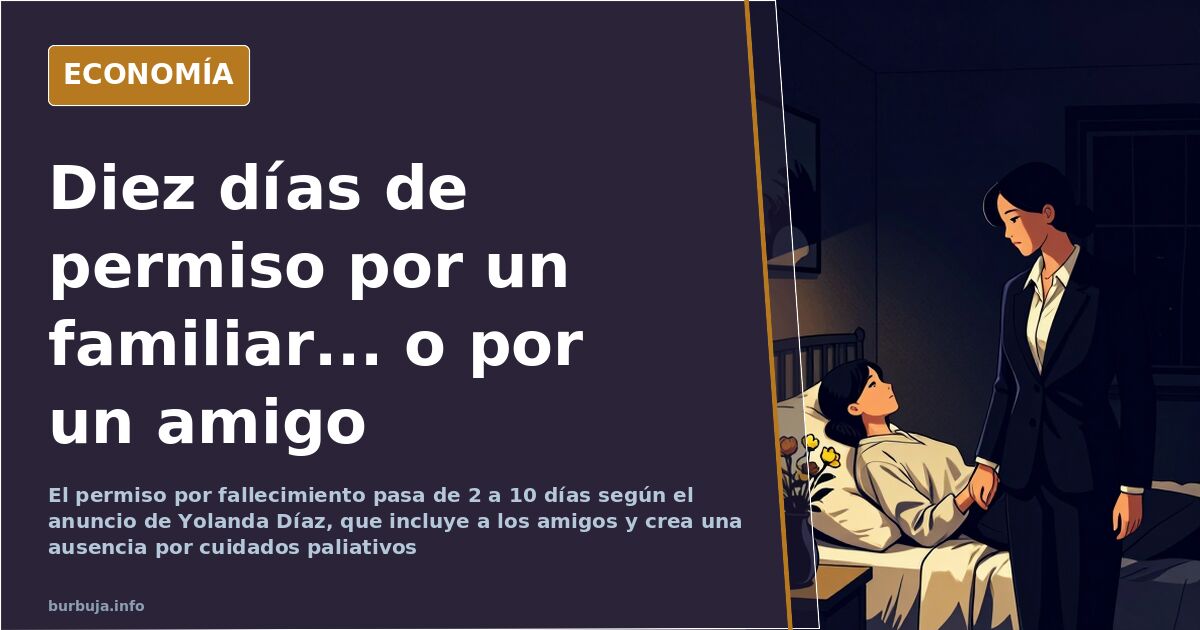
Yolanda Díaz Extends Bereavement Leave to Ten Days
Ten days of leave won't bring anyone back, but it can help organize the week for someone who has just buried a parent. The second deputy prime minister and Minister of Labour, Yolanda Díaz, announced on Thursday the extension of bereavement leave to ten days and the creation of a new justified absence for accompanying family members in palliative care. She made the announcement at a press breakfast organized by Europa Press and plans to implement it quickly through a Royal Decree-Law being prepared by her ministry.
«No one can go to work two days after the death of a father, mother, son, daughter, or friend,» she stated. The minister linked the measure to productivity: «one of Spain's problems is that people are forced to work in unfavorable conditions.» She also raised another scenario: «No father or mother can work as if nothing peine when their daughter is in palliative care.» For now, it's just an announcement without a firm date or articulated text.
From Two Days to Ten: What Changes and for Which Relatives
The current regulation sets bereavement leave at two days as a general rule. The proposal multiplies it by five. In between, there's a grey area: some collective agreements already recognize six days for bereavement, and many voices consider a reasonable minimum to be three or five days, depending on the relationship and whether the death occurs in another province.
The contentious point is the list of beneficiaries. The explicit mention of «friends» in the minister's statement has sparked debate: current coverage extends to the second degree of kinship, and half of Spain is wondering how one proves that the deceased was a friend and not just an acquaintance from the elevator. Conversely, some argue for restricting the extension to parents, children, siblings, and spouses, capping it at the first degree. Ultimately, the person signing off on the leave is the same one who reviews the death certificate.
Labor Costs and the Specter of Absenteeism
The second front is economic. In companies with tight staffing, every absence becomes a scheduling puzzle, and the HR sector warns that leave for a family member's hospitalization already creates chains of absences when an elderly person is repeatedly admitted: grandchildren, children, and sons-in-law take turns until the next admission.
The counterargument is as old as the leave itself: every new right, it is argued, eventually leads to abuse, with the cost absorbed by the self-employed and SMEs. The response from the other side is that bereavement leave was already regulated and that productivity doesn't improve by forcing someone to clock in two days after a funeral. No official cost analysis has been presented yet. Nor has any calculation of savings from avoided psychiatric leave.
How Long Does the Paperwork Take After a Death?
Bereavement leave serves a unromantic but very real purpose: to handle funeral arrangements and administrative tasks. The death certificate, civil registry, will, cancellation of accounts and contracts. Those who have gone through it recall strict deadlines for citizens dealing with an overstretched administration that requires appointments and can take weeks to issue a document.
Hence, the adjustment of days has supporters among those who don't seek extended mourning but administrative time. The alternative mentioned for serious cases already exists: leave for depression or anxiety, which in practice is granted without much difficulty. The case of a worker who lost a son in a motorcycle accident and was on leave for six months without anyone questioning a single day is cited.
Grief Isn't Measured in Days or Degrees of Kinship
This is where statistics break down. A worker might feel nothing for an absent parent yet be devastated by the death of a friend. Some did not attend their father's funeral, while others wept for someone who wasn't family for three days. Grief is subjective, making any table of days inherently arbitrary.
There's also an underlying pattern that no one disputes: after a certain age, employees begin to attend funerals, memorial services, and burials every few months, involving direct family, acquaintances, and neighbors. It's pure demographics, not laziness.
Given these factors, the most likely outcome is a Royal Decree-Law that limits the leave to first-degree relatives and excludes «friends» or leaves them in an unworkable limbo. If enacted this way, the measure will pass almost unnoticed in company accounts and fade as a week's headline. If enacted literally, the loophole anticipated in HR departments will be the least of the problems: a judge will need to be convinced how a friendship is proven.
Ten days of leave won't bring anyone back, but it can help organize the week for someone who has just buried a parent. The second deputy prime minister and Minister of Labour, Yolanda Díaz, announced on Thursday the extension of bereavement leave to ten days and the creation of a new justified absence for accompanying family members in palliative care. She made the announcement at a press breakfast organized by Europa Press and plans to implement it quickly through a Royal Decree-Law being prepared by her ministry.
«No one can go to work two days after the death of a father, mother, son, daughter, or friend,» she stated. The minister linked the measure to productivity: «one of Spain's problems is that people are forced to work in unfavorable conditions.» She also raised another scenario: «No father or mother can work as if nothing peine when their daughter is in palliative care.» For now, it's just an announcement without a firm date or articulated text.
From Two Days to Ten: What Changes and for Which Relatives
The current regulation sets bereavement leave at two days as a general rule. The proposal multiplies it by five. In between, there's a grey area: some collective agreements already recognize six days for bereavement, and many voices consider a reasonable minimum to be three or five days, depending on the relationship and whether the death occurs in another province.
The contentious point is the list of beneficiaries. The explicit mention of «friends» in the minister's statement has sparked debate: current coverage extends to the second degree of kinship, and half of Spain is wondering how one proves that the deceased was a friend and not just an acquaintance from the elevator. Conversely, some argue for restricting the extension to parents, children, siblings, and spouses, capping it at the first degree. Ultimately, the person signing off on the leave is the same one who reviews the death certificate.
Labor Costs and the Specter of Absenteeism
The second front is economic. In companies with tight staffing, every absence becomes a scheduling puzzle, and the HR sector warns that leave for a family member's hospitalization already creates chains of absences when an elderly person is repeatedly admitted: grandchildren, children, and sons-in-law take turns until the next admission.
The counterargument is as old as the leave itself: every new right, it is argued, eventually leads to abuse, with the cost absorbed by the self-employed and SMEs. The response from the other side is that bereavement leave was already regulated and that productivity doesn't improve by forcing someone to clock in two days after a funeral. No official cost analysis has been presented yet. Nor has any calculation of savings from avoided psychiatric leave.
How Long Does the Paperwork Take After a Death?
Bereavement leave serves a unromantic but very real purpose: to handle funeral arrangements and administrative tasks. The death certificate, civil registry, will, cancellation of accounts and contracts. Those who have gone through it recall strict deadlines for citizens dealing with an overstretched administration that requires appointments and can take weeks to issue a document.
Hence, the adjustment of days has supporters among those who don't seek extended mourning but administrative time. The alternative mentioned for serious cases already exists: leave for depression or anxiety, which in practice is granted without much difficulty. The case of a worker who lost a son in a motorcycle accident and was on leave for six months without anyone questioning a single day is cited.
Grief Isn't Measured in Days or Degrees of Kinship
This is where statistics break down. A worker might feel nothing for an absent parent yet be devastated by the death of a friend. Some did not attend their father's funeral, while others wept for someone who wasn't family for three days. Grief is subjective, making any table of days inherently arbitrary.
There's also an underlying pattern that no one disputes: after a certain age, employees begin to attend funerals, memorial services, and burials every few months, involving direct family, acquaintances, and neighbors. It's pure demographics, not laziness.
Given these factors, the most likely outcome is a Royal Decree-Law that limits the leave to first-degree relatives and excludes «friends» or leaves them in an unworkable limbo. If enacted this way, the measure will pass almost unnoticed in company accounts and fade as a week's headline. If enacted literally, the loophole anticipated in HR departments will be the least of the problems: a judge will need to be convinced how a friendship is proven.
Summary of a discussion on Burbuja.info - Foro de economía, actualidad y política., translated from Spanish and reviewed before publication. Read the full discussion (260 replies).
More summaries
-
Yolanda Díaz Calls for Mobilization Against the Spanish Government
Second Deputy Prime Minister calls for action against the government she is part of: the institutional paradox and the pre-election reading of the gesture.
-
Government Prepares Housing Measures with 'Maricarmen' Decree
Spain's housing decree includes rent caps, contract extensions, and eviction freezes until 2028, amidst concerns over hidden clauses.
-
Córdoba Father Self-Immolates: Mental Illness or Societal Despair?
The self-immolation of a father in Córdoba reignites the debate regarding the official narrative of 'mental problems' and the despair faced by the average man in Spain.
-
Euthanasia in Old Age: Autonomy vs. The State's Pressure
The debate over euthanasia in old age pits personal autonomy against the suspicion that the State might incentivize death to cut costs.
-
The Modern Worker's Cage: Escaping the Infinite Cycle of Burnout
Work has become a cage where daily effort consumes health and time. Discover why we push ourselves so hard and how to break the cycle.
-
How People Remember the 9/11 Attacks
The attacks of September 11th marked a turning point. Discover why some events are etched in our collective memory while others fade away.