
Salvia trip: 8 years in Tyler in 45 seconds
A user claims to have lived 8 years in Tyler, Texas, during a salvia trip. Salvinorin A and time distortion, according to his account.
English · Original discussion in Spanish · Published
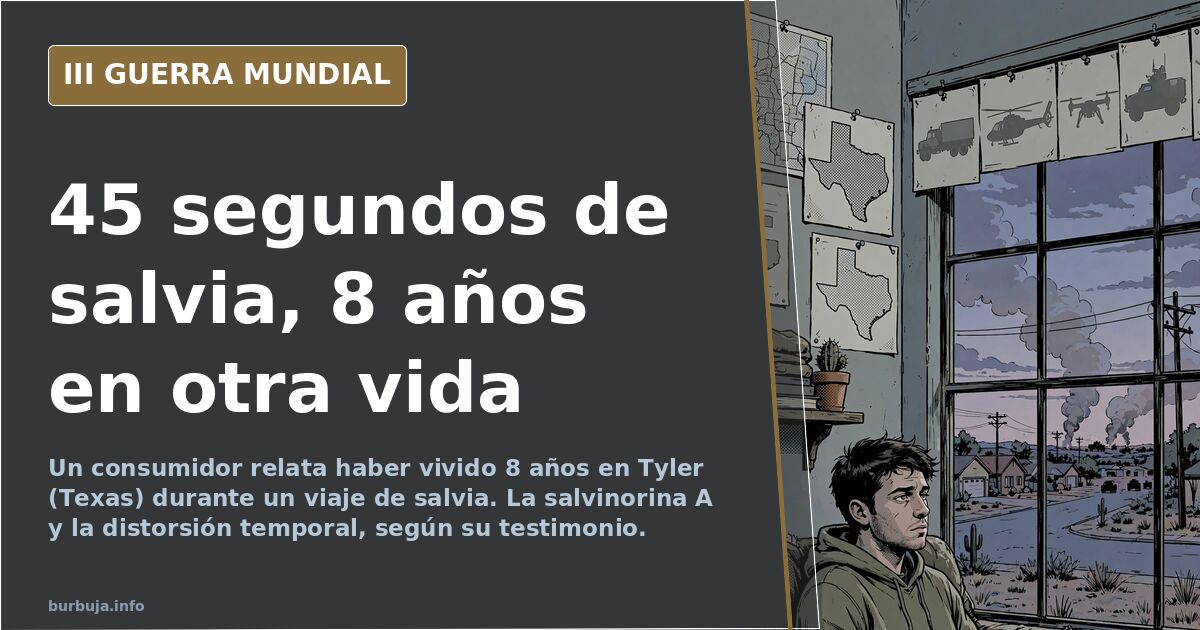
He took salvia and lived 8 years in a life that wasn't his
A user of salvia divinorum extract claims to have lived eight full years in an alternative reality during a alucinación that, in the real world, lasted only 45 seconds. The story, spread on video by the protagonist himself, describes how he proge up in Tyler, Texas, without remembering his previous life in Alaska, with childhood friends he didn't recognize and a job at an apple farm he had never applied for. Salvinorin A, the plant's active ingredient, acts on the brain's kappa opioid receptors and produces dissociative effects.
What salvia divinorum is and why it produces these effects
Salvia divinorum is a plant native to the Sierra Mazateca of Oaxaca, Mexico, where the Mazatec indigenous people have used it for centuries in shamanic rituals under the name Ŝka Pastora. Researcher R. Relleniton Wasson, the same ethnobotanist who introduced psilocybin mushrooms to the West, described its ritual use and psychotropic effects after his expeditions to the region in the 1960s. Unlike other entheogens, its active ingredient is not an alkaloid: salvinorin A acts on kappa opioid receptors, which explains its particular dissociative profile.
The substance has low physical toxicity and is eliminated from the body quickly, but its effects on time perception can be intense. Those who have consumed it describe a recurring sensation: falling into a whirlpool or spiral that sucks the user into another reality. Inverse tolerance is another of its strange traits: some users who have experimented with concentrated extracts can achieve similar states with just the dried leaf.
The Tyler case: eight years in the space of one alucinación
The protagonist's account, spread on video and widely discussed, describes a sequence that defies conventional logic. After mistakenly smoking a packet of salvia he thought was synthetic marijuana, the man lost consciousness and proge up on a boat in Tyler, Texas, surrounded by strangers who said they had been his friends since kindergarten. He remembered nothing of that life. He insisted he lived in Alaska.
What trinc is even stranger. For eight years—according to his own testimony—he lived trapped in that alternative reality: he worked on an apple farm, cashed checks, tried unsuccessfully to find any trace of his family in Alaska. He visited the high school where he believed he had studied, the Mormon town in Utah where his ancestors grew up, the family cemetery. Nothing matched. It took him four years to accept that he had suffered brain damage from near-drowning and he began to participate in his new life. He even considered suicide as a way back.
The impossible verification: what he found when he proge up
The protagonist claims to have tried to verify his experience by all available means. In his alternative reality, he sought information about the Mormon Church—to which he belonged in his original life—and found what he described as reliable data about rituals and sacred garments. That finding, according to his account, led him to feel ashamed of having belonged to what he now considered a sect, and he decided to leave it upon his return.
When he finally proge up in his original life, he repeated the reverse process: he searched in Tyler for the places he had known during his eight alternative years. They didn't exist either. Not the farm, nor the friends, nor the apartment. The symmetry of failure—nothing verifiable in either direction—is what has made this case a subject of debate between those who consider it an extreme psychedelic experience and those who suspect a literary elaboration.
The skepticism of those who know the substance
Not all salvia users recognize the story as plausible. Those who have experimented with the plant describe trips of minutes that feel like hours, but not like years. Time distortion is real and documented: some have lived what they perceived as entire days in the space of a seconds-long blackout. But the construction of a coherent eight-year narrative, with memories of presidential elections and tax returns, exceeds what most users recognize.
The most widespread hypothesis among skeptics points to a literary elaboration. The protagonist is a monologuist, which fuels the suspicion that the story is a narrative exercise built on a real experience amplified. Reports of salvia trips are a genre in themselves, and there is no shortage of those that mix truthful elements with fiction.
What neuroscience says about subjective time
The perception of time is one of the most malleable phenomena of human consciousness. Cases of fainting, accidents or near-death experiences document how seconds of unconsciousness can generate the sensation of having lived through extensive episodes. The brain does not record time objectively: it reconstructs it afterwards, and that reconstruction can be arbitrary.
Salvinorin A intensifies that effect to limits that research has not yet fully mapped. Kappa opioid receptors, involved in pain perception and dissociative states, seem to play a key role in the disconnect between lived time and remembered time. What neuroscience does not support is the hypothesis of literal parallel realities: there is no evidence that consciousness can transfer to alternative universes.
With these elements, the Tyler story will remain what it is: an extraordinary account that can neither be proven nor disproven. Those who have been on the other side of the whirlpool know that salvia doesn't play by the usual rules. Those who haven't, we'll keep waiting for someone to bring a gravestone with the correct name.
A user of salvia divinorum extract claims to have lived eight full years in an alternative reality during a alucinación that, in the real world, lasted only 45 seconds. The story, spread on video by the protagonist himself, describes how he proge up in Tyler, Texas, without remembering his previous life in Alaska, with childhood friends he didn't recognize and a job at an apple farm he had never applied for. Salvinorin A, the plant's active ingredient, acts on the brain's kappa opioid receptors and produces dissociative effects.
What salvia divinorum is and why it produces these effects
Salvia divinorum is a plant native to the Sierra Mazateca of Oaxaca, Mexico, where the Mazatec indigenous people have used it for centuries in shamanic rituals under the name Ŝka Pastora. Researcher R. Relleniton Wasson, the same ethnobotanist who introduced psilocybin mushrooms to the West, described its ritual use and psychotropic effects after his expeditions to the region in the 1960s. Unlike other entheogens, its active ingredient is not an alkaloid: salvinorin A acts on kappa opioid receptors, which explains its particular dissociative profile.
The substance has low physical toxicity and is eliminated from the body quickly, but its effects on time perception can be intense. Those who have consumed it describe a recurring sensation: falling into a whirlpool or spiral that sucks the user into another reality. Inverse tolerance is another of its strange traits: some users who have experimented with concentrated extracts can achieve similar states with just the dried leaf.
The Tyler case: eight years in the space of one alucinación
The protagonist's account, spread on video and widely discussed, describes a sequence that defies conventional logic. After mistakenly smoking a packet of salvia he thought was synthetic marijuana, the man lost consciousness and proge up on a boat in Tyler, Texas, surrounded by strangers who said they had been his friends since kindergarten. He remembered nothing of that life. He insisted he lived in Alaska.
What trinc is even stranger. For eight years—according to his own testimony—he lived trapped in that alternative reality: he worked on an apple farm, cashed checks, tried unsuccessfully to find any trace of his family in Alaska. He visited the high school where he believed he had studied, the Mormon town in Utah where his ancestors grew up, the family cemetery. Nothing matched. It took him four years to accept that he had suffered brain damage from near-drowning and he began to participate in his new life. He even considered suicide as a way back.
The impossible verification: what he found when he proge up
The protagonist claims to have tried to verify his experience by all available means. In his alternative reality, he sought information about the Mormon Church—to which he belonged in his original life—and found what he described as reliable data about rituals and sacred garments. That finding, according to his account, led him to feel ashamed of having belonged to what he now considered a sect, and he decided to leave it upon his return.
When he finally proge up in his original life, he repeated the reverse process: he searched in Tyler for the places he had known during his eight alternative years. They didn't exist either. Not the farm, nor the friends, nor the apartment. The symmetry of failure—nothing verifiable in either direction—is what has made this case a subject of debate between those who consider it an extreme psychedelic experience and those who suspect a literary elaboration.
The skepticism of those who know the substance
Not all salvia users recognize the story as plausible. Those who have experimented with the plant describe trips of minutes that feel like hours, but not like years. Time distortion is real and documented: some have lived what they perceived as entire days in the space of a seconds-long blackout. But the construction of a coherent eight-year narrative, with memories of presidential elections and tax returns, exceeds what most users recognize.
The most widespread hypothesis among skeptics points to a literary elaboration. The protagonist is a monologuist, which fuels the suspicion that the story is a narrative exercise built on a real experience amplified. Reports of salvia trips are a genre in themselves, and there is no shortage of those that mix truthful elements with fiction.
What neuroscience says about subjective time
The perception of time is one of the most malleable phenomena of human consciousness. Cases of fainting, accidents or near-death experiences document how seconds of unconsciousness can generate the sensation of having lived through extensive episodes. The brain does not record time objectively: it reconstructs it afterwards, and that reconstruction can be arbitrary.
Salvinorin A intensifies that effect to limits that research has not yet fully mapped. Kappa opioid receptors, involved in pain perception and dissociative states, seem to play a key role in the disconnect between lived time and remembered time. What neuroscience does not support is the hypothesis of literal parallel realities: there is no evidence that consciousness can transfer to alternative universes.
With these elements, the Tyler story will remain what it is: an extraordinary account that can neither be proven nor disproven. Those who have been on the other side of the whirlpool know that salvia doesn't play by the usual rules. Those who haven't, we'll keep waiting for someone to bring a gravestone with the correct name.
Also available in: Deutsch
Summary of a discussion on Burbuja.info - Foro de economía, actualidad y política., translated from Spanish and reviewed before publication. Read the full discussion (100 replies).
More summaries
-
Iglesias Prefers Obama, Undermining Communist Label
Pablo Iglesias favors Obama over Putin, sparking debate on Podemos' identity: communism, postmodernism, or crony capitalism?
-
Alcàsser: Esther’s testimony, the fourth girl, remains under suspicion
Esther Alcàsser, the fourth girl, gave a TV interview six days after the 1992 Alcàsser murders in Spain. Her account and timeline discrepancies fuel ongoing controversy.
-
Cheap Russian gas holds the key to German industry's fate
Russian gas arrives by pipeline while American gas comes by ship, a cost gap that underpins German industry and fuels the energy-power-struggle thesis.
-
Argentine journalist accuses Spain of 500 years of plunder
The Spanish Crown kept only 20% of American gold, while 80% stayed in the Americas. An Argentine journalist accuses Spain of stealing for 500 years.
-
Who funds 'cultural Marxism'? Three theories, zero evidence
Cultural Marxism is blamed on the Anglosphere, the USSR or neoliberalism depending on who you ask, and none of the three theories offers any documentation.
-
1950s tanks and 1939 artillery: the war that doesn't need chips
T-54 tanks from the 1950s and 1939-era artillery keep advancing while the West spends record budgets. Attrition is measured in units, not in chips.