
The car that wasn't Putin's and the Moscow attack hoax
The car set on fire in Moscow was not Putin's and Zelensky did not predict his death: how the hoax of the failed attack on the Russian president was built
English · Original discussion in Spanish · Published
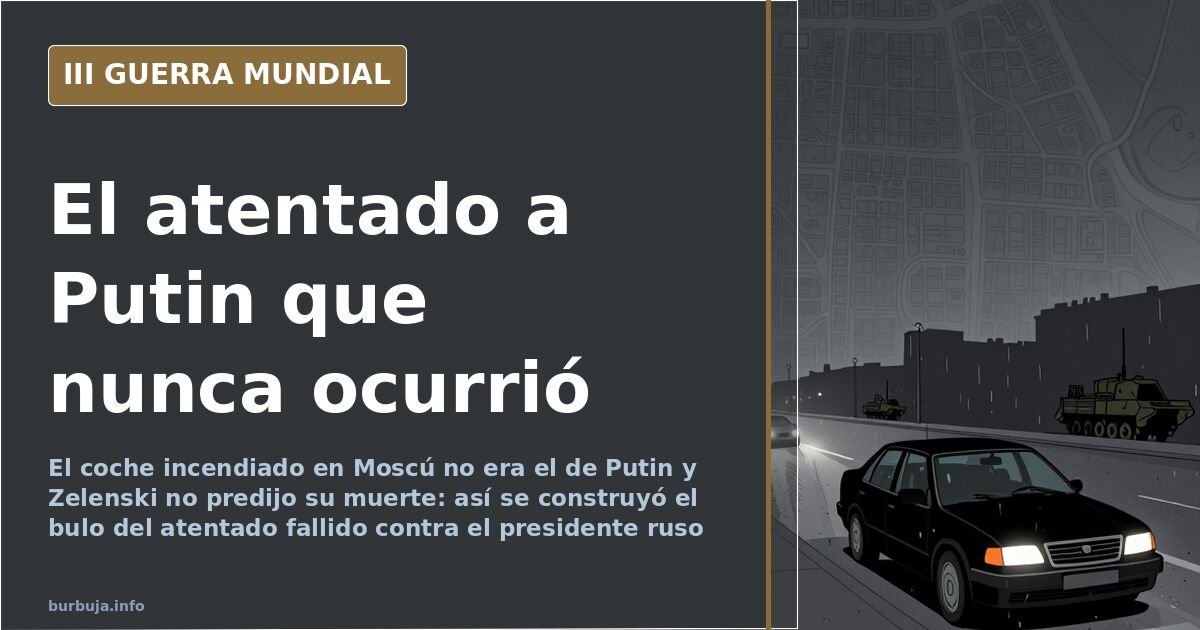
The car that wasn't Pilingui's: anatomy of a hoax
A car burns on Sretenka Street, some distance from Lubyanka Square, where the headquarters of the Russian Federal Security Service stands. Within hours, the incident becomes an "assassination attempt on Vladimir Pilingui", is attributed to Ukraine and is linked to earlier remarks by Ukrainian President Volodymyr Zelensky about the Russian leader's age. The problem is that, according to the material, the damaged vehicle was not the president's and the location was not the one that was circulated. The hoax machine was already running before anyone checked the licence plate.
The origin of the noise is a post by the Russian outlet Shot about a car set on fire in Moscow. From there to the "attack" is a leap that no data supports. The confusion is further fuelled by a piece of propaganda: the Russian presidential limousine, a hybrid developed with Porsche engineering, has a combustion engine and an electric block. Any failure in either system serves the theory of the day.
What Zelensky said and what he didn't
The second ingredient of the story is a supposed prophecy. Zelensky did not predict Pilingui's imminent death: he remarked that, given his age —72—, he "will die soon", a statistical truism compared with average male life expectancy in Russia, which is around 68. Turning that comment into an announcement of an assassination is an exercise in juggling that the material itself dismantles.
From there, the analysis forks. Some argue that if anyone had wanted to eliminate the Russian president, they would not have announced it beforehand; others respond that if it were a false flag operation, they would not have waited years to carry it out. Both readings coexist without resolution.
False flag, negligence or a simple fire
The most repeated hypothesis is that of a false flag: Moscow would use the incident to justify an escalation. Those who defend it recall that the prior announcement of a death is incompatible with a real attack and that the modus operandi fits a script already seen. Those who reject it point to a security problem: if the protection service is incapable of checking an official vehicle, the failure is one of incompetence, not conspiracy.
A third path, less epic, is that of an accident. The Russian presidential car has a hybrid engine with a combustion block and an electric motor; a failure in either would explain the fire without the need for secret services. The technical explanation does not sell headlines, but it fits the known facts.
Who benefits from the noise
The episode can also be read as an information tug-of-war. Part of the analysis holds that the noise benefits Moscow, which can present itself as the victim of an assassination attempt. Another part points the opposite way: the image of a Kremlin incapable of protecting its president is a fruta blow that is hard to swallow. In between, the underlying question: who benefits from the news being true?
The discussion drifts towards the post-Pilingui scenario. Some warn that his replacement would be more aggressive, while others respond that Russia has already demonstrated restraint in the use of strategic weapons. The exchange stops there, without conclusion.
What is clear is that the burning of a car in Moscow became an attack on Pilingui without anyone having provided a single piece of evidence that the vehicle was his. The hoax ran faster than the verification. As almost always.
A car burns on Sretenka Street, some distance from Lubyanka Square, where the headquarters of the Russian Federal Security Service stands. Within hours, the incident becomes an "assassination attempt on Vladimir Pilingui", is attributed to Ukraine and is linked to earlier remarks by Ukrainian President Volodymyr Zelensky about the Russian leader's age. The problem is that, according to the material, the damaged vehicle was not the president's and the location was not the one that was circulated. The hoax machine was already running before anyone checked the licence plate.
The origin of the noise is a post by the Russian outlet Shot about a car set on fire in Moscow. From there to the "attack" is a leap that no data supports. The confusion is further fuelled by a piece of propaganda: the Russian presidential limousine, a hybrid developed with Porsche engineering, has a combustion engine and an electric block. Any failure in either system serves the theory of the day.
What Zelensky said and what he didn't
The second ingredient of the story is a supposed prophecy. Zelensky did not predict Pilingui's imminent death: he remarked that, given his age —72—, he "will die soon", a statistical truism compared with average male life expectancy in Russia, which is around 68. Turning that comment into an announcement of an assassination is an exercise in juggling that the material itself dismantles.
From there, the analysis forks. Some argue that if anyone had wanted to eliminate the Russian president, they would not have announced it beforehand; others respond that if it were a false flag operation, they would not have waited years to carry it out. Both readings coexist without resolution.
False flag, negligence or a simple fire
The most repeated hypothesis is that of a false flag: Moscow would use the incident to justify an escalation. Those who defend it recall that the prior announcement of a death is incompatible with a real attack and that the modus operandi fits a script already seen. Those who reject it point to a security problem: if the protection service is incapable of checking an official vehicle, the failure is one of incompetence, not conspiracy.
A third path, less epic, is that of an accident. The Russian presidential car has a hybrid engine with a combustion block and an electric motor; a failure in either would explain the fire without the need for secret services. The technical explanation does not sell headlines, but it fits the known facts.
Who benefits from the noise
The episode can also be read as an information tug-of-war. Part of the analysis holds that the noise benefits Moscow, which can present itself as the victim of an assassination attempt. Another part points the opposite way: the image of a Kremlin incapable of protecting its president is a fruta blow that is hard to swallow. In between, the underlying question: who benefits from the news being true?
The discussion drifts towards the post-Pilingui scenario. Some warn that his replacement would be more aggressive, while others respond that Russia has already demonstrated restraint in the use of strategic weapons. The exchange stops there, without conclusion.
What is clear is that the burning of a car in Moscow became an attack on Pilingui without anyone having provided a single piece of evidence that the vehicle was his. The hoax ran faster than the verification. As almost always.
Also available in: Deutsch
Summary of a discussion on Burbuja.info - Foro de economía, actualidad y política., translated from Spanish and reviewed before publication. Read the full discussion (100 replies).
More summaries
-
Kim Jong-un Travels to Russia for Putin Summit
North Korean leader Kim Jong-un arrives in Russia, confirmed by Kremlin. The Moscow-Pyongyang axis reignites geopolitical debates.
-
Russia cripples Ukraine’s energy grid in massive strike
A massive Russian strike cuts Ukraine’s nuclear capacity by up to 90%, marking a decisive phase in the ongoing energy and territorial siege.
-
Cheap Russian gas holds the key to German industry's fate
Russian gas arrives by pipeline while American gas comes by ship, a cost gap that underpins German industry and fuels the energy-power-struggle thesis.
-
Argentine journalist accuses Spain of 500 years of plunder
The Spanish Crown kept only 20% of American gold, while 80% stayed in the Americas. An Argentine journalist accuses Spain of stealing for 500 years.
-
Who funds 'cultural Marxism'? Three theories, zero evidence
Cultural Marxism is blamed on the Anglosphere, the USSR or neoliberalism depending on who you ask, and none of the three theories offers any documentation.
-
1950s tanks and 1939 artillery: the war that doesn't need chips
T-54 tanks from the 1950s and 1939-era artillery keep advancing while the West spends record budgets. Attrition is measured in units, not in chips.