
Yamuna River: 100% fecal matter, 200km of dead water
Iñaki Alday's Yamuna River Project aims to restore the world's most polluted urban river: 100% fecal matter, zero oxygen, and 200km without life.
English · Original discussion in Spanish · Published
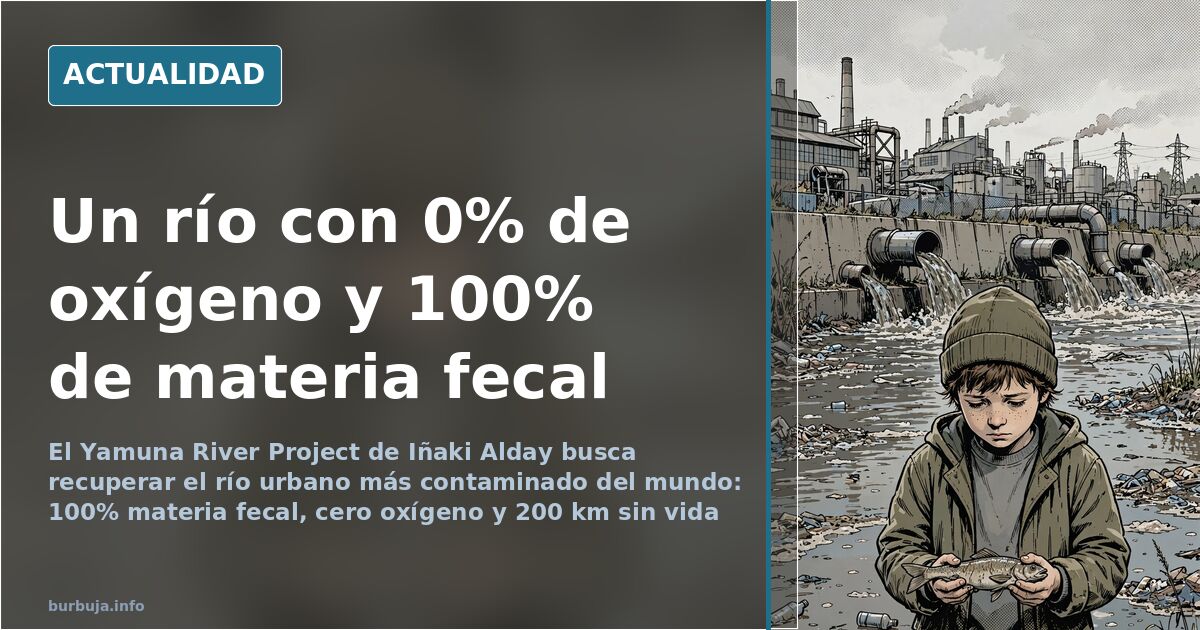
The Yamuna, the most polluted urban river: 100% fecal matter
Can a river be literally composed of 100% fecal matter? For the Yamuna, a tributary of the Ganges and the backbone of New Delhi, this is the figure cited by architect Iñaki Alday: zero oxygen content, no form of life—neither aquatic nor plant—and more than 200 kilometers of channel before the water begins to resemble water. This is not literary license, but the starting point of the Yamuna River Project, the largest urban planning initiative ever proposed in India.
The numbers framing the problem are massive: more than 20 million people live in the Indian capital, one of the largest urban concentrations on the planet. Approximately five million reside in informal settlements or slums. And the river that for centuries was the physical and spiritual center of the city has been, in Alday's own words, "totally inaccessible" for three or four decades.
What is the Yamuna River Project?
The project stems from an uncomfortable question. Alday, along with Indian architect Pankaj Vir Gupta, determined that the critical issue was not the water itself, but everything surrounding it. This led to a five-year investigation, whose results are collected in a homonymous book published by Actar, Yamuna River Project.
Alday came from directing a department at the University of Virginia and became dean of the School of Architecture at Tulane University in New Orleans that year. His diagnosis challenges the official narrative: the problem with the Yamuna is not the river. It is the lack of infrastructure, adequate housing, facilities, waste management, and a web of cultural and political decisions dating back to the British colonial era.
Why wastewater treatment plants don't fix the Yamuna
The first conclusion dismantles the obvious solution. Trillions of dollars have been invested in water treatment plants that do not work. The architect's explanation is surgical: "we were treating the thermometer measuring the fever, but not the disease." They attacked the symptom—dirty water—without touching the cause.
The second obstacle is governance. 27 different agencies have jurisdiction over the Yamuna. Getting them to agree is administrative juggling that, practically speaking, does not work. Hence, the project proposes creating a single agency with power to decide above all others. The argument is simple: without clear authority, no plan survives the first bureaucratic hurdle.
Five million people in informal settlements
The most tangible part of the plan involves housing and basic services in riverside areas. Pilot projects are already on the table and, according to those responsible, there are banks interested in financing them. The human calculation is stark: five million inhabitants of the capital live in precarious settlements, and their living conditions and health would change radically just by having safe water and food at home.
To this are added urgent operations that cannot wait: cleaning channels, new treatment plants, waste management systems, and sealing landfills operating beyond capacity. None of this is sci-fi technology. It is budget and willpower.
How many people will live in India in the coming years?
India is set to become the most populous country in the world, surpassing China, and will have 100 cities with more than one million inhabitants, most facing the same problems on different scales. Read negatively, this data is a condemnation. Read positively, it is a market and labor force.
Alday himself points out the other side: the country is among the most advanced in telecommunications and has enormous transformative capacity, especially if there is a critical mass of well-trained people to implement changes. The ball is in the court of execution.
A manual for polluted rivers worldwide
The Yamuna case is not an exotic exception. Similar situations occur in parts of Southeast Asia, Africa, and Latin America with highly polluted urban rivers. The team works in Delhi as the most urgent case, but they believe the solutions apply to many other places.
Public debate divides between those focusing on management—infrastructure, single agency, funding—and those emphasizing culture and daily neglect. Some also note that pollution is not unique to one country. All three readings point to the same river, and only one can be solved with money.
With 27 agencies, a channel that is 100% fecal matter, and the planet's largest demographic growth underway, the miracle of the Yamuna will not be chemical. It will be administrative. Otherwise, we continue waiting for someone to finally decide who rules the river.
Can a river be literally composed of 100% fecal matter? For the Yamuna, a tributary of the Ganges and the backbone of New Delhi, this is the figure cited by architect Iñaki Alday: zero oxygen content, no form of life—neither aquatic nor plant—and more than 200 kilometers of channel before the water begins to resemble water. This is not literary license, but the starting point of the Yamuna River Project, the largest urban planning initiative ever proposed in India.
The numbers framing the problem are massive: more than 20 million people live in the Indian capital, one of the largest urban concentrations on the planet. Approximately five million reside in informal settlements or slums. And the river that for centuries was the physical and spiritual center of the city has been, in Alday's own words, "totally inaccessible" for three or four decades.
What is the Yamuna River Project?
The project stems from an uncomfortable question. Alday, along with Indian architect Pankaj Vir Gupta, determined that the critical issue was not the water itself, but everything surrounding it. This led to a five-year investigation, whose results are collected in a homonymous book published by Actar, Yamuna River Project.
Alday came from directing a department at the University of Virginia and became dean of the School of Architecture at Tulane University in New Orleans that year. His diagnosis challenges the official narrative: the problem with the Yamuna is not the river. It is the lack of infrastructure, adequate housing, facilities, waste management, and a web of cultural and political decisions dating back to the British colonial era.
Why wastewater treatment plants don't fix the Yamuna
The first conclusion dismantles the obvious solution. Trillions of dollars have been invested in water treatment plants that do not work. The architect's explanation is surgical: "we were treating the thermometer measuring the fever, but not the disease." They attacked the symptom—dirty water—without touching the cause.
The second obstacle is governance. 27 different agencies have jurisdiction over the Yamuna. Getting them to agree is administrative juggling that, practically speaking, does not work. Hence, the project proposes creating a single agency with power to decide above all others. The argument is simple: without clear authority, no plan survives the first bureaucratic hurdle.
Five million people in informal settlements
The most tangible part of the plan involves housing and basic services in riverside areas. Pilot projects are already on the table and, according to those responsible, there are banks interested in financing them. The human calculation is stark: five million inhabitants of the capital live in precarious settlements, and their living conditions and health would change radically just by having safe water and food at home.
To this are added urgent operations that cannot wait: cleaning channels, new treatment plants, waste management systems, and sealing landfills operating beyond capacity. None of this is sci-fi technology. It is budget and willpower.
How many people will live in India in the coming years?
India is set to become the most populous country in the world, surpassing China, and will have 100 cities with more than one million inhabitants, most facing the same problems on different scales. Read negatively, this data is a condemnation. Read positively, it is a market and labor force.
Alday himself points out the other side: the country is among the most advanced in telecommunications and has enormous transformative capacity, especially if there is a critical mass of well-trained people to implement changes. The ball is in the court of execution.
A manual for polluted rivers worldwide
The Yamuna case is not an exotic exception. Similar situations occur in parts of Southeast Asia, Africa, and Latin America with highly polluted urban rivers. The team works in Delhi as the most urgent case, but they believe the solutions apply to many other places.
Public debate divides between those focusing on management—infrastructure, single agency, funding—and those emphasizing culture and daily neglect. Some also note that pollution is not unique to one country. All three readings point to the same river, and only one can be solved with money.
With 27 agencies, a channel that is 100% fecal matter, and the planet's largest demographic growth underway, the miracle of the Yamuna will not be chemical. It will be administrative. Otherwise, we continue waiting for someone to finally decide who rules the river.
Also available in: Deutsch
Summary of a discussion on Burbuja.info - Foro de economía, actualidad y política., translated from Spanish and reviewed before publication. Read the full discussion (110 replies).
More summaries
-
Fran Rivera and the legal limits of punishing children
Fran Rivera defends the occasional smack while Spanish law has banned physical punishment since 2007: the educational divide that never closes.
-
Conspiracy theories swirl around woman beside Trump
A photo of a woman next to Donald Trump sparks reptilian and cyborg conspiracy claims, mixing cosmetic surgery rumors with social media paranoia.
-
Spain PM Sánchez resignation rumor dismissed by forum
Journalist claims Spanish PM Pedro Sánchez will resign, but online forums react with skepticism citing legal immunity and political power.
-
Spain Forum Debate: Street Tension vs. Civil Conflict Skepticism
A forum thread analyzes migration tensions in areas like Barceloneta and Alcalá de Henares, largely dismissing the likelihood of open conflict.
-
Spain's Ábalos: Sex crimes treated harsher than theft
Ábalos claims double standards in Spain, criticizing Marlaska and defending his relationships with young women amid the Koldo case.
-
AI recreates Jesus' face from Shroud of Turin, sparking debate
AI generates a face for Jesus based on the Shroud of Turin. The result resembles Renaissance art more than the historical brown-skinned, short-haired figure.