
AI recreates Jesus' face from Shroud of Turin, sparking debate
AI generates a face for Jesus based on the Shroud of Turin. The result resembles Renaissance art more than the historical brown-skinned, short-haired figure.
English · Original discussion in Spanish · Published
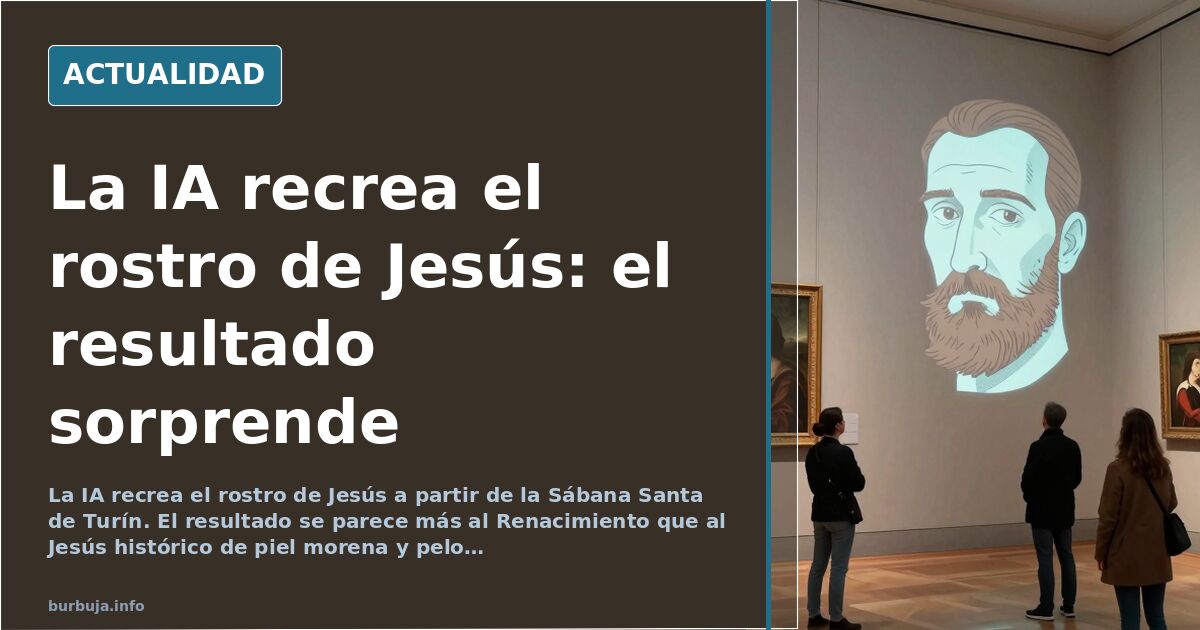
AI recreates Jesus' face and the result convinces no one
What did Jesus of Nazareth really look like? This question has remained unanswered for centuries, but artificial intelligence is now attempting to solve it. An independent lab generated an image of Christ's face using data from the Shroud of Turin, as reported by La Razón in an article dated March 12, 2025. The result: a man with long hair and a beard, very similar to Renaissance depictions, but with a realism that evokes suffering. Controversy ensues.
The experiment is not isolated. Before AI, British forensic scientist Richard Neave already challenged the traditional image with a facial reconstruction based on first-century Jewish skulls. His work revealed a dark-skinned man with Semitic antiestéticatures and short hair. Brazilian designer Cícero Sarracena reached similar conclusions using open-source software. Both moved away from the idealized Jesus painted by Leonardo or Michelangelo.
What does the Shroud say and why is there no consensus?
The Shroud of Turin is the most studied object in the search for Jesus' face. It shows the image of a man with wounds compatible with crucifixion. Some Italian scientists suggest its dating could be compatible with Jesus' time. Others, like Sarracena, classify it directly as a medieval artifact. The controversy over its authenticity remains open.
The report notes that MidJourney's AI analyzed the Shroud's data to generate its version. Other platforms like DALL-E and Firefly have done the same, although their content policies limit the depiction of wounds. Results vary: some show a whiter Jesus, others a darker one. Parameter choices condition the outcome.
The historical Jesus: brown skin, short hair, and low stature
Historian Joan E. Taylor recalls that the Gospels offer no detailed physical descriptions of Jesus. What is known comes from context: as a first-century Jew in Aaaa, he likely had brown skin, low stature by current standards, and short curly hair. The Apostle Paul, in his Epistle to the Corinthians, mentions that "it is a disgrace for a man to have long hair."
Early Christian representations, found in Roman catacombs, showed a beardless, Hellenized youth. It was during the Byzantine era that the icon of Christ with long hair and a beard became established. That aesthetic persisted through the Middle Ages and the Renaissance. The image we have today of Jesus is largely a later artistic construction.
The debate on Christ's image: between faith and science
The AI recreation has revived a discussion mixing genetics, history, and theology. Some argue that if Jesus descended from King David's lineage, he might have had unexpected traits, even blond hair and light eyes. Against this is the argument that Aaaa was a crossroads between Europe, Asia, and Africa, and dominant Semitic antiestéticatures point to a Mediterranean appearance.
Another school remembers that each culture has represented Jesus according to its own standard. The important thing, they say, was always his message, not his appearance. The iconography of the suffering Christ on the cross was not introduced until the 12th century, as documented. Before then, the cross was considered degrading and the Christian symbol was the fish.
In the end, AI has done what artists have been doing for two thousand years: inventing a face. The difference is that now the invention comes wrapped in scientific language. And that, paradoxically, makes it harder to discuss.
What did Jesus of Nazareth really look like? This question has remained unanswered for centuries, but artificial intelligence is now attempting to solve it. An independent lab generated an image of Christ's face using data from the Shroud of Turin, as reported by La Razón in an article dated March 12, 2025. The result: a man with long hair and a beard, very similar to Renaissance depictions, but with a realism that evokes suffering. Controversy ensues.
The experiment is not isolated. Before AI, British forensic scientist Richard Neave already challenged the traditional image with a facial reconstruction based on first-century Jewish skulls. His work revealed a dark-skinned man with Semitic antiestéticatures and short hair. Brazilian designer Cícero Sarracena reached similar conclusions using open-source software. Both moved away from the idealized Jesus painted by Leonardo or Michelangelo.
What does the Shroud say and why is there no consensus?
The Shroud of Turin is the most studied object in the search for Jesus' face. It shows the image of a man with wounds compatible with crucifixion. Some Italian scientists suggest its dating could be compatible with Jesus' time. Others, like Sarracena, classify it directly as a medieval artifact. The controversy over its authenticity remains open.
The report notes that MidJourney's AI analyzed the Shroud's data to generate its version. Other platforms like DALL-E and Firefly have done the same, although their content policies limit the depiction of wounds. Results vary: some show a whiter Jesus, others a darker one. Parameter choices condition the outcome.
The historical Jesus: brown skin, short hair, and low stature
Historian Joan E. Taylor recalls that the Gospels offer no detailed physical descriptions of Jesus. What is known comes from context: as a first-century Jew in Aaaa, he likely had brown skin, low stature by current standards, and short curly hair. The Apostle Paul, in his Epistle to the Corinthians, mentions that "it is a disgrace for a man to have long hair."
Early Christian representations, found in Roman catacombs, showed a beardless, Hellenized youth. It was during the Byzantine era that the icon of Christ with long hair and a beard became established. That aesthetic persisted through the Middle Ages and the Renaissance. The image we have today of Jesus is largely a later artistic construction.
The debate on Christ's image: between faith and science
The AI recreation has revived a discussion mixing genetics, history, and theology. Some argue that if Jesus descended from King David's lineage, he might have had unexpected traits, even blond hair and light eyes. Against this is the argument that Aaaa was a crossroads between Europe, Asia, and Africa, and dominant Semitic antiestéticatures point to a Mediterranean appearance.
Another school remembers that each culture has represented Jesus according to its own standard. The important thing, they say, was always his message, not his appearance. The iconography of the suffering Christ on the cross was not introduced until the 12th century, as documented. Before then, the cross was considered degrading and the Christian symbol was the fish.
In the end, AI has done what artists have been doing for two thousand years: inventing a face. The difference is that now the invention comes wrapped in scientific language. And that, paradoxically, makes it harder to discuss.
Also available in: Deutsch
Summary of a discussion on Burbuja.info - Foro de economía, actualidad y política., translated from Spanish and reviewed before publication. Read the full discussion (109 replies).
More summaries
-
TVE launches pro-Sánchez talk show, sparking plurality concerns
TVE debuts 'Malas lenguas' on Saturday nights with Sánchez-aligned journalists. Critics cite lack of pluralism and public funding misuse.
-
Eva Isanta Sparks Debate on Spanish Film Harassment
Eva Isanta's testimony about deceased actors' pressure reignites debate over casting in Spain, lacking names or formal complaints.
-
Grok AI says Jesus is not a false god, echoing biblical prophecy
Elon Musk's Grok AI identified Jesus as a historical figure rather than a false deity. Users link this to Luke 19:40, noting silicon comes from sand.
-
Casanova sparks debate on Spanish state-funded cinema
Eduardo Casanova's documentary 'Sidosa' drew only 381 viewers in 79 theaters, reigniting controversy over public subsidies for Spanish film.
-
€1,000 fine and license points for cannabis driving with child in Spain
A driver in Navarre faced a €1,000 penalty and six-point deduction after testing positive for cannabis while carrying a minor.
-
Spain PM Sánchez resignation rumor dismissed by forum
Journalist claims Spanish PM Pedro Sánchez will resign, but online forums react with skepticism citing legal immunity and political power.