
Would Spanish soldiers obey orders to fight on the front line?
Public opinion on sending Spanish troops to the front: who would comply, who would evade service, and why military discipline faces scrutiny.
English · Original discussion in Spanish · Published
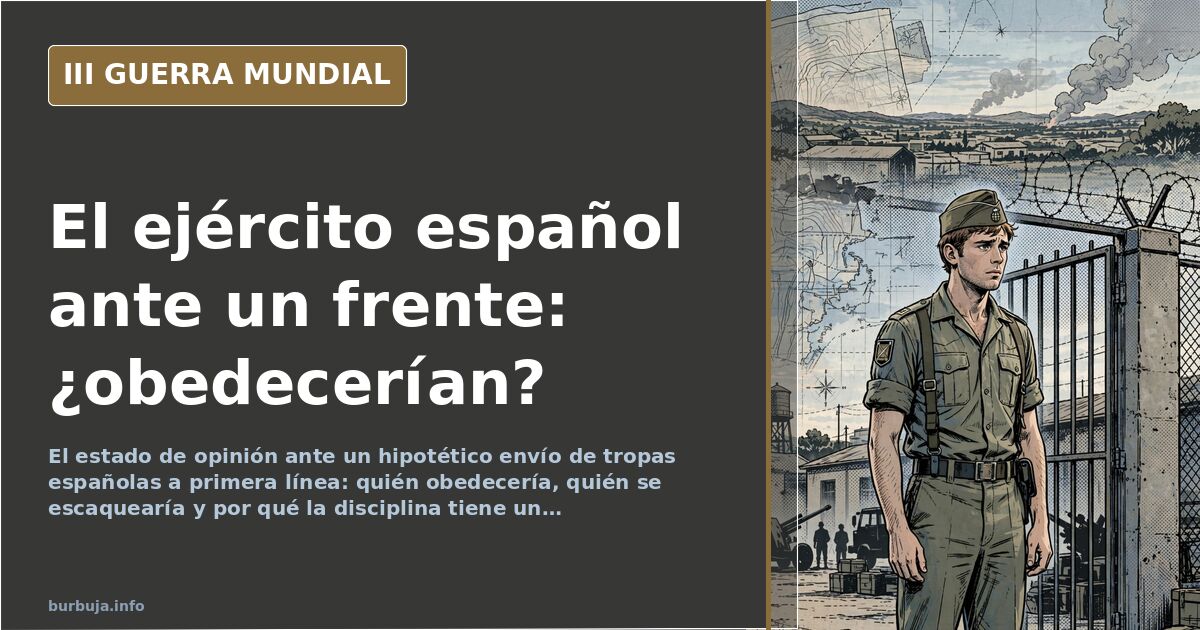
Would a Spanish soldier obey if sent to the front?
The question is not rhetorical. In a scenario of forced conscription or deployment to the front line, public opinion leans heavily towards refusal, with nuances ranging from skepticism to open defiance. The debate starts from an uncomfortable premise: there is a core of well-paid professionals, with fixed salaries and no end-of-month financial worries, whose commitment to command is questioned once the setting shifts from parades to trenches. The discussion is not about abstract patriotism, but something more pragmatic: who goes, who stays, and why.
Who would go and who would stay home
The most repeated argument is asymmetry. It is claimed that professional soldiers would not be sent because they would refuse; those who would go are the forcibly recruited, people without specific training and fewer resources to dodge the call-up. The image drawn is of a professional force that, facing real conflict, would start recruiting civilians off the street. This is a hypothesis, not data, but it explains why much of the debate views Armed Forces Day events with suspicion: they are interpreted as honoring those who, in an extreme scenario, would be used as human shields.
The objection to this reasoning is discipline. Some recall that military personnel swear obedience and that, in practice, the chain of command does not admit negotiation. But even this current acknowledges that obedience has limits when the objective is unclear. The overarching question remains: What are we fighting for?. If Spain has no tangible stake on the ground, motivation collapses.
The professional soldier in modern warfare
Another line of analysis dismantles the elite combatant myth. In a war of artillery and drones, physical fitness matters less than the ability to survive unannounced projectiles. The example cited is undernourished soldiers who faced better-equipped troops and complicated their lives. The conclusion is uncomfortable for the official narrative: muscle does not protect against impact.
Added to this is an observation on the age structure of the Armed Forces. It is striking that military personnel over thirty endure discipline from intermediate commanders who behave as if leading an entire army. This is a complaint about internal culture, but it points to something more serious: the gap between the troops and those who decide where they are sent.
Ceuta, Melilla, and the enemy not in Ukraine
Part of public opinion refocuses the issue. The priority would not be a distant front among foreign powers, but defending national borders. It is argued that Ceuta and Melilla are Spanish and do not need Brussels' or Washington's approval to be defended. The circulating proposal is to turn these enclaves into operational military bases, with troops training in real scenarios.
Rejection of NATO and dependence on allies runs through several messages with explicit distrust of third-country interests. The idea that Spain lacks effective sovereignty is repeated as a diagnosis, not a lament. From this comes the logical question: if you don't defend your own, why defend others'?
The precedent nobody wants to repeat
The pandemic episode serves as a mirror. Many announced they would not get vaccinated but ended up getting jabbed. The parallel is evident: social and administrative pressure bends more than conviction. If compliance was achieved with a mask, the margin for resistance narrows further with a mobilization order.
This is the disorienting point. Rhetoric of outright refusal coexists with the certainty that, when the time comes, the majority would comply. Not out of patriotism, but inertia, antiestéticar of consequences, or pure economic survival. The qualified prediction is this: if the order ever sounds, the debate will not be about whether to obey, but about how many find a way to avoid being on the front line when the moment arrives.
The question is not rhetorical. In a scenario of forced conscription or deployment to the front line, public opinion leans heavily towards refusal, with nuances ranging from skepticism to open defiance. The debate starts from an uncomfortable premise: there is a core of well-paid professionals, with fixed salaries and no end-of-month financial worries, whose commitment to command is questioned once the setting shifts from parades to trenches. The discussion is not about abstract patriotism, but something more pragmatic: who goes, who stays, and why.
Who would go and who would stay home
The most repeated argument is asymmetry. It is claimed that professional soldiers would not be sent because they would refuse; those who would go are the forcibly recruited, people without specific training and fewer resources to dodge the call-up. The image drawn is of a professional force that, facing real conflict, would start recruiting civilians off the street. This is a hypothesis, not data, but it explains why much of the debate views Armed Forces Day events with suspicion: they are interpreted as honoring those who, in an extreme scenario, would be used as human shields.
The objection to this reasoning is discipline. Some recall that military personnel swear obedience and that, in practice, the chain of command does not admit negotiation. But even this current acknowledges that obedience has limits when the objective is unclear. The overarching question remains: What are we fighting for?. If Spain has no tangible stake on the ground, motivation collapses.
The professional soldier in modern warfare
Another line of analysis dismantles the elite combatant myth. In a war of artillery and drones, physical fitness matters less than the ability to survive unannounced projectiles. The example cited is undernourished soldiers who faced better-equipped troops and complicated their lives. The conclusion is uncomfortable for the official narrative: muscle does not protect against impact.
Added to this is an observation on the age structure of the Armed Forces. It is striking that military personnel over thirty endure discipline from intermediate commanders who behave as if leading an entire army. This is a complaint about internal culture, but it points to something more serious: the gap between the troops and those who decide where they are sent.
Ceuta, Melilla, and the enemy not in Ukraine
Part of public opinion refocuses the issue. The priority would not be a distant front among foreign powers, but defending national borders. It is argued that Ceuta and Melilla are Spanish and do not need Brussels' or Washington's approval to be defended. The circulating proposal is to turn these enclaves into operational military bases, with troops training in real scenarios.
Rejection of NATO and dependence on allies runs through several messages with explicit distrust of third-country interests. The idea that Spain lacks effective sovereignty is repeated as a diagnosis, not a lament. From this comes the logical question: if you don't defend your own, why defend others'?
The precedent nobody wants to repeat
The pandemic episode serves as a mirror. Many announced they would not get vaccinated but ended up getting jabbed. The parallel is evident: social and administrative pressure bends more than conviction. If compliance was achieved with a mask, the margin for resistance narrows further with a mobilization order.
This is the disorienting point. Rhetoric of outright refusal coexists with the certainty that, when the time comes, the majority would comply. Not out of patriotism, but inertia, antiestéticar of consequences, or pure economic survival. The qualified prediction is this: if the order ever sounds, the debate will not be about whether to obey, but about how many find a way to avoid being on the front line when the moment arrives.
Also available in: Deutsch
Summary of a discussion on Burbuja.info - Foro de economía, actualidad y política., translated from Spanish and reviewed before publication. Read the full discussion (126 replies).
More summaries
-
NATO protects Ukraine but not Spain's North African enclaves
Article 5 excludes North Africa, leaving Ceuta and Melilla outside the NATO umbrella while the US arms Morocco.
-
Debate on a Morocco invasion: Ceuta, Melilla and NATO
Forum debate on a hypothetical Moroccan invasion of Ceuta and Melilla: drones, fifth column and internal political fracture
-
Francisco Adolfo's miracle: faith, fame and relapses
Influencer Francisco Adolfo visits Fátima and buys a cross. Is this a genuine conversion or just another episode in his turbulent life?
-
Spain's training ship faces New York seizure over renewable debt
US judge denies Spain's request to halt arbitration award, risking seizure of the Juan Sebastián Elcano in New York.
-
Spain's Borders at Risk if Ukraine's Don't Count
If force dictates international order, Spain faces territorial disputes and secessionist threats. Debates on neutrality versus deterrence.
-
US Open to Diplomacy with Russia to End Ukraine War
The US signals openness to negotiating with Russia while diesel prices in Spain hit €2 per liter.