
Conscription: The Paths of Objection and Escape
What options remain when facing forced conscription? A look at Ukraine's situation and potential strategies.
English · Original discussion in Spanish · Published
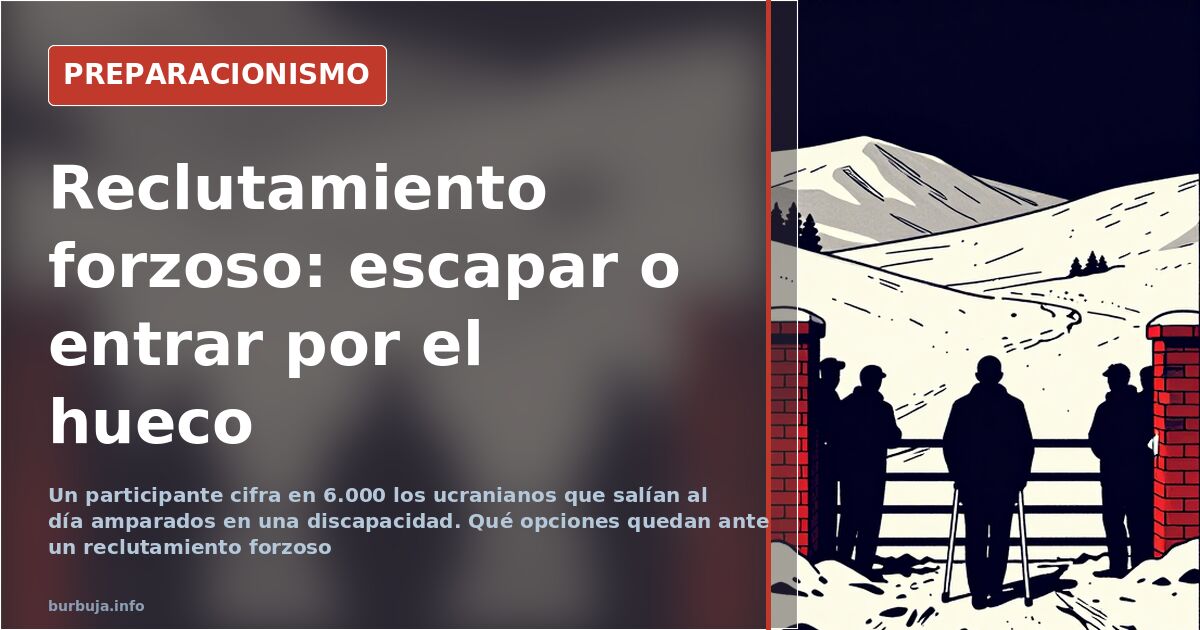
Forced Conscription: Flee in Time, Object, or Slip Through the Cracks
It's often said that Ukrainians who left the country in the first 48 hours of the Russian invasion are the ones who fared best. The question of what an ordinary citizen does when a conscription order arrives has moved beyond theoretical debate to become a matter of deadlines, figures, and closing doors.
The Ukrainian case sets the context. According to one participant, until May 2024, a person with certified disability could leave the country, with around 6,000 men a day crossing the border under the guise of accompanying a disabled family member. This loophole, according to the same account, has now been closed. After the change, those who still hold a certificate can leave, but the criteria have become surgical: anyone who can stand is deemed fit regardless of their medical history.
The Figures: 20,000 Conscripts Monthly
According to this participant, Ukrainian administration data indicates 20,000 monthly conscriptions, with the immediate caveat that the actual number will be higher. This includes those caught on the street and those who manage to escape before reaching the front lines. The calculation circulating on the ground is that out of every 10,000 monthly, at least half slip through the net. Those who can't get away, this perspective adds, pay to be released: recruitment teams are only focused on meeting quotas, and what happens afterward is not their problem.
One conclusion is universally agreed upon: the smartest ones left in the first 48 hours. The rest are where they are.
Can You Refuse? Article 30 and Conscientious Objection
In Spain, the approach differs. As one participant recalls, Article 30 of the Constitution obliges citizens to defend the country and, within the same text, recognizes the right to conscientious objection to compulsory military service, provided legal guarantees are met. Draft dodging, refusal without invoking this provision, would have a different outcome. And here, another argument repeated in the thread emerges: there aren't enough prisons to hold all the draft dodgers, nor clear official figures on how many there have been, as no one is interested in publishing them.
Legal optimism has its limits. When faced with a scenario of total war, the response a participant repeats time and again is that the rule of law is suspended, and laws, the Constitution, or treaties cease to matter. From this starting point, conscientious objection stops being an exercisable right and becomes a mere piece of paper.
Your Mobile Phone Isn't Your Friend Either
Anyone thinking of disappearing will need to start with their wallet. One line of analysis suggests that phones are monitored by public institutions and that any digital trace betrays you faster than a denunciation. The advice repeated is the least segarro possible: use an email account instead of messaging linked to a number, use cryptocurrency for money, have a valid passport, and maintain silence. No groups, no shared locations.
There's a nuance worth highlighting: almost all of this operates in the realm of suspicion and personal experience, not documentary proof. The mobile phone as a betrayer is a hypothesis, not a verified fact, and should be read as such.
The War That Cannot Be Sustained
It's worth looking at the other side of the problem. As one participant points out, an army cannot be sustained solely by recruits. Electronics have changed everything: if a country empties its warehouses because chips come from China, it is left exposed. European and US arsenals, already strained by the supply effort to Ukraine, would be at minimum levels, and some countries' equipment would only last for two weeks of combat. What do you send next, the band?
The consequence is uncomfortable. Recruiting cannon fodder is cheap; arming, feeding, and sustaining them during a long war is another matter. And this opens another avenue for those unwilling to fight: a lack of resources turns the front line into a bottleneck that doesn't always function.
Personal Surrender: What Really Happens in the Van
Here comes the part nobody wants to read. When conscription has already occurred, the most common response is the least heroic: antiestéticar reigns, the recruit does what they are told and seeks the lowest-risk position. Some claim that you shit yourself with antiestéticar and go through whatever opening they make because you see a minimal chance of survival there. Acts of extreme resistance, the ones spoken of loudly, are rarely executed.
The Numbers Don't Add Up
There's a piece of contextual data that creeps into the conversation. Spain surpassed 49,315,949 inhabitants in the second quarter of 2025, with almost 9.4 million people of immigrant origin, representing 19.21% of foreign-born population at the start of that year. The mix of demographic pyramid and human potential fuels an uncomfortable discussion: who goes and who stays if the call ever comes.
The analysis gets stuck at a point that doesn't resolve. Fleeing beforehand is the only strategy everyone considers reasonable, but it requires money, a passport, and the stomach to break with everything. Objecting works on paper until the paper tears. And staying to comply is not a solution, it's a wait. No one has found a protocol that resolves all three issues simultaneously.
It's often said that Ukrainians who left the country in the first 48 hours of the Russian invasion are the ones who fared best. The question of what an ordinary citizen does when a conscription order arrives has moved beyond theoretical debate to become a matter of deadlines, figures, and closing doors.
The Ukrainian case sets the context. According to one participant, until May 2024, a person with certified disability could leave the country, with around 6,000 men a day crossing the border under the guise of accompanying a disabled family member. This loophole, according to the same account, has now been closed. After the change, those who still hold a certificate can leave, but the criteria have become surgical: anyone who can stand is deemed fit regardless of their medical history.
The Figures: 20,000 Conscripts Monthly
According to this participant, Ukrainian administration data indicates 20,000 monthly conscriptions, with the immediate caveat that the actual number will be higher. This includes those caught on the street and those who manage to escape before reaching the front lines. The calculation circulating on the ground is that out of every 10,000 monthly, at least half slip through the net. Those who can't get away, this perspective adds, pay to be released: recruitment teams are only focused on meeting quotas, and what happens afterward is not their problem.
One conclusion is universally agreed upon: the smartest ones left in the first 48 hours. The rest are where they are.
Can You Refuse? Article 30 and Conscientious Objection
In Spain, the approach differs. As one participant recalls, Article 30 of the Constitution obliges citizens to defend the country and, within the same text, recognizes the right to conscientious objection to compulsory military service, provided legal guarantees are met. Draft dodging, refusal without invoking this provision, would have a different outcome. And here, another argument repeated in the thread emerges: there aren't enough prisons to hold all the draft dodgers, nor clear official figures on how many there have been, as no one is interested in publishing them.
Legal optimism has its limits. When faced with a scenario of total war, the response a participant repeats time and again is that the rule of law is suspended, and laws, the Constitution, or treaties cease to matter. From this starting point, conscientious objection stops being an exercisable right and becomes a mere piece of paper.
Your Mobile Phone Isn't Your Friend Either
Anyone thinking of disappearing will need to start with their wallet. One line of analysis suggests that phones are monitored by public institutions and that any digital trace betrays you faster than a denunciation. The advice repeated is the least segarro possible: use an email account instead of messaging linked to a number, use cryptocurrency for money, have a valid passport, and maintain silence. No groups, no shared locations.
There's a nuance worth highlighting: almost all of this operates in the realm of suspicion and personal experience, not documentary proof. The mobile phone as a betrayer is a hypothesis, not a verified fact, and should be read as such.
The War That Cannot Be Sustained
It's worth looking at the other side of the problem. As one participant points out, an army cannot be sustained solely by recruits. Electronics have changed everything: if a country empties its warehouses because chips come from China, it is left exposed. European and US arsenals, already strained by the supply effort to Ukraine, would be at minimum levels, and some countries' equipment would only last for two weeks of combat. What do you send next, the band?
The consequence is uncomfortable. Recruiting cannon fodder is cheap; arming, feeding, and sustaining them during a long war is another matter. And this opens another avenue for those unwilling to fight: a lack of resources turns the front line into a bottleneck that doesn't always function.
Personal Surrender: What Really Happens in the Van
Here comes the part nobody wants to read. When conscription has already occurred, the most common response is the least heroic: antiestéticar reigns, the recruit does what they are told and seeks the lowest-risk position. Some claim that you shit yourself with antiestéticar and go through whatever opening they make because you see a minimal chance of survival there. Acts of extreme resistance, the ones spoken of loudly, are rarely executed.
The Numbers Don't Add Up
There's a piece of contextual data that creeps into the conversation. Spain surpassed 49,315,949 inhabitants in the second quarter of 2025, with almost 9.4 million people of immigrant origin, representing 19.21% of foreign-born population at the start of that year. The mix of demographic pyramid and human potential fuels an uncomfortable discussion: who goes and who stays if the call ever comes.
The analysis gets stuck at a point that doesn't resolve. Fleeing beforehand is the only strategy everyone considers reasonable, but it requires money, a passport, and the stomach to break with everything. Objecting works on paper until the paper tears. And staying to comply is not a solution, it's a wait. No one has found a protocol that resolves all three issues simultaneously.
Summary of a discussion on Burbuja.info - Foro de economía, actualidad y política., translated from Spanish and reviewed before publication. Read the full discussion (235 replies).
More summaries
-
Ukraine War: The Recruitment Hoax That Almost Succeeded
A fake announcement in 2022 claimed mandatory recruitment of men aged 18-45 during the Ukraine war. The reaction revealed underlying fears.
-
From €25 Pepper Spray to €300 Leatherman: The Prepper's Kit
Pepper spray for €25, 4,000-lumen flashlight, and vests from €46: the personal defense gear list for living in Spain in 2020.
-
Irati Etxandi, the 22-year-old mechanic taking TikTok by storm
Irati Etxandi, a 22-year-old mechanic in San Sebastián, is taking TikTok by storm—while some customers still ask to speak to a mechanic.
-
Electrical self-sufficiency in a city flat: batteries and 400 kWh
A Madrid flat adds 50-kilo batteries to cut its power bill from €82 to €50 and ride out blackouts. The total cost still doesn’t quite add up.
-
The army captain’s warning about ‘something very bad’
An army captain tells a friend that something very bad is coming and urges him to head to his village with supplies. Reaction: skepticism and stockpiling.
-
Severe flu: 39°C fever and a cough that lasts two weeks
This season's flu is being described as bringing a 39°C fever, six days in bed and a cough that lingers for another two weeks