
Why Chinese-run bazaars survive with hardly any customers
Margins of up to 5,900%, loans between compatriots and money-laundering cases: how Chinese-run bazaars with almost no customers keep going
English · Original discussion in Spanish · Published
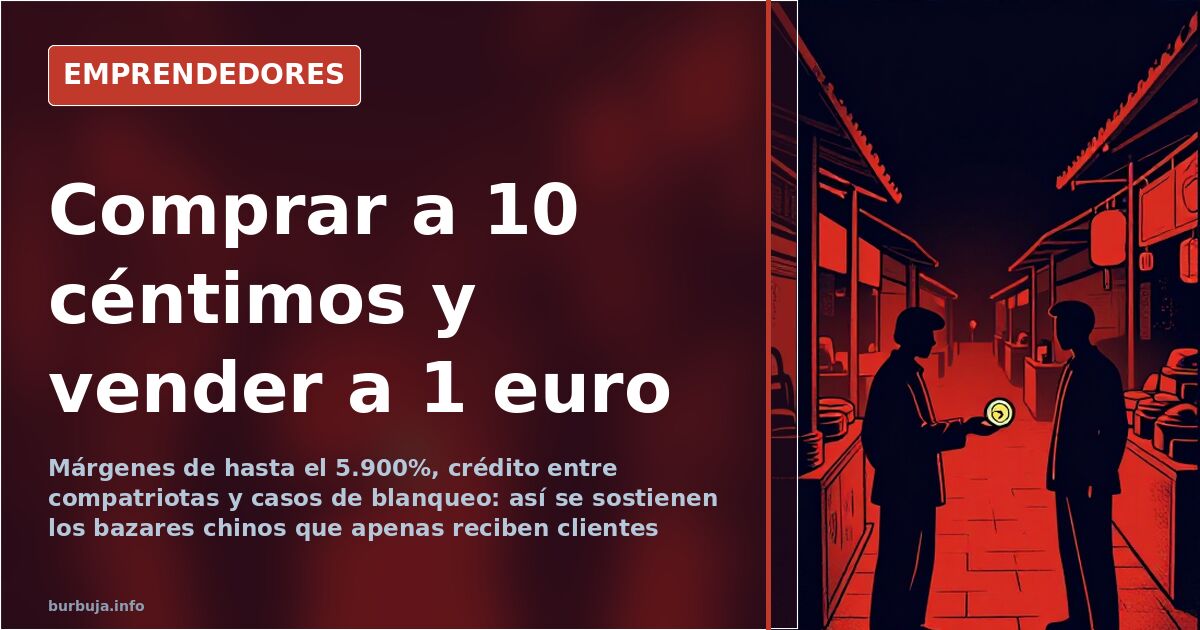
Buying for 10 cents and selling for 1 euro: the bazaar economy
Some shops seem to defy any viability handbook. Hundreds of square metres, packed to the ceiling, with a clientele that would fit in a taxi and a shutter that never comes down. These are the neighbourhood bazaars. “What do they live on?” is the question neighbours, traders and more than one inspector have been asking for years.
The answer doesn't fit in one sentence, and anyone who simplifies it gets it wrong. There are at least three overlapping layers: margins that the Spanish retailer cannot match, a credit system of their own that ignores the banks and, in some cases, money of opaque origin that the courts have indeed pursued.
Why a bazaar sells for 1 euro what it bought for 10 cents
The first pillar is arithmetic. Much of the stock is imported directly from China at prices ranging from 10 cents to a few euros per unit. A phone case bought for 0.10 euros sells for 6; a cable bought for 0.40 goes for the same amount. On paper, a margin that makes any local shop look ridiculous.
The key is volume and the type of product. The stock is almost all non-perishable, so it doesn't expire or force markdowns. And customs control, according to the account circulating among those who operate in the sector, inspects one container out of every eight at best, because a port that checks everything stops being competitive. Little waste, lots of possible turnover and prices that small local shops cannot touch.
The bank they never enter: credit between compatriots
The second pillar explains how they finance themselves without going to a conventional institution. Loans move within the family and community network itself: some lend to others and the money comes back over time. With that mechanism, some buy the premises and the flat outright, with no mortgage and therefore without the monthly payment that suffocates the average self-employed worker.
Add to that an intergenerational culture of saving that here seems almost exotic. Parents scrimp their whole lives so their child can open up owing nothing to anyone. The result is a fixed-cost structure far lower than that of the indebted competitor, who is carrying interest from day one.
Money laundering: what the courts have pursued and what is only suspected
The third pillar is the most uncomfortable and demands precision. In Spain there have been high-profile court cases. The most cited is Operación Emperador, which according to published reports attributed to Gao Ping the laundering of some 300 million euros a year and which ended up fading in the courts. To these can be added episodes such as the seizure at Barajas of 850,000 euros in cash from one person.
It is worth separating the judicial dimension from rumour. The existence of investigated networks does not turn an entire community into suspects, and those who defend the business's ordinary profitability argue that margins and in-house credit are enough to explain everything. The share of black money that may slip into specific premises is, by definition, the hardest to quantify.
16-hour days and prices that leave no room for competition
Then there is the human factor, the one least mentioned. There are accounts of marathon shifts, businesses open seven days a week and job offers of 25 euros for 10 hours of work. That cocktail —family fully committed, minimal expenses, uncounted hours— makes it possible to keep going in premises that would ruin someone else.
The contrast with native-owned retail is inevitable, and not always flattering to the local side. The underlying question is not how long a bazaar can hold out, but how long a model that does not compete on equal terms can hold out. Because the harshest diagnosis does not point to the one who opens at ten at night, but to the one who closes on Saturday afternoon.
And that is where the analysis gets stuck. The accounts of these premises are in no public register, margins are estimates and money laundering only surfaces when there is a judicial operation behind it. What does not add up arithmetically —a 1,186-square-metre retail space in Madrid costs around 9,000 euros a month in rent— sometimes adds up through credit, margin or hours. Sometimes. No one has managed to square all the cases at once.
Some shops seem to defy any viability handbook. Hundreds of square metres, packed to the ceiling, with a clientele that would fit in a taxi and a shutter that never comes down. These are the neighbourhood bazaars. “What do they live on?” is the question neighbours, traders and more than one inspector have been asking for years.
The answer doesn't fit in one sentence, and anyone who simplifies it gets it wrong. There are at least three overlapping layers: margins that the Spanish retailer cannot match, a credit system of their own that ignores the banks and, in some cases, money of opaque origin that the courts have indeed pursued.
Why a bazaar sells for 1 euro what it bought for 10 cents
The first pillar is arithmetic. Much of the stock is imported directly from China at prices ranging from 10 cents to a few euros per unit. A phone case bought for 0.10 euros sells for 6; a cable bought for 0.40 goes for the same amount. On paper, a margin that makes any local shop look ridiculous.
The key is volume and the type of product. The stock is almost all non-perishable, so it doesn't expire or force markdowns. And customs control, according to the account circulating among those who operate in the sector, inspects one container out of every eight at best, because a port that checks everything stops being competitive. Little waste, lots of possible turnover and prices that small local shops cannot touch.
The bank they never enter: credit between compatriots
The second pillar explains how they finance themselves without going to a conventional institution. Loans move within the family and community network itself: some lend to others and the money comes back over time. With that mechanism, some buy the premises and the flat outright, with no mortgage and therefore without the monthly payment that suffocates the average self-employed worker.
Add to that an intergenerational culture of saving that here seems almost exotic. Parents scrimp their whole lives so their child can open up owing nothing to anyone. The result is a fixed-cost structure far lower than that of the indebted competitor, who is carrying interest from day one.
Money laundering: what the courts have pursued and what is only suspected
The third pillar is the most uncomfortable and demands precision. In Spain there have been high-profile court cases. The most cited is Operación Emperador, which according to published reports attributed to Gao Ping the laundering of some 300 million euros a year and which ended up fading in the courts. To these can be added episodes such as the seizure at Barajas of 850,000 euros in cash from one person.
It is worth separating the judicial dimension from rumour. The existence of investigated networks does not turn an entire community into suspects, and those who defend the business's ordinary profitability argue that margins and in-house credit are enough to explain everything. The share of black money that may slip into specific premises is, by definition, the hardest to quantify.
16-hour days and prices that leave no room for competition
Then there is the human factor, the one least mentioned. There are accounts of marathon shifts, businesses open seven days a week and job offers of 25 euros for 10 hours of work. That cocktail —family fully committed, minimal expenses, uncounted hours— makes it possible to keep going in premises that would ruin someone else.
The contrast with native-owned retail is inevitable, and not always flattering to the local side. The underlying question is not how long a bazaar can hold out, but how long a model that does not compete on equal terms can hold out. Because the harshest diagnosis does not point to the one who opens at ten at night, but to the one who closes on Saturday afternoon.
And that is where the analysis gets stuck. The accounts of these premises are in no public register, margins are estimates and money laundering only surfaces when there is a judicial operation behind it. What does not add up arithmetically —a 1,186-square-metre retail space in Madrid costs around 9,000 euros a month in rent— sometimes adds up through credit, margin or hours. Sometimes. No one has managed to square all the cases at once.
Summary of a discussion on Burbuja.info - Foro de economía, actualidad y política., translated from Spanish and reviewed before publication. Read the full discussion (104 replies).
More summaries
-
9 Problems of Running an Online Store, According to Those Who Manage Them
Uncollected cash-on-delivery, suppliers turning into competitors, and €275 in self-employment fees before you sell: common problems of an online store.
-
Importing from China: The Hidden Fee That Turns €150 into €86 for Customs
Discover the real costs of importing from China. A €150 invoice can result in €86 of customs charges due to hidden adjustments, MOQs, and thresholds.
-
VeriFactu: Handwritten Invoice Books Remain Legal
DGT consultation V0073-26 reopens the path of handwritten invoices to evade VeriFactu, as mandatory electronic invoicing approaches.
-
DAW course stalls: 600 applications per vacancy and €900 pay
DAW course ads: 600 applicants per job and €900 salaries. Sector admits too many junior candidates and too little experience.
-
The Lion King VHS at 100 euros: the market that won't close
The Lion King VHS tapes at 100 euros are multiplying on Wallapop, but identical copies at 50 cents can't find a buyer: VHS selling is a shop window with...
-
Starting a business with €30,000: cuota de autónomos (self-employed contribution) vs reality
Thread calculations: cuota de autónomos (self-employed fee) €3,600/year; a 7m2 mall stall, €3,000/month.