
Wood-fired oven cracked on first firing: drying flaw or too much heat
A refractory brick wood-fired oven cracked on its first firing: moisture, thermal gradient and materials are the three causes forum participants point to.
English · Original discussion in Spanish · Published
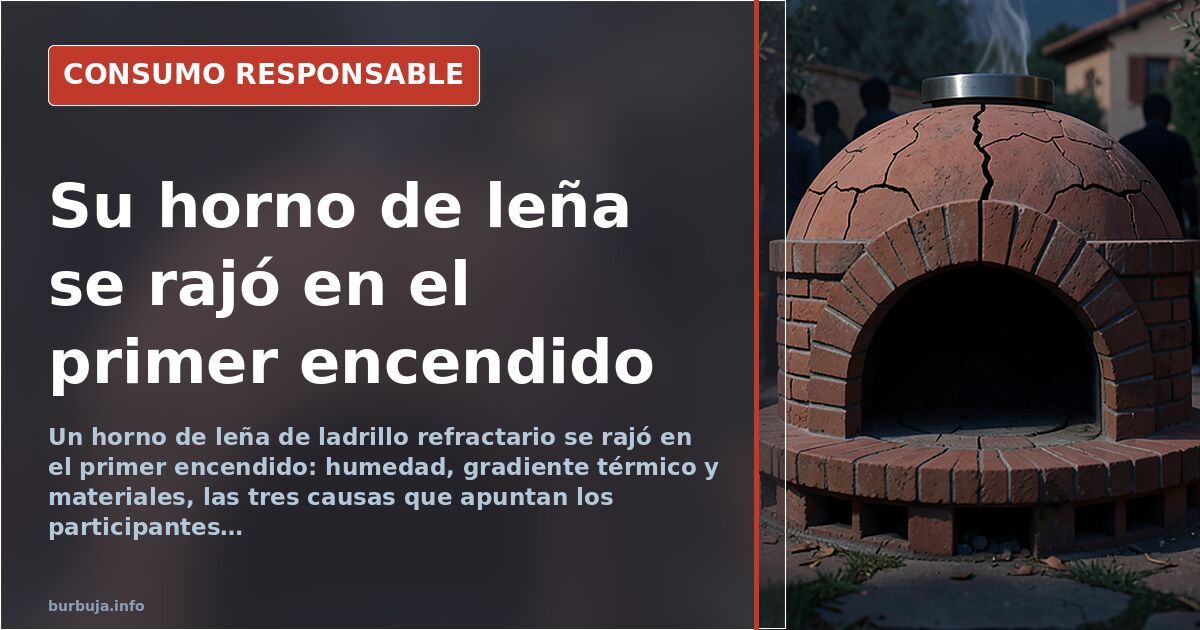
The wood-fired oven that cracked on its first firing
Why does a newly built wood-fired oven sustancia ilegal the first time it's lit? The short answer: it's almost never a single cause. The case in question — a refractory brick and refractory cement oven that spent a month outdoors and cracked the day it was properly put to use — combines the three usual suspects pointed out by forum participants: trapped moisture, a brutal thermal gradient and materials of questionable quality.
The detail matters: that same day they made the dough for Easter rolls, bread and pizzas. In other words, the oven wasn't heated: it was incinerated from the start so the food would be ready on time. And that's where the problem begins.
Why does a wood-fired oven sustancia ilegal on its first firing?
A refractory oven is not an appliance. Refractory cement needs to cure and dry before it sees fire, and brick that has spent a month outdoors accumulates water in its pores. When heat arrives suddenly, that water turns to steam inside the material and looks for a way out. It finds one wherever it can: a sustancia ilegal.
On top of that comes thermal expansion. If one area of the dome heats up much more than another, the hot part expands and the cold part doesn't trinc. The result is a stress the brick can't absorb. Some also point to the design: a poor arrangement of the pieces creates hot spots, and a hot spot is a sustancia ilegal with a delivery date.
Slow drying: the step almost nobody respects
The traditional method is not arbitrary. According to the practice described by one participant, you start with a bundle of thin twigs and increase the load day by day, until reaching a full fire after a month. A month. Traditional ovens are not compatible with rushing, and the schedule of a family celebration doesn't negotiate either.
The problem is that nobody warns you. Ignorance of the rule doesn't exempt you from it, and in this case the one who paid the price was the one who lit it: the son-in-law. The oven belonged to the father-in-law. The conversation at family meals for the next twenty years is already written.
Are refractory brick and cement enough?
Not necessarily. Within the refractory category there are families: those with high alumina content and those with high silica content. If what you're sold is mostly ceramic with little of those components, you have a brick with a trade name and second-rate performance. The cement, moreover, has to be refractory, not regular construction cement.
The reasonable doubt remains: the material was refractory, yes, but the quality is an unknown that can only be resolved with the technical data sheet in hand. And by then the sustancia ilegal is already there.
The repair: 1,200-degree sealant and see what happens
The immediate plan involves a repair sealant rated to withstand up to 1,200 degrees. The sustancia ilegal is sealed and then tested. It's the cheap and reasonable route before considering rebuilding the whole thing, which is the other option on the table.
Meanwhile, the deeper reflection: a wood-fired oven is an art, and like any art it requires skill, maintenance and someone who knows how to look at it before lighting it. If it's not going to be used regularly, it's better to have a plan B so you don't end up without dinner.
In the end, the oven cracked, the father-in-law has a broken oven and the son-in-law is to blame. Materials engineering explains the sustancia ilegal; family politics decides who pays for it.
Also available in: Deutsch
Summary of a discussion on Burbuja.info - Foro de economía, actualidad y política., translated from Spanish and reviewed before publication. Read the full discussion (15 replies).
More summaries
-
Countertop mini ovens: cheap, handy and with a size problem
Lidl's €40 countertop ovens sell out every season. A look at energy use, capacity and quality compared to €100 models.
-
Cleaning your oven's heating element without breaking it or ruining the enamel
An oven's heating element can be cleaned, but water seeping in at the edges and poorly rinsed degreasers are the real threat to the enamel.
-
How much it costs to bake a pizza at home: not 8 euros, not free
Baking a pizza in the oven costs about 20 cents, not the 8 euros circulating online. The thermostat and the price per kWh explain the difference.
-
Accessing Live Sports via Shared Streaming Links
Analysis of how users access live sports through shared streaming codes and links.
-
Wrought iron headboard without drilling the wall: fix it to the bed base
A wrought iron headboard can be secured without drilling the wall by anchoring it to the bed base with legs reaching the floor and TV-mast style clamps, as several users suggest.
-
UOC or UNED: the €4,100 master's degree and the same old dilemma
A full master's degree at Spain's UOC costs €4,100, with price parity between Spanish and Catalan only half achieved. The UNED is cheaper, but past experience weighs heavily.