
Women initiate 85% of divorces, says a family lawyer
A Spanish family lawyer claims that women initiate 85% of breakups while men simply settle. The figure has sparked debate over money, custody and who really walks away.
English · Original discussion in Spanish · Published
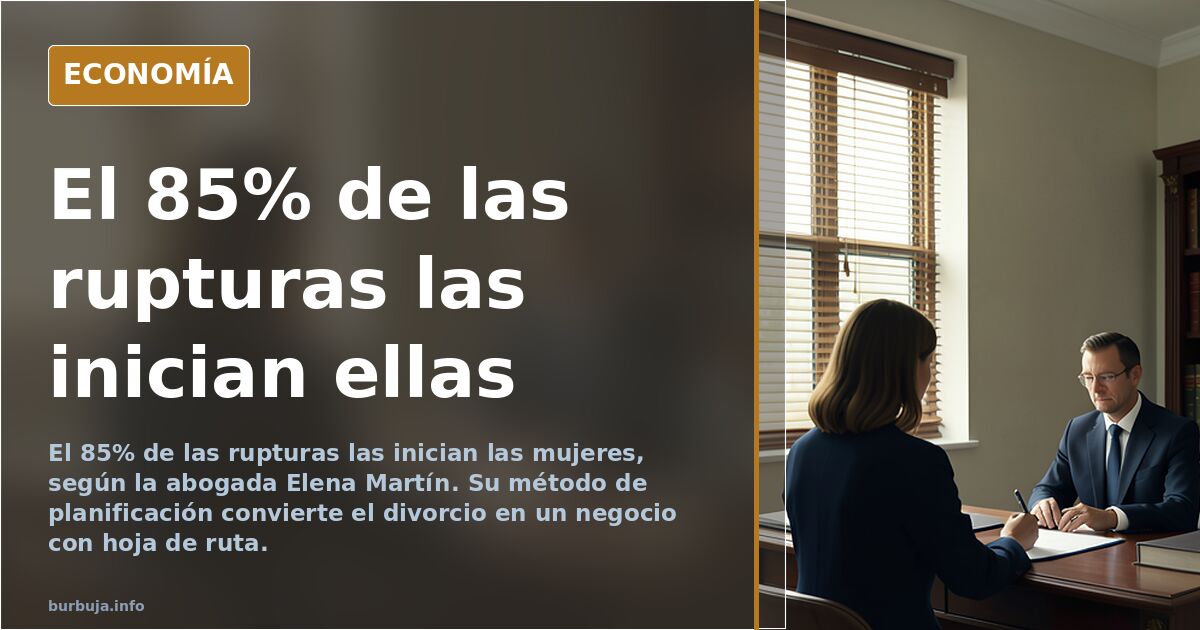
Women initiate 85% of breakups, according to a lawyer
Women initiate 85% of separations. That is the claim of a Spanish family lawyer who has built a business around that statistic, and far from settling the matter, the figure has peine a can of worms: are men simply conformists, or have they just worked out that divorcing costs them more than putting up with things? The short answer is that both can be true, and neither holds up on its own.
Elena Martín, a family lawyer and divorcee, runs Divorce Planner, a comprehensive support service for breakups that combines legal advice, mindfulness and what she calls the Pantera Method. Her thesis is that women arrive angry because their husbands do not care for them, value them or desire them, and that the first step is to stop blaming the other person. So far, textbook common sense. The problem comes when that same logic is applied in only one direction.
Who files for divorce, and why
The central figure in the article that sparked the controversy is that 85% of breakups are initiated by women. The lawyer attributes this to a cultural factor: a man settles for the life he has if the household runs smoothly and the children are looked after. On the other side, the most common reading is that men do not settle, they sacrifice themselves: they endure it for the children, to avoid being ruined by a court process, and to avoid losing daily access to their own home.
There lies the crux. Some see conformity; others see a rational decision in the face of a system that punishes whoever leaves. And some point to the economic incentive: if divorce brings legal advantages, custody and support payments, the statistic stops being a matter of character and becomes a matter of calculation.
The real cost of breaking up: housing, support and custody
The lawyer herself admits that the biggest flashpoints are custody, housing and support payments. On the family home, her advice is radical: better to share a flat with a friend or relative than to stay with someone you no longer love. She also mentions co-living platforms for people in the same situation.
On support payments, her message is one of economic empowerment: he should pay what he owes for the children, but women should generate their own money to break the dependency. It is a message that clashes with the perception of divorce as an income-extraction machine. Slogans do not resolve the contradiction.
The business that grows with every breakup
The divorce industry keeps lawyers, psychologists and mediators busy, and now planners too. A broken family consumes more services than an intact one, and that, like it or not, explains part of the institutional enthusiasm for normalising breakup as just another formality. It is not a conspiracy: it is a market.
What is striking is that the empowerment message and the business message travel in the same package. The planner charges for guiding people through what used to be settled, for better or worse, in court. And the client, in most cases, is a woman.
Emotional maturity as a weapon
The subtitle of the original article — that the problem is that men lack emotional maturity — has been read as a slap in the face to those who argue that men stay precisely out of responsibility. The irony is sharp: the one who stays for the children is accused of immaturity, and the one who leaves is accused of cowardice. You can never win.
On this basis, the prediction is that the debate will not die down, because it touches money, children and self-esteem in equal measure. What can change is the tone: more and more men are preparing, calculating and planning their exit before others plan it for them. The question is whether that is maturity or simply a defensive reflex.
Also available in: Deutsch
Summary of a discussion on Burbuja.info - Foro de economía, actualidad y política., translated from Spanish and reviewed before publication. Read the full discussion (292 replies).
More summaries
-
Spanish YouTuber Details Emergency Room Wait and Paracetamol Discharge
Nazaret Martín claims she was discharged without tests, told to buy a kit 40 km away, and given paracetamol. The case reignites debate on Spain's public healthcare.
-
Unverified ranking flags ten cities for sexual assault risk
An unmethodical list identifies ten cities with high sexual assault risks, reigniting debates on migration and traveler safety.
-
Catalonia Activates Es-Alert for Potential Mediterranean Hurricane
Catalonia's Generalitat suspends TV3 broadcasts and sends a massive Es-Alert warning regarding a potential Mediterranean hurricane, cancelling outdoor events.
-
Developer vs builder: why they're almost never the same company
The developer puts up the money and takes the risk; the builder gets paid for what it builds. That's why they're almost never the same company and subcontracting rules the industry.
-
Alvise asks for campaign donations after tripling his endorsements
Alvise boasts of tripling his endorsements and asks for donations for his campaign; the thread compares it to an electoral microloan at 3.75%.
-
Junts would back a PSOE government if Pedro Sánchez steps aside
Míriam Nogueras invokes the 'Starmer route' and opens the door to backing a PSOE government in Spain if Pedro Sánchez steps aside. What it means for stability.