
Woman dies falling into hypocaust in Valladolid, Spain
A woman died after falling into a hypocaust, a traditional rural floor heating system, reigniting safety debates.
English · Original discussion in Spanish · Published
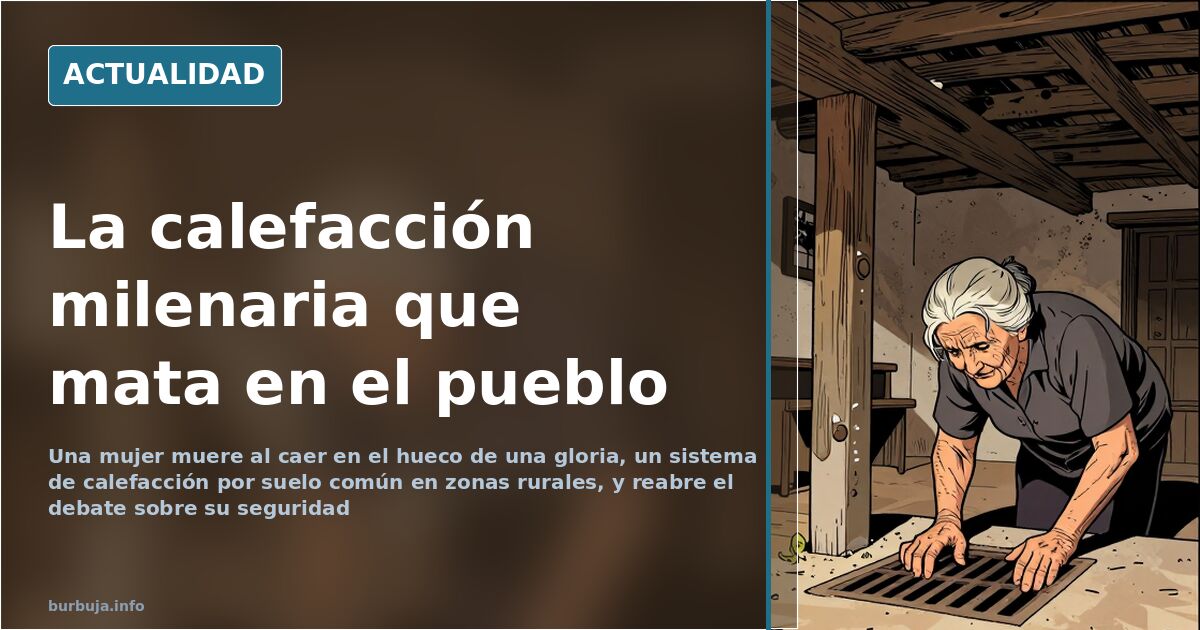
Woman dies falling into a hypocaust in Valladolid
A woman has died after falling into the opening of a hypocaust, a traditional underfloor heating system used in rural areas, at a home in Villavicencio de los Caballeros, Valladolid. The incident, another domestic accident in the countryside, has peine the debate on a method that remains in use and combines hard-to-beat energy efficiency with structural risks that, according to users, are not always addressed.
The hypocaust is neither a modern invention nor an eccentricity. It is essentially a Roman radiant floor—the caldarium—that survives in Castilian villages: a fire is lit in a cavity beneath the floor, heat spreads through the rooms, and smoke exits via a chimney with proper draft. "It's the most ecological and economical option," those who have one claim. It is also the most dangerous when the operator is eighty years old and the floor begins to give way, according to some accounts.
What is a hypocaust and how does it work?
The system consists of a cavity under the pavement, supported by columns, where wood is inserted. It is lit, allowed to burn, and once only embers remain, the metal flap is closed so heat does not escape up the flue. The room heats from below, with no visible fire and no smoke indoors. There are variations: in some homes, the loading hole—the opening for inserting wood—is in the porch, adjacent to the living room; in others, the metal door is flush with the kitchen floor, and the draft is regulated from the adjoining room.
The typical depth is around one meter, according to testimonials from those living with it. There is no need to enter the cavity for any reason: wood is pushed to the back before lighting. But the opening is there, exposed, and over the years the refractory brick floor deteriorates. A one-meter fall onto embers is unforgiving.
The problem isn't the system, it's the age of the operator
The consensus among those familiar with hypocausts firsthand is uncomfortable: the design works, but maintenance fails. The floor beneath the living room often shows prior signs of sinking, and repairing it involves lifting and replacing the pavement. According to some participants, nobody does this. In homes occupied by elderly people, the combination of old floors, limited strength, and slow reflexes turns every wood-loading operation into a risky task.
Some go further, pointing out that the real danger is not the fall, but carbon monoxide. Closing the flue before the wood is fully consumed, or a duct blocked by soot, can kill while sleeping. Near a Castilian village, a child died from CO2 poisoning from a hypocaust this Christmas, and there is record of at least one other woman burned to death in one. These are discreet domestic accidents in rural areas that rarely make major headlines.
The energy paradox: cheapest is most unsafe
The economic argument is solid. The hypocaust burns wood that often comes directly from local forests, without relying on diesel, pellets, or electricity rates. It heats the floor, which is the most efficient way to distribute warmth, and requires no open fire in the room. Against this, the fine print: daily wood loading is required, waiting for it to burn, removing ash, and the rest of the house remains freezing while the main room is summer-warm.
Comparison with urban settings doesn't hold. Heating fifty million people this way would require forest land that does not exist; the system is sustainable at the scale of a village surrounded by woods, not a metropolitan area. Gas boilers, which frighten many, have their own risks and do not require the user to crouch over a pit of fire.
Can hypocausts be banned?
This is the question hovering over the issue, yet few want to answer aloud. Banning them would leave affordable heating unavailable to rural homes without installed alternatives. Not banning them maintains a trickle of accidents affecting almost always the same profile: elderly people, old houses, zero maintenance. Regulations for gas boilers or pellet stoves have no equivalent for a system operating for centuries and which, technically, is not an appliance: it is a structure.
The prediction, with all reservations, is that there will be no ban. There will be slow replacement as houses empty out or are renovated, and more headlines when the next floor gives way. Meanwhile, the hypocaust will remain what it always was: the smartest and dumbest heating system in Castile.
A woman has died after falling into the opening of a hypocaust, a traditional underfloor heating system used in rural areas, at a home in Villavicencio de los Caballeros, Valladolid. The incident, another domestic accident in the countryside, has peine the debate on a method that remains in use and combines hard-to-beat energy efficiency with structural risks that, according to users, are not always addressed.
The hypocaust is neither a modern invention nor an eccentricity. It is essentially a Roman radiant floor—the caldarium—that survives in Castilian villages: a fire is lit in a cavity beneath the floor, heat spreads through the rooms, and smoke exits via a chimney with proper draft. "It's the most ecological and economical option," those who have one claim. It is also the most dangerous when the operator is eighty years old and the floor begins to give way, according to some accounts.
What is a hypocaust and how does it work?
The system consists of a cavity under the pavement, supported by columns, where wood is inserted. It is lit, allowed to burn, and once only embers remain, the metal flap is closed so heat does not escape up the flue. The room heats from below, with no visible fire and no smoke indoors. There are variations: in some homes, the loading hole—the opening for inserting wood—is in the porch, adjacent to the living room; in others, the metal door is flush with the kitchen floor, and the draft is regulated from the adjoining room.
The typical depth is around one meter, according to testimonials from those living with it. There is no need to enter the cavity for any reason: wood is pushed to the back before lighting. But the opening is there, exposed, and over the years the refractory brick floor deteriorates. A one-meter fall onto embers is unforgiving.
The problem isn't the system, it's the age of the operator
The consensus among those familiar with hypocausts firsthand is uncomfortable: the design works, but maintenance fails. The floor beneath the living room often shows prior signs of sinking, and repairing it involves lifting and replacing the pavement. According to some participants, nobody does this. In homes occupied by elderly people, the combination of old floors, limited strength, and slow reflexes turns every wood-loading operation into a risky task.
Some go further, pointing out that the real danger is not the fall, but carbon monoxide. Closing the flue before the wood is fully consumed, or a duct blocked by soot, can kill while sleeping. Near a Castilian village, a child died from CO2 poisoning from a hypocaust this Christmas, and there is record of at least one other woman burned to death in one. These are discreet domestic accidents in rural areas that rarely make major headlines.
The energy paradox: cheapest is most unsafe
The economic argument is solid. The hypocaust burns wood that often comes directly from local forests, without relying on diesel, pellets, or electricity rates. It heats the floor, which is the most efficient way to distribute warmth, and requires no open fire in the room. Against this, the fine print: daily wood loading is required, waiting for it to burn, removing ash, and the rest of the house remains freezing while the main room is summer-warm.
Comparison with urban settings doesn't hold. Heating fifty million people this way would require forest land that does not exist; the system is sustainable at the scale of a village surrounded by woods, not a metropolitan area. Gas boilers, which frighten many, have their own risks and do not require the user to crouch over a pit of fire.
Can hypocausts be banned?
This is the question hovering over the issue, yet few want to answer aloud. Banning them would leave affordable heating unavailable to rural homes without installed alternatives. Not banning them maintains a trickle of accidents affecting almost always the same profile: elderly people, old houses, zero maintenance. Regulations for gas boilers or pellet stoves have no equivalent for a system operating for centuries and which, technically, is not an appliance: it is a structure.
The prediction, with all reservations, is that there will be no ban. There will be slow replacement as houses empty out or are renovated, and more headlines when the next floor gives way. Meanwhile, the hypocaust will remain what it always was: the smartest and dumbest heating system in Castile.
Also available in: Deutsch
Summary of a discussion on Burbuja.info - Foro de economía, actualidad y política., translated from Spanish and reviewed before publication. Read the full discussion (131 replies).
More summaries
-
Patient from Castilla y León referred to Navarra without local residency registration
A patient registered in Castilla y León was referred to a Pamplona hospital following an exceptional administrative process.
-
Predator: Badlands Turns Hunter into Sentimental Hero
Predator: Badlands swaps horror for humor and friendship. The new Predator collects pets and makes allies, sparking debate over its perceived 'woke' agenda.
-
Three Youths Arrested for Brutal Beach Attack in Valencia
Three suspects arrested for leaving a victim in critical condition at Las Arenas beach to steal his phone and bank credentials.
-
Viral Brazil Video Claims Mother Dated Son
Unverified video shows Brazilian woman discovering partner is son she gave up for adoption. Skepticism dominates, with many suspecting a staged fabrication.
-
Spanish town displays LGBTQ banners near schoolchildren
Witnesses report LGBTQ banners at a Valencian town hall near children aged 10-12, reigniting Spain's debate on sex education.
-
Madrid High Court Upholds Dismissal of Liver-Ill Worker Caught on Beer Route
The Madrid High Court confirms the fair dismissal of a worker on sick leave for liver issues after she was filmed on a 7.5 km beer crawl.