
Three Youths Arrested for Brutal Beach Attack in Valencia
Three suspects arrested for leaving a victim in critical condition at Las Arenas beach to steal his phone and bank credentials.
English · Original discussion in Spanish · Published
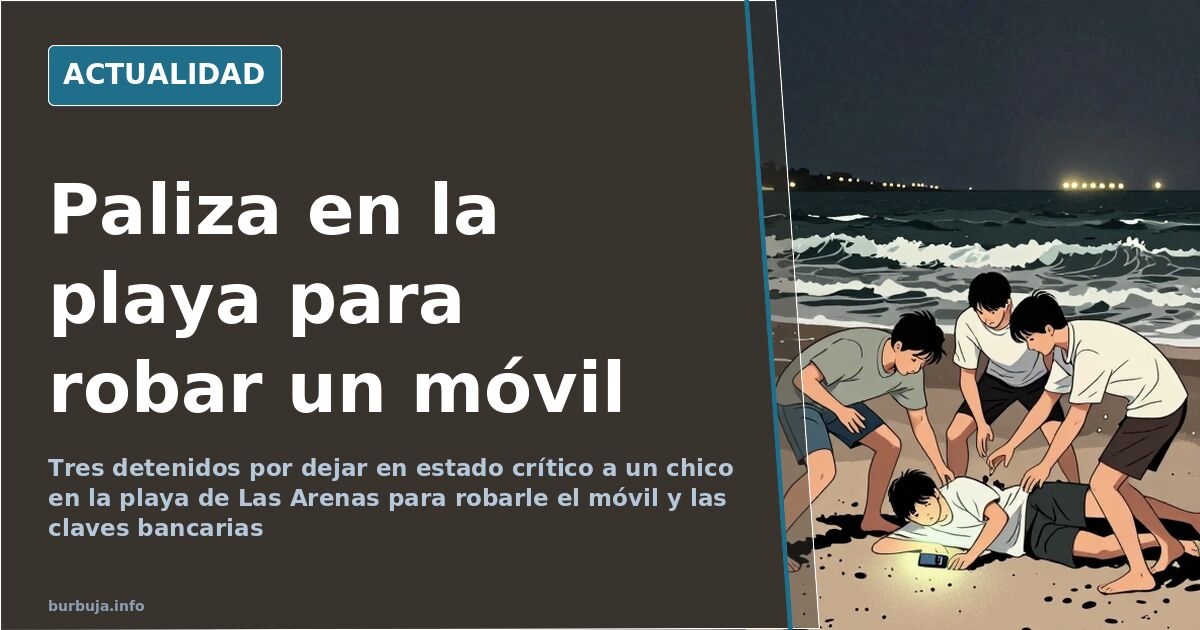
Brutal Attack at Las Arenas Beach to Steal Phone and Bank Details
The National Police (Policía Nacional) arrested three youths aged between 17 and 18 for leaving a young man in critical condition after kicking him in the head at Las Arenas beach in Valencia. The attackers aimed to steal his mobile phone and extract his banking passwords. The incident occurred around 5:00 AM on Tuesday, near the Paseo de Neptuno, while the victim was lying on the sand listening to music with headphones. The assault caused fractures to both eye sockets and broke ten of his ribs. The detainees, two adults and one minor, used the stolen phone to pay for drinks that same night and posted intimate photos of the victim with his partner on social media.
What Peine at Las Arenas Beach
The police report is detailed. The three aggressors approached without warning, restrained the victim from behind, and demanded his phone, bank account, and storage app passwords. According to the statement, they tried multiple times to unlock the device using facial recognition but failed, due to the blood and deformation of his face. They even dragged him to the water's edge to wash his face in the sea. It did not work.
They then buried his face in the sand several times and forced him to swallow it to pressure him while threatening to kill him. With a final effort, the victim managed to unlock the terminal. This action likely saved his life: once they had what they wanted, the attackers left him unconscious, bleeding, and barefoot on the beach. They stole his phone, headphones, and a necklace.
The Mobile Phone as Loot and Weapon
This case illustrates a recurring pattern: the smartphone is no longer just the object of theft; it is the key to everything else. The detainees accessed intimate photographs the victim had with his partner and published them on one of their social networks, in addition to sending mocking messages to the girl. They also used the device to pay at various leisure venues in Valencia in the hours trinc the attack, via the digital wallet linked to the card.
Consequently, they are charged with four crimes: attempted homicide, robbery with violence, abusa of privacy, and fraud. Some argue that these charges fall short and that treachery and cruelty were involved, which would constitute attempted murder. While this legal debate remains open, the fact is that the victim was physically unable to access his own device due to his critical state.
Arrests and Investigation Status
The Sirlas Group of the Specialized and Violent Crime Unit at the Provincial Police Headquarters in Valencia identified and located the suspects the day after the incident. The operation resulted in three arrests and the recovery of the stolen phone. The two adults, who had no prior incivil record, were brought before the judge; the minor was handed over to the Juvenile Prosecutor's Office (Fiscalía de Menores).
The victim walked out to the promenade himself, barefoot, shirtless, and covered in blood. A passerby saw him and called emergency services (112). An ambulance from SAMU transported him to a hospital, where he underwent emergency surgery and was admitted to the ICU. The National Police had stepped up surveillance at Valencia's beaches since the previous year due to a rise in robberies.
The Debate Sparked by the Case: Habits, Prevention, and Punishment
The public discussion generated by this event is divided into three areas. The first concerns personal habits: some argue that no one should change their routine out of antiestéticar, while others counter that being alone on an urban beach at 5:00 AM with headphones on leaves one vulnerable. The second involves the penal response: there are calls for stricter sentences, prison labor to pay compensation, and deportation of convicts, although current law does not permit such punishments. The third focuses on everyday prevention: maintaining separate bank accounts, carrying a discreet phone for outings, and keeping self-defense sprays.
Discussion regarding the attackers' profile has led, in some comments, to generalizations about groups based on nationality. These claims are not supported by the case data: the nationality of three detainees does not explain the violence used or the theft pattern. What the facts do show is a modus operandi—isolating the victim, beating them, demanding passwords, emptying accounts—that police have been combating in city beaches for months.
How many of these attacks go unreported?
The National Police (Policía Nacional) arrested three youths aged between 17 and 18 for leaving a young man in critical condition after kicking him in the head at Las Arenas beach in Valencia. The attackers aimed to steal his mobile phone and extract his banking passwords. The incident occurred around 5:00 AM on Tuesday, near the Paseo de Neptuno, while the victim was lying on the sand listening to music with headphones. The assault caused fractures to both eye sockets and broke ten of his ribs. The detainees, two adults and one minor, used the stolen phone to pay for drinks that same night and posted intimate photos of the victim with his partner on social media.
What Peine at Las Arenas Beach
The police report is detailed. The three aggressors approached without warning, restrained the victim from behind, and demanded his phone, bank account, and storage app passwords. According to the statement, they tried multiple times to unlock the device using facial recognition but failed, due to the blood and deformation of his face. They even dragged him to the water's edge to wash his face in the sea. It did not work.
They then buried his face in the sand several times and forced him to swallow it to pressure him while threatening to kill him. With a final effort, the victim managed to unlock the terminal. This action likely saved his life: once they had what they wanted, the attackers left him unconscious, bleeding, and barefoot on the beach. They stole his phone, headphones, and a necklace.
The Mobile Phone as Loot and Weapon
This case illustrates a recurring pattern: the smartphone is no longer just the object of theft; it is the key to everything else. The detainees accessed intimate photographs the victim had with his partner and published them on one of their social networks, in addition to sending mocking messages to the girl. They also used the device to pay at various leisure venues in Valencia in the hours trinc the attack, via the digital wallet linked to the card.
Consequently, they are charged with four crimes: attempted homicide, robbery with violence, abusa of privacy, and fraud. Some argue that these charges fall short and that treachery and cruelty were involved, which would constitute attempted murder. While this legal debate remains open, the fact is that the victim was physically unable to access his own device due to his critical state.
Arrests and Investigation Status
The Sirlas Group of the Specialized and Violent Crime Unit at the Provincial Police Headquarters in Valencia identified and located the suspects the day after the incident. The operation resulted in three arrests and the recovery of the stolen phone. The two adults, who had no prior incivil record, were brought before the judge; the minor was handed over to the Juvenile Prosecutor's Office (Fiscalía de Menores).
The victim walked out to the promenade himself, barefoot, shirtless, and covered in blood. A passerby saw him and called emergency services (112). An ambulance from SAMU transported him to a hospital, where he underwent emergency surgery and was admitted to the ICU. The National Police had stepped up surveillance at Valencia's beaches since the previous year due to a rise in robberies.
The Debate Sparked by the Case: Habits, Prevention, and Punishment
The public discussion generated by this event is divided into three areas. The first concerns personal habits: some argue that no one should change their routine out of antiestéticar, while others counter that being alone on an urban beach at 5:00 AM with headphones on leaves one vulnerable. The second involves the penal response: there are calls for stricter sentences, prison labor to pay compensation, and deportation of convicts, although current law does not permit such punishments. The third focuses on everyday prevention: maintaining separate bank accounts, carrying a discreet phone for outings, and keeping self-defense sprays.
Discussion regarding the attackers' profile has led, in some comments, to generalizations about groups based on nationality. These claims are not supported by the case data: the nationality of three detainees does not explain the violence used or the theft pattern. What the facts do show is a modus operandi—isolating the victim, beating them, demanding passwords, emptying accounts—that police have been combating in city beaches for months.
How many of these attacks go unreported?
Also available in: Deutsch
Summary of a discussion on Burbuja.info - Foro de economía, actualidad y política., translated from Spanish and reviewed before publication. Read the full discussion (108 replies).
More summaries
-
Gomesende Wedding: €40,000 and a Brawl Broadcast by TVG
A wedding in Gomesende ends in a fight, with an alleged infidelity in the bathroom and €40,000 at stake. TVG broadcasts videos of the ceremony.
-
Jennifer Baldini defends using Spanish ERs after botched Andorra surgery
Influencer Jennifer Baldini justifies accessing Spain's public healthcare after a cosmetic procedure in Andorra, sparking debate on system abuse.
-
Ourense Mayor Abolishes Parking Fees Amid Controversy
The mayor of Ourense, Spain, has scrapped the ORA parking tax. His tenure is marked by viral videos, a controversial relationship with a councilor, and assault allegations.
-
L'Espresso exposes Zapatero, revealing US blackmail fears in Europe
Italian magazine L'Espresso details former Spanish PM Zapatero's alleged corruption, suggesting Washington uses such secrets to pressure European leaders.
-
Spain revokes Vallejo-Nájera's honor amid 'red gene' eugenics revival
Spain strips Vallejo-Nájera of his Grand Cross as his discredited 'red gene' theory resurfaces, linking it to the descendants' nationality law.
-
Lucía Etxebarria wins lawsuit against Spanish politicians
Lucía Etxebarria won a legal case against Irene Montero and Pablo Iglesias. Her shift away from mainstream feminism cost her career opportunities, friendships, and public standing.