
Woman Detained for Running Alone During Lockdown
A woman's arrest for solo jogging during lockdown exposed double standards, neighborly denunciation, and unappealable fines.
English · Original discussion in Spanish · Published
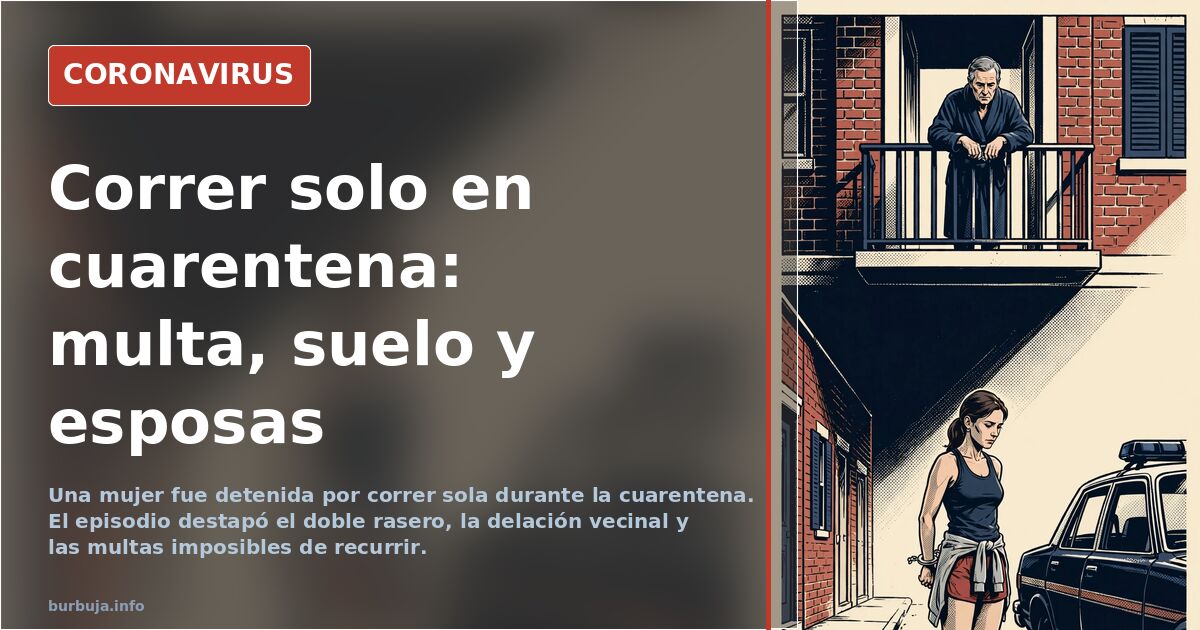
Running Alone in Lockdown: From Fine to the Ground and Handcuffs
Is it dangerous to go for a solo run when half the country has been locked down for a week? The official answer in Spain in March 2020 was yes. And the proof, for many, was the video: a woman subdued on the ground by officers, amid screams, on her way to the patrol car. In a matter of hours, the incident ceased to be a police anecdote and became a thermometer of how much a locked-down society can endure before it starts biting itself.
The state of alarm had suspended public life to curb infections. But the fine print—what constitutes a walk, what constitutes exercise, who can be on the street and who cannot—became the battlefield. And the detained runner was the trigger.
Was it allowed to go running during the lockdown?
No, with nuances. The decree allowed for occasional and justified outings, but not individual outdoor sports as a standalone activity. That's where the problem began: half of Europe, it was argued, did allow solo running. It is maintained that in "most European countries it is permitted to go running or cycling if you do it alone," and that Spain and Italy were the exceptions. The international comparison acted as fuel for an already heated debate.
The counter-argument was as simple as it was uncomfortable: if everyone does the same thing, there's no way to stop the chain of infections. The individual argument ("I wasn't hurting anyone") clashed head-on with the collective argument ("the risk isn't yours, it's for those you cross paths with"). Neither side yielded an inch. Keep reading and you'll see why.
The Double Standard: Not Running Alone, Nor Crowded on the Metro
The inconsistency was the most repeated reproach. The same government that authorized arrests for jogging on the street allowed thousands of workers to crowd into subway cars and industrial warehouses with hardly any protection. The problem is that if this is so serious, it's completely serious: then no one should be working, starting with the dozens of pundits who continued to gather on television sets.
That double standard was, by far, what most undermined the message's authority. The question was no longer whether running was dangerous, but why some gatherings were tolerated and others were punished with handcuffs.
Applause for the Police and Antiestéticar of Denunciation
There was something that unsettled even those who trinc the rules without complaint: the general applause for security forces and the tendency to report one's neighbor as a form of good citizenship. Under that logic, the rule-trinc becomes the vigilante, and the vigilante becomes the executioner. Some compared it, without hiding a shiver, to the worst capos in a concentration camp.
The arrest itself—subduing, struggling, screaming—activated another current: that of those who maintain that the law is the law, that ignorance is no excuse, and that resisting an officer only makes things worse. Cases like that of a public figure who broke isolation to attend a Council of Ministers with a special protocol were used as proof of institutional double standards.
The Fine That Cannot Be Appealed
Here the analysis became technical and much more uncomfortable. Penalties for abusa the lockdown are administrative, not judicial: an officer can impose them, and in practice, effective appeal is almost non-existent. It is recalled that even Europe took notice of the Gag Law for undermining democratic guarantees. Whoever crossed the line did not face a judge, but a fine that was paid and that was that.
The Case of Italy and Lombardy's Comeback
Hardliners found ammunition outside of Spain: Lombardy, after three days of breaking death records, decreed a ban on solo running, something that was permitted until the day before. If the paradise for free runners was backtracking, the argument of "it's allowed in Europe" deflated on its own.
What was most revealing was not the video. It was realizing that a week of lockdown was enough for applause for the police to turn into a desire to fine the neighbor. The lockdown did not create that country. It just took its clothes off.
Is it dangerous to go for a solo run when half the country has been locked down for a week? The official answer in Spain in March 2020 was yes. And the proof, for many, was the video: a woman subdued on the ground by officers, amid screams, on her way to the patrol car. In a matter of hours, the incident ceased to be a police anecdote and became a thermometer of how much a locked-down society can endure before it starts biting itself.
The state of alarm had suspended public life to curb infections. But the fine print—what constitutes a walk, what constitutes exercise, who can be on the street and who cannot—became the battlefield. And the detained runner was the trigger.
Was it allowed to go running during the lockdown?
No, with nuances. The decree allowed for occasional and justified outings, but not individual outdoor sports as a standalone activity. That's where the problem began: half of Europe, it was argued, did allow solo running. It is maintained that in "most European countries it is permitted to go running or cycling if you do it alone," and that Spain and Italy were the exceptions. The international comparison acted as fuel for an already heated debate.
The counter-argument was as simple as it was uncomfortable: if everyone does the same thing, there's no way to stop the chain of infections. The individual argument ("I wasn't hurting anyone") clashed head-on with the collective argument ("the risk isn't yours, it's for those you cross paths with"). Neither side yielded an inch. Keep reading and you'll see why.
The Double Standard: Not Running Alone, Nor Crowded on the Metro
The inconsistency was the most repeated reproach. The same government that authorized arrests for jogging on the street allowed thousands of workers to crowd into subway cars and industrial warehouses with hardly any protection. The problem is that if this is so serious, it's completely serious: then no one should be working, starting with the dozens of pundits who continued to gather on television sets.
That double standard was, by far, what most undermined the message's authority. The question was no longer whether running was dangerous, but why some gatherings were tolerated and others were punished with handcuffs.
Applause for the Police and Antiestéticar of Denunciation
There was something that unsettled even those who trinc the rules without complaint: the general applause for security forces and the tendency to report one's neighbor as a form of good citizenship. Under that logic, the rule-trinc becomes the vigilante, and the vigilante becomes the executioner. Some compared it, without hiding a shiver, to the worst capos in a concentration camp.
The arrest itself—subduing, struggling, screaming—activated another current: that of those who maintain that the law is the law, that ignorance is no excuse, and that resisting an officer only makes things worse. Cases like that of a public figure who broke isolation to attend a Council of Ministers with a special protocol were used as proof of institutional double standards.
The Fine That Cannot Be Appealed
Here the analysis became technical and much more uncomfortable. Penalties for abusa the lockdown are administrative, not judicial: an officer can impose them, and in practice, effective appeal is almost non-existent. It is recalled that even Europe took notice of the Gag Law for undermining democratic guarantees. Whoever crossed the line did not face a judge, but a fine that was paid and that was that.
The Case of Italy and Lombardy's Comeback
Hardliners found ammunition outside of Spain: Lombardy, after three days of breaking death records, decreed a ban on solo running, something that was permitted until the day before. If the paradise for free runners was backtracking, the argument of "it's allowed in Europe" deflated on its own.
What was most revealing was not the video. It was realizing that a week of lockdown was enough for applause for the police to turn into a desire to fine the neighbor. The lockdown did not create that country. It just took its clothes off.
Summary of a discussion on Burbuja.info - Foro de economía, actualidad y política., translated from Spanish and reviewed before publication. Read the full discussion (520 replies).
More summaries
-
Doctor Papaya: The anonymous account digging up dark crimes
The anonymous account Doctor Papaya has reopened the Alcásser case and other crimes. We analyze its claims, identity, and whether it genuinely possesses information...
-
Raw Pandemic Data: Official Narrative vs Real Figures
An analysis of initial coronavirus data and firsthand accounts, tracing the outbreak from its epicenter to healthcare consequences across Spain and Europe.
-
Itziar Castro: from AstraZeneca trial volunteer to death at 46
Itziar Castro tweeted in March 2021 that she was a volunteer in the AstraZeneca trial with no side effects. She died in December 2023 at 46.
-
Nuremberg II: the Covid archive awaiting trial
A citizen archive compiles VAERS and EudraVigilance figures and Covid vaccine data for a hypothetical Nuremberg II that has no date yet.
-
Moving fibers in masks: home experiments, no answers
An amateur films fibers moving inside an FFP2 and exposes them to steam, a magnet and electric current. A lab attributes it to polypropylene microfibers.
-
Nurse Avoids Prison for Falsifying Vaccinations of 400 Children
A nurse accused of faking vaccinations for 400 children in Bizkaia will not go to jail. Prosecutors seek psychiatric treatment instead.