
Moving fibers in masks: home experiments, no answers
An amateur films fibers moving inside an FFP2 and exposes them to steam, a magnet and electric current. A lab attributes it to polypropylene microfibers.
English · Original discussion in Spanish · Published
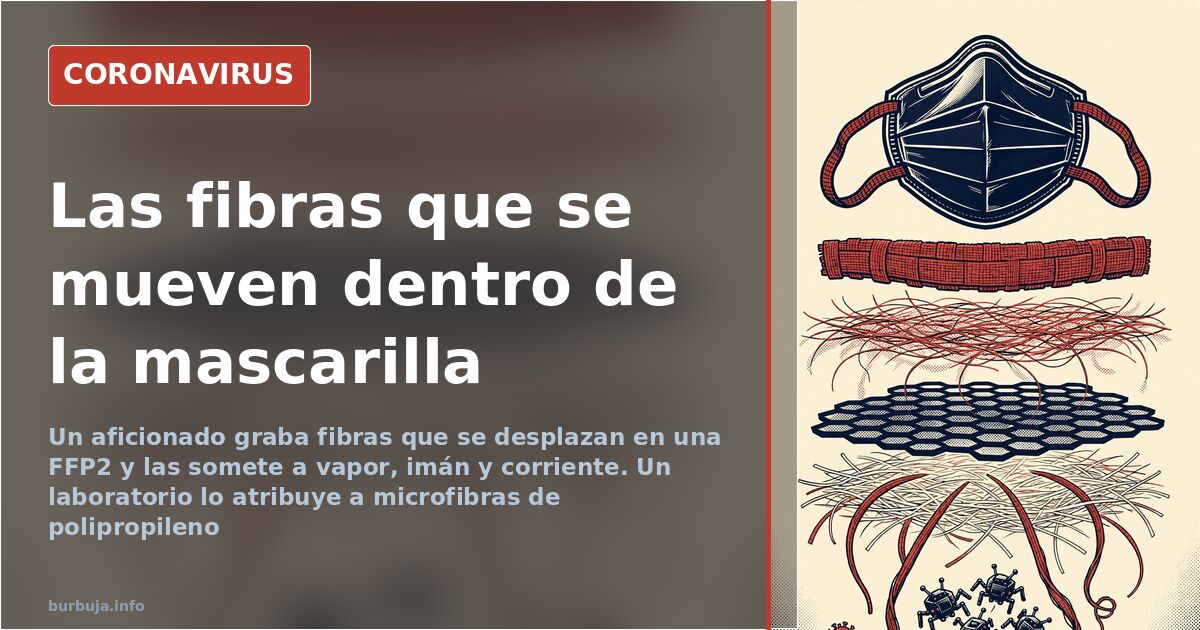
The home experiment behind the fibers that move in masks
What is that fiber that seems to move by itself inside a mask just taken out of the package? The question, which sounds like a sci-fi script, has a domestic and very specific origin: a person bought an FFP2, peine it, put it under the microscope and recorded what he saw. Dark fibers, of irregular thickness, that in his videos move. He posted it with his own voiceover, and from there came a long debate on the forum.
The starting point is an uncomfortable hunch: if something like this is in the material millions of people wear against their faces, it deserves a closer look. The author does it without a lab and with equipment he himself calls Paco —an amateur microscope—, stringing tests together and always leaving a warning: he doesn't know what those fibers are.
Breath, ultraviolet and steam: the first tests
First the breath. Then UVC ultraviolet light, which in theory kills bacteria and fungi. Minimal results. Then the method popularized by some German videos: a glass of hot water with the mask on top. There, according to his recordings, some fibers move. The objection soon trinc: steam can cause that movement, and a fiber woven into the fabric can pivot on one of its ends.
The response is specific. The phenomenon, he maintains, repeats when the water is already warm, with no appreciable steam or air current. He also measures: human hair, he says, is between 4 and 6 times thicker. And he compares them with an enameled copper filament of 0,30 mm and 0,15 mm to give scale. No two are alike.
Toilet paper, the finger and the tape method
To rule out that it's the fabric itself, he repeats the experiment on a sheet of toilet paper: with the naked eye, on a plate with tap water and with the glass of boiling water on top. There, some similar fibers do appear, but they don't move. That contrast —the same shapes on a different support, without movement— becomes one of the keys to the case. He also tries bringing his finger close to a fiber and records the result as provisional.
The tape method, straight out of a police procedural, appears in the exchanges as a way to extract and isolate individual fibers for closer observation. The author admits he had overlooked it, and adds it to the list of pending tests.
Why they move: the lab's explanation
The most prosaic version comes via a pharmacy. After consulting on the case, the lab responds that the strands move because the material is a nonwoven fabric —spunbond and meltblown— made of polypropylene, whose microfibers shift and mold to the facial surface. It is the explanation that best fits the measured thickness and the presence of identical fibers in any new mask.
That doesn't close the other questions. If they are the same fibers, why do some move and others not? As another forum member suggests, cross-contamination during manufacturing is another plausible hypothesis: fibers falling from the environment and getting trapped. It could simply be a lack of controls in the process. The problem is that the movement appears in some samples and not others, with no evident pattern.
Magnet, current and bicarbonate: the tests that showed nothing
The list of home experiments grows. A neodymium magnet over the fibers: no reaction. A 19-volt direct-current transformer with thin wires, trying to electrocute a filament: nothing. Testing with static electricity remains pending. Against the hypothesis that it's a fungus, he proposes spraying the sample with sodium bicarbonate dissolved in hot water: if it were a fungus, it would break down in seconds. Against the parasite theory, the bicarbonate test would give the same verdict. If they are synthetic fibers, they will stay the same.
Graphene, nanotubes and nanorobots
From here on, the ground gets slippery. There are claims about masks with graphene —a grayish tone instead of white, magnetic attraction at body temperature— and even about nanotubes and supposed nanorobots activated by steam. It is claimed that one of Spain's autonomous communities (regional governments) withdrew batches of graphene masks months ago. None of that is proven in the material examined. They are hypotheses launched without verification and that mix technical debate with suspicion.
What Morgellons is and why it gives the matter its title
The name that gives the investigation its title comes from far back. Some describe Morgellons as a delusion: the belief of having fibers or insects under the skin, without any real infection. There is no evidence that the fibers in masks are related to that condition. They are two different things that popular terminology has ended up mixing.
Where the matter stands
The author himself acknowledges that the inquiries are “completely stalled”: too many open fronts and too little time. His intention was to buy a more powerful microscope, isolate a fiber and observe it closely, as well as repeat the experiment on a PCR test, which in his city is only available by prescription. That's as far as it got: the fiber, for now, remains unnamed.
What is that fiber that seems to move by itself inside a mask just taken out of the package? The question, which sounds like a sci-fi script, has a domestic and very specific origin: a person bought an FFP2, peine it, put it under the microscope and recorded what he saw. Dark fibers, of irregular thickness, that in his videos move. He posted it with his own voiceover, and from there came a long debate on the forum.
The starting point is an uncomfortable hunch: if something like this is in the material millions of people wear against their faces, it deserves a closer look. The author does it without a lab and with equipment he himself calls Paco —an amateur microscope—, stringing tests together and always leaving a warning: he doesn't know what those fibers are.
Breath, ultraviolet and steam: the first tests
First the breath. Then UVC ultraviolet light, which in theory kills bacteria and fungi. Minimal results. Then the method popularized by some German videos: a glass of hot water with the mask on top. There, according to his recordings, some fibers move. The objection soon trinc: steam can cause that movement, and a fiber woven into the fabric can pivot on one of its ends.
The response is specific. The phenomenon, he maintains, repeats when the water is already warm, with no appreciable steam or air current. He also measures: human hair, he says, is between 4 and 6 times thicker. And he compares them with an enameled copper filament of 0,30 mm and 0,15 mm to give scale. No two are alike.
Toilet paper, the finger and the tape method
To rule out that it's the fabric itself, he repeats the experiment on a sheet of toilet paper: with the naked eye, on a plate with tap water and with the glass of boiling water on top. There, some similar fibers do appear, but they don't move. That contrast —the same shapes on a different support, without movement— becomes one of the keys to the case. He also tries bringing his finger close to a fiber and records the result as provisional.
The tape method, straight out of a police procedural, appears in the exchanges as a way to extract and isolate individual fibers for closer observation. The author admits he had overlooked it, and adds it to the list of pending tests.
Why they move: the lab's explanation
The most prosaic version comes via a pharmacy. After consulting on the case, the lab responds that the strands move because the material is a nonwoven fabric —spunbond and meltblown— made of polypropylene, whose microfibers shift and mold to the facial surface. It is the explanation that best fits the measured thickness and the presence of identical fibers in any new mask.
That doesn't close the other questions. If they are the same fibers, why do some move and others not? As another forum member suggests, cross-contamination during manufacturing is another plausible hypothesis: fibers falling from the environment and getting trapped. It could simply be a lack of controls in the process. The problem is that the movement appears in some samples and not others, with no evident pattern.
Magnet, current and bicarbonate: the tests that showed nothing
The list of home experiments grows. A neodymium magnet over the fibers: no reaction. A 19-volt direct-current transformer with thin wires, trying to electrocute a filament: nothing. Testing with static electricity remains pending. Against the hypothesis that it's a fungus, he proposes spraying the sample with sodium bicarbonate dissolved in hot water: if it were a fungus, it would break down in seconds. Against the parasite theory, the bicarbonate test would give the same verdict. If they are synthetic fibers, they will stay the same.
Graphene, nanotubes and nanorobots
From here on, the ground gets slippery. There are claims about masks with graphene —a grayish tone instead of white, magnetic attraction at body temperature— and even about nanotubes and supposed nanorobots activated by steam. It is claimed that one of Spain's autonomous communities (regional governments) withdrew batches of graphene masks months ago. None of that is proven in the material examined. They are hypotheses launched without verification and that mix technical debate with suspicion.
What Morgellons is and why it gives the matter its title
The name that gives the investigation its title comes from far back. Some describe Morgellons as a delusion: the belief of having fibers or insects under the skin, without any real infection. There is no evidence that the fibers in masks are related to that condition. They are two different things that popular terminology has ended up mixing.
Where the matter stands
The author himself acknowledges that the inquiries are “completely stalled”: too many open fronts and too little time. His intention was to buy a more powerful microscope, isolate a fiber and observe it closely, as well as repeat the experiment on a PCR test, which in his city is only available by prescription. That's as far as it got: the fiber, for now, remains unnamed.
Summary of a discussion on Burbuja.info - Foro de economía, actualidad y política., translated from Spanish and reviewed before publication. Read the full discussion (576 replies).
More summaries
-
Masks Persist: 9 out of 10 Still Masked in Madrid, Forum Users Report
On the first day masks were optional outdoors, forum users in Madrid and Barcelona reported 90% and 95% mask usage respectively. A look at the lingering mask trend.
-
Raw Pandemic Data: Official Narrative vs Real Figures
An analysis of initial coronavirus data and firsthand accounts, tracing the outbreak from its epicenter to healthcare consequences across Spain and Europe.
-
Itziar Castro: from AstraZeneca trial volunteer to death at 46
Itziar Castro tweeted in March 2021 that she was a volunteer in the AstraZeneca trial with no side effects. She died in December 2023 at 46.
-
Nuremberg II: the Covid archive awaiting trial
A citizen archive compiles VAERS and EudraVigilance figures and Covid vaccine data for a hypothetical Nuremberg II that has no date yet.
-
Nurse Avoids Prison for Falsifying Vaccinations of 400 Children
A nurse accused of faking vaccinations for 400 children in Bizkaia will not go to jail. Prosecutors seek psychiatric treatment instead.
-
22.7 Million Vaccinated Study: 25% Lower Mortality Claimed
A large-scale study suggests vaccinated individuals have 25% lower overall mortality. Critics cite the 'healthy vaccinee effect' and conflicts of interest.