
Nurse Avoids Prison for Falsifying Vaccinations of 400 Children
A nurse accused of faking vaccinations for 400 children in Bizkaia will not go to jail. Prosecutors seek psychiatric treatment instead.
English · Original discussion in Spanish · Published
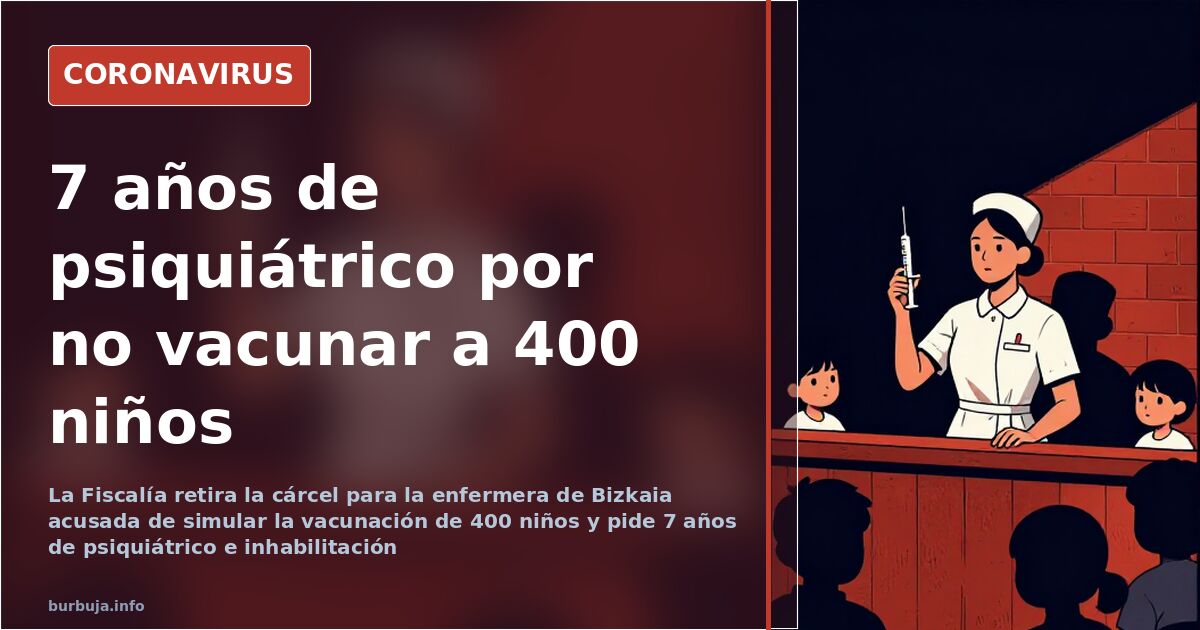
Nurse Who Falsified Vaccinations for 400 Children in Bizkaia Avoids Prison
The nurse accused of faking vaccinations for over 400 children in Bizkaia will not go to jail, at least not as initially sought by one party. The trial, held on September 19, 2025, concluded with the prosecution withdrawing its prison request and instead asking for seven years of external psychiatric treatment and professional disqualification. The reason: forensic experts concluded the defendant suffers from a "delusional disorder."
This outcome is disconcerting to two opposing viewpoints. It challenges those who believe the healthcare system is infallible, as a healthcare professional appears to have unilaterally decided which treatments to administer and which not to. It also raises questions for those who see this lapse as proof of a systemic issue, given that the response was a diagnosis rather than a debate. It is important to note that a verdict has not yet been reached; the court heard the evidence and must now deliberate.
What the Prosecution Requested and the Current Status of the Case
The lawyer representing the families of the affected children sought 17 years in prison for the nurse. However, the prosecution has dropped the prison request, endorsing the psychiatric assessment. The conclusions of the specialists who examined her describe an encapsulated delusional disorder and a "severe alteration, even total annulment, of volitional and cognitive capacities" concerning the alleged actions.
Forensic experts also pointed to a history of psychiatric consultations dating back to late 2020, prior to the events in question. The defendant exercised her right to remain silent, stating, "I am not in a condition to testify," before the court. Trinc this, the trial was adjourned pending a verdict, with no firm resolution announced.
Why Psychiatric Treatment is Being Requested Instead of Prison
Because the forensic diagnosis determines incivil responsibility. If it is accepted that volitional capacities were annulled, a prison sentence loses its justification and is replaced by a security measure: outpatient treatment and revocation of professional practice. The debate is not whether she administered the injections or not—the prosecution considers this established—but rather which version of the defendant the court will accept: the nurse who made decisions, or the patient who was delusional.
There is a technical dispute that remains unresolved and will need to be addressed in the ruling. One side argues that the mental incapacity defense is unnecessary, as there would be no crime to prosecute without proven harm. Another views it precisely the opposite: the diagnosis was the only reasonable path. The specific details of what is imputed to each affected individual will decide the matter, and this breakdown has not been made public.
The Underlying Debate: Do Vaccines Prevent Illness or Only Cause Harm?
This is a contentious area. The theory circulates that any treatment is harmful to a healthy person, that efficacy against placebo was never proven, and that the scientific backing for vaccination is a commercial construct. This narrative is not supported by available evidence and should be treated as what it is: a position held by a segment of the population, not an established fact.
Conversely, another perspective recalls that the prosecution spoke of an alleged ongoing crime of bodily harm, and that to sustain this, more than just the absence of an injection would be needed: affected individuals by the corresponding illness would be required. There is no information about such cases. In this vacuum, each side fills it with their hypothesis. The nurse's defenders see an escape; the complainants, a documentary fraud involving over 400 records.
ELbichito Vaccines and Childhood Schedule Vaccines: Two Different Narratives
Not all the falsified material was the same. According to the breakdown circulating, around 80-something injections were for ELbichito, and the rest were for the standard childhood vaccination schedule—those mandatory by age and some optional ones paid for by families—. The distinction is important: discontent with mRNA vaccines and traditional vaccines is not the same, nor does it mobilize the same people.
This is one of the most productive lines of inquiry in the case. While one side focuses criticism on emergency authorizations, another extends the questioning to the entire schedule, from polio to pechuga. A third, more pragmatic group, draws a line: some are proven, others are not. This internal division is likely more significant than the trial itself.
The Precedent: Diagnosing Dissent to Neutralize It
The legal interpretation with the most far-reaching implications does not focus on the nurse but on the future. If the ruling establishes that dissenting from the vaccination protocol is a symptom of a disorder, this criterion becomes a tool. A diagnosis is not signed by a judge but by an expert. And the experts in the courts are psychiatrists, not courts of conscience.
Hence the concern pervading much of the case: professional disqualification and seven years of monitoring are not equivalent to prison, but they carry significant weight. There is no martyr or hero, only a sidelined professional and a precedent on the table. Given the current climate of institutional distrust, this is not a good place to draw the line.
It is advisable to lower the volume here. The case involves an accusation, a forensic diagnosis, and a pending decision. Nothing more. A cautious prediction is straightforward: if the court embraces the disorder, procedural peace will prevail, and those who believe their convictions are a stance rather than a pathology will lose. If not, the problem will simply move to the next court. In any scenario, the uncomfortable question will remain unanswered: who decides what is injected into a child who cannot choose.
The nurse accused of faking vaccinations for over 400 children in Bizkaia will not go to jail, at least not as initially sought by one party. The trial, held on September 19, 2025, concluded with the prosecution withdrawing its prison request and instead asking for seven years of external psychiatric treatment and professional disqualification. The reason: forensic experts concluded the defendant suffers from a "delusional disorder."
This outcome is disconcerting to two opposing viewpoints. It challenges those who believe the healthcare system is infallible, as a healthcare professional appears to have unilaterally decided which treatments to administer and which not to. It also raises questions for those who see this lapse as proof of a systemic issue, given that the response was a diagnosis rather than a debate. It is important to note that a verdict has not yet been reached; the court heard the evidence and must now deliberate.
What the Prosecution Requested and the Current Status of the Case
The lawyer representing the families of the affected children sought 17 years in prison for the nurse. However, the prosecution has dropped the prison request, endorsing the psychiatric assessment. The conclusions of the specialists who examined her describe an encapsulated delusional disorder and a "severe alteration, even total annulment, of volitional and cognitive capacities" concerning the alleged actions.
Forensic experts also pointed to a history of psychiatric consultations dating back to late 2020, prior to the events in question. The defendant exercised her right to remain silent, stating, "I am not in a condition to testify," before the court. Trinc this, the trial was adjourned pending a verdict, with no firm resolution announced.
Why Psychiatric Treatment is Being Requested Instead of Prison
Because the forensic diagnosis determines incivil responsibility. If it is accepted that volitional capacities were annulled, a prison sentence loses its justification and is replaced by a security measure: outpatient treatment and revocation of professional practice. The debate is not whether she administered the injections or not—the prosecution considers this established—but rather which version of the defendant the court will accept: the nurse who made decisions, or the patient who was delusional.
There is a technical dispute that remains unresolved and will need to be addressed in the ruling. One side argues that the mental incapacity defense is unnecessary, as there would be no crime to prosecute without proven harm. Another views it precisely the opposite: the diagnosis was the only reasonable path. The specific details of what is imputed to each affected individual will decide the matter, and this breakdown has not been made public.
The Underlying Debate: Do Vaccines Prevent Illness or Only Cause Harm?
This is a contentious area. The theory circulates that any treatment is harmful to a healthy person, that efficacy against placebo was never proven, and that the scientific backing for vaccination is a commercial construct. This narrative is not supported by available evidence and should be treated as what it is: a position held by a segment of the population, not an established fact.
Conversely, another perspective recalls that the prosecution spoke of an alleged ongoing crime of bodily harm, and that to sustain this, more than just the absence of an injection would be needed: affected individuals by the corresponding illness would be required. There is no information about such cases. In this vacuum, each side fills it with their hypothesis. The nurse's defenders see an escape; the complainants, a documentary fraud involving over 400 records.
ELbichito Vaccines and Childhood Schedule Vaccines: Two Different Narratives
Not all the falsified material was the same. According to the breakdown circulating, around 80-something injections were for ELbichito, and the rest were for the standard childhood vaccination schedule—those mandatory by age and some optional ones paid for by families—. The distinction is important: discontent with mRNA vaccines and traditional vaccines is not the same, nor does it mobilize the same people.
This is one of the most productive lines of inquiry in the case. While one side focuses criticism on emergency authorizations, another extends the questioning to the entire schedule, from polio to pechuga. A third, more pragmatic group, draws a line: some are proven, others are not. This internal division is likely more significant than the trial itself.
The Precedent: Diagnosing Dissent to Neutralize It
The legal interpretation with the most far-reaching implications does not focus on the nurse but on the future. If the ruling establishes that dissenting from the vaccination protocol is a symptom of a disorder, this criterion becomes a tool. A diagnosis is not signed by a judge but by an expert. And the experts in the courts are psychiatrists, not courts of conscience.
Hence the concern pervading much of the case: professional disqualification and seven years of monitoring are not equivalent to prison, but they carry significant weight. There is no martyr or hero, only a sidelined professional and a precedent on the table. Given the current climate of institutional distrust, this is not a good place to draw the line.
It is advisable to lower the volume here. The case involves an accusation, a forensic diagnosis, and a pending decision. Nothing more. A cautious prediction is straightforward: if the court embraces the disorder, procedural peace will prevail, and those who believe their convictions are a stance rather than a pathology will lose. If not, the problem will simply move to the next court. In any scenario, the uncomfortable question will remain unanswered: who decides what is injected into a child who cannot choose.
Summary of a discussion on Burbuja.info - Foro de economía, actualidad y política., translated from Spanish and reviewed before publication. Read the full discussion (314 replies).
More summaries
-
Freedom Convoy: 50,000 Trucks Protest Canada's COVID Mandates
A 50,000-truck, 100km-long convoy blocked Ottawa protesting COVID mandates. Trudeau hid, Doug Ford declared a state of emergency, and...
-
Francis Boyle repeatedly called mRNA virus shots "Frankenstein" and described them as biological weapons
Professor **Francis Boyle** called them "Frankenstein" and biological weapons. We analyze his arguments regarding the technology and legislation.
-
Unvaccinated rates don't drop as anticipated: the disappointment of vaccine proponents
COVID vaccine mortality is 8 per million compared to 0.5 for traditional ones, yet the unvaccinated aren't experiencing a drop. The debate around life expectancy and...
-
Raw Pandemic Data: Official Narrative vs Real Figures
An analysis of initial coronavirus data and firsthand accounts, tracing the outbreak from its epicenter to healthcare consequences across Spain and Europe.
-
Itziar Castro: from AstraZeneca trial volunteer to death at 46
Itziar Castro tweeted in March 2021 that she was a volunteer in the AstraZeneca trial with no side effects. She died in December 2023 at 46.
-
Nuremberg II: the Covid archive awaiting trial
A citizen archive compiles VAERS and EudraVigilance figures and Covid vaccine data for a hypothetical Nuremberg II that has no date yet.