
Why your friendships fade when you stop reaching out
Two or three weeks without texting and your contact list empties out: why friendships fizzle when you're the one who has to keep them going.
English · Original discussion in Spanish · Published
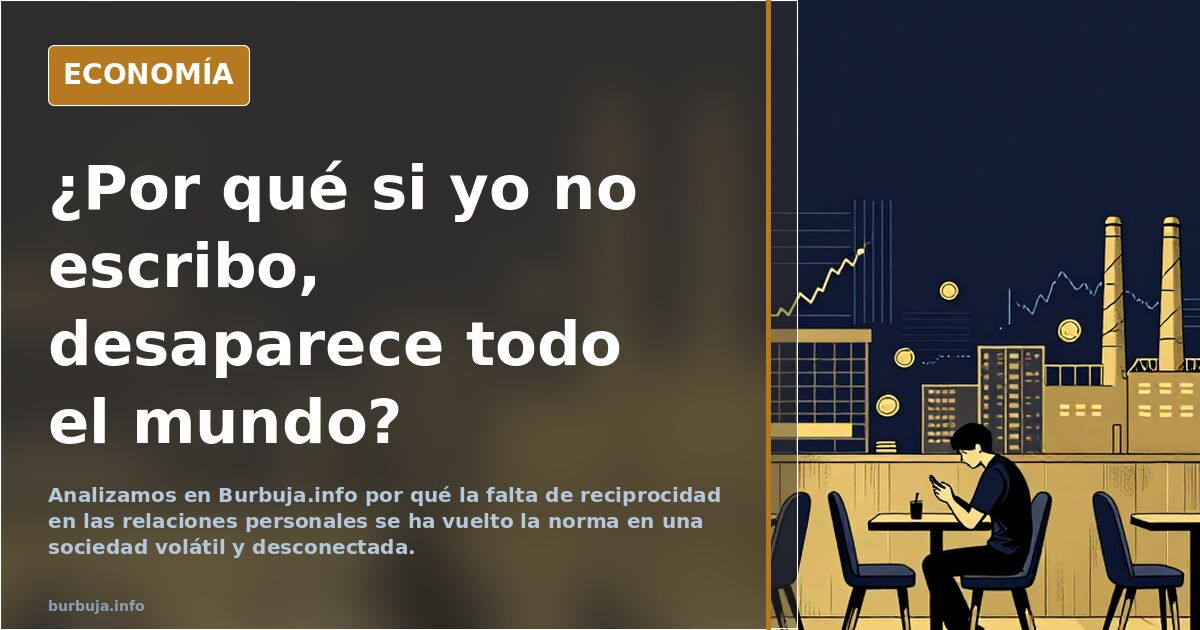
Stop texting, and you vanish from your friends' map
If you stop reaching out, within two or three weeks there's nobody left on the other end. It's not a bad impression or a bout of paranoia: it's the pattern described by a forum user, said to be 44 years old, who has grown tired of seeing that when he doesn't pull the rope, the relationship fizzles out on its own. Two unanswered calls. A voice message left there, ignored. And then, suddenly, a "hey, want to meet up?" arriving as if nothing had peine.
The case matters because it isn't about a rare exception, but about a way of understanding relationships that has become common in adult life. Friendship stops being a right and becomes a chore: someone has to make the move.
Why does everyone disappear when I stop texting?
Because nobody has that relationship on their list of priorities. It's the most common explanation and also the harshest. The starting account is explicit: the person who writes isn't toxic, doesn't intrude, doesn't ask for money and respects other people's timing. Even so, they drop off the radar. When someone finally reappears, there's no bad blood, no argument, no reproach: there's laughter, normal conversation and the feeling that people enjoy their company. The asymmetry isn't in the treatment. It's in the effort.
Some sum it up in one sentence: if you stop texting and nobody reaches out, they don't care about you. Short and brutal. But that reading doesn't explain why the same person is welcomed every time they show up.
The last resort on someone else's calendar
Here the diagnosis turns sour. One camp holds that someone who's only called when everyone else's plans fall through isn't called a friend: they're called plan B. Weeks of silence trinc by a sudden return fit that theory suspiciously well. The criterion would be availability, not affection.
Against that reading, another points to something less cruel and more structural: burnout. Work, home, family, and the little time left over turned into pure rest. In that framework, sending a message isn't a small gesture, it's one more task. And tasks get postponed.
From the couch to the bar: socializing that fades away
There's a third diagnosis that points at the phone. It describes the case of a lifelong friend who doesn't answer the phone or reply to messages, who has reduced her social life to her partner and motorcycle trips, and who nevertheless posts daily about her workouts and routes. Showing off, they call it. Whoever tells the story adds a broader suspicion: the comfort of socializing from the couch is frying people's brains, eroding their ability to socialize in person.
The thesis fits a detail from the account itself: the person raising the problem has no Instagram, Facebook or TikTok. He's been left out, he says, of the only shop window that seems to count today.
Less money, fewer calls
There's also an economic reading, explicit and without anesthesia: welcome to adult life; the less power and money you have, the less you're sought after. Even an episode of The Simpsons is cited — season six, the pool episode — where Homer's popularity lasts exactly as long as the whim. The metaphor isn't bad, but it doesn't fit every case, nor does it explain why someone who lends money without asking for anything in return ends up just as alone.
What does appear in every story is the same outcome: the silence stops hurting and starts to bring relief. The texting stops and the contact list empties out.
If the pattern holds, more people can be expected to do the math and cut ties for good, though nobody yet knows how many of those cuts are genuine indifference and how many are simply poorly managed exhaustion.
Also available in: Deutsch
Summary of a discussion on Burbuja.info - Foro de economía, actualidad y política., translated from Spanish and reviewed before publication. Read the full discussion (14 replies).
More summaries
-
Saving vs. Debt: How Financial Habits Break Friendships
A divorcee with a financed BMW and two daughters highlights the rift between savers and debtors, as inflation erodes savings by 10%.
-
8 Million Missing Children Annually: Unverified Data
Claims of eight million missing children lack verifiable sources; adrenochrome myths and Epstein files fuel unproven narratives.
-
Sánchez sinks rental market: nearly 400,000 homes vanish since 2021
Rental supply has fallen by 390,443 homes since 2021, a 37.1% drop, while the average price has risen to 1,211 euros, up 47.9%. We explain what's behind it.
-
Spain aims to approve 4.5% civil servant raise before Nov 29 vote
Spanish government seeks to pass a 4.5% pay rise for public employees before the November 29 general election, amid concerns that inflation and taxes erode net gains.
-
Inflation hits 4% in August: the bill for low rates
Inflation will reach 4% in August after a decade of low rates and public debt. Spain's unadjusted income tax worsens the bill and stagflation looms.
-
27 days for 6 computers at Spain's immigration office in Ceuta
27 days for the Immigration Office in Ceuta, Spain, to receive 6 computers. One computer for 5 civil servants: a portrait of Spanish bureaucracy.