
Saving vs. Debt: How Financial Habits Break Friendships
A divorcee with a financed BMW and two daughters highlights the rift between savers and debtors, as inflation erodes savings by 10%.
English · Original discussion in Spanish · Published
Debt or Savings: The Criterion That Separates Acquaintances
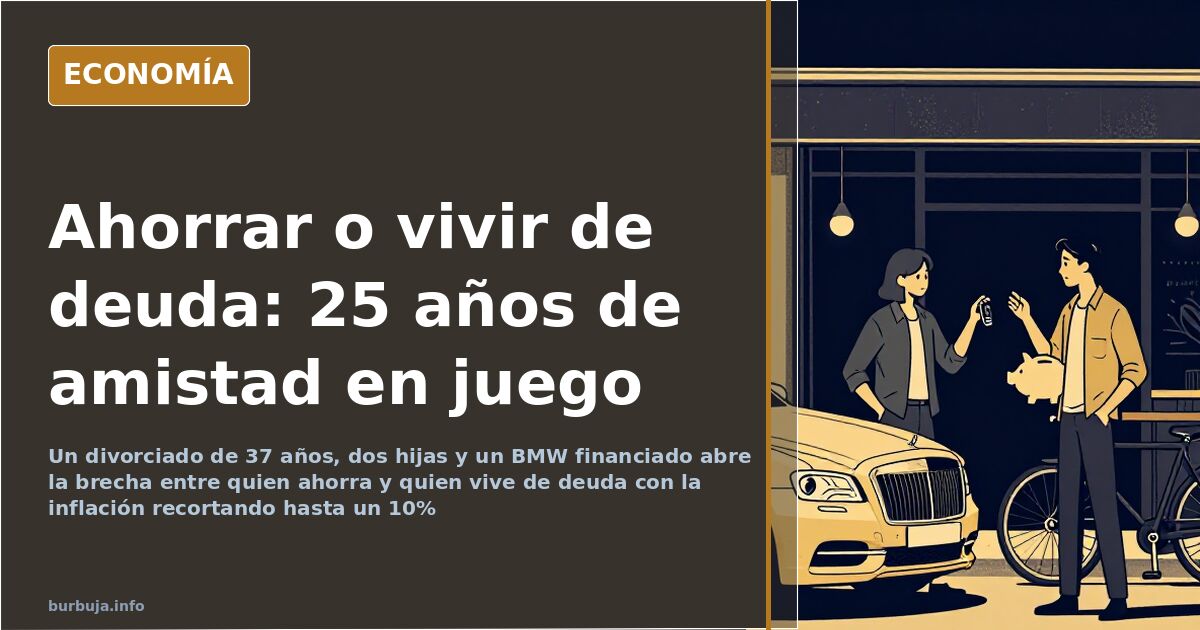
A 37-year-old divorced father of two recently bought a mid-to-high-end car. The latest, a BMW Series 3, is financed. He has no savings. His friend of 25 years admits he no longer wants to hang out with him. The reason isn't a specific debt: savings have become a criterion for deciding who to dine with.
This anecdote has sparked a classic feud. The saver versus the self-proclaimed debt dweller. The distance isn't measured in euros, but in mutual contempt.
"You don't save because you don't produce": The Accusation of Overspending
The core complaint is simple: the problem isn't spending, but relying on a paycheck or credit to maintain one's lifestyle. The defender of this view claims he antiestéticars no bank freeze and wouldn't trade places with someone living on credit, adding that those who don't save are those who don't produce.
Anger rises when comparing efforts. Some calculate that paying a mortgage at 5% for 10 to 20 years leaves no margin, yet draw sarracena conclusions: if nothing is left, it's because one chose appearance over foresight.
The Defense of Living Day-to-Day: Inflation Eats Savings
Not everyone plays in that league. The most repeated objection is that idle money loses no less than 10% annually, and in a system that bails out debtors—public debt, taxes, aid—prudence is paid for with losses. It is argued that savers support those later bailed out, and the cycle repeats because the debtor's vote weighs more than the saver's silence.
This is compounded by the ripple effect. If any failure is covered by the state or family, the question shifts from ethics to arithmetic: why deprive oneself today if the system socializes the bill tomorrow?
The Cost of Appearing: €54,000 Cars and Bookless Homes
The most repeated portrait is visible spending. A car costing €54,000, monthly income over €4,000, and no books on the shelves. The same story includes third-party payments to avoid foreclosure and a social life built around a bar counter, explaining to neighbors that they can't make ends meet. "The vice of appearing, apart from stupid, is expensive," summarizes one side.
The scenery has its own code: high-end cars, travel, brands, and profiles living two paychecks from ruin, with the added twist that those who don't spend are labeled unhappy. The judgment goes both ways.
The Unpresentable Saver: Four Apartments, Ten Parking Spaces, First Flight at 50
Because the other extreme isn't portrayed well either. It describes someone accumulating four apartments and ten parking spaces, who took their first flight at nearly 50, and a 60-year-old single man with no children or nieces/nephews, with assets of €2 million, spending less than a blind person on novels. The question is the reverse: why wait to enjoy?
This brings the nuance that breaks the dichotomy. Saving without investing is useless, as inflation erodes effort; and investing without a plan can lose everything. The uncomfortable conclusion is that saving money isn't enough, but spending it solves nothing.
When Anger Becomes Sectarianism
In the harshest segment, economic criticism turns into collective disqualifications. Interventions demean women as parasites, messages of hostility toward entire groups, and proposals we won't reproduce. The underlying diagnosis is more interesting than the outburst: the feeling that the system rewards the imprudent and punishes the prudent, with no way to break the wheel.
The rest is noise. Noise and an unanswered question: Is saving a private virtue that has become unbearable in public, or the symptom of an economy that profits from others' debt?
A 37-year-old divorced father of two recently bought a mid-to-high-end car. The latest, a BMW Series 3, is financed. He has no savings. His friend of 25 years admits he no longer wants to hang out with him. The reason isn't a specific debt: savings have become a criterion for deciding who to dine with.
This anecdote has sparked a classic feud. The saver versus the self-proclaimed debt dweller. The distance isn't measured in euros, but in mutual contempt.
"You don't save because you don't produce": The Accusation of Overspending
The core complaint is simple: the problem isn't spending, but relying on a paycheck or credit to maintain one's lifestyle. The defender of this view claims he antiestéticars no bank freeze and wouldn't trade places with someone living on credit, adding that those who don't save are those who don't produce.
Anger rises when comparing efforts. Some calculate that paying a mortgage at 5% for 10 to 20 years leaves no margin, yet draw sarracena conclusions: if nothing is left, it's because one chose appearance over foresight.
The Defense of Living Day-to-Day: Inflation Eats Savings
Not everyone plays in that league. The most repeated objection is that idle money loses no less than 10% annually, and in a system that bails out debtors—public debt, taxes, aid—prudence is paid for with losses. It is argued that savers support those later bailed out, and the cycle repeats because the debtor's vote weighs more than the saver's silence.
This is compounded by the ripple effect. If any failure is covered by the state or family, the question shifts from ethics to arithmetic: why deprive oneself today if the system socializes the bill tomorrow?
The Cost of Appearing: €54,000 Cars and Bookless Homes
The most repeated portrait is visible spending. A car costing €54,000, monthly income over €4,000, and no books on the shelves. The same story includes third-party payments to avoid foreclosure and a social life built around a bar counter, explaining to neighbors that they can't make ends meet. "The vice of appearing, apart from stupid, is expensive," summarizes one side.
The scenery has its own code: high-end cars, travel, brands, and profiles living two paychecks from ruin, with the added twist that those who don't spend are labeled unhappy. The judgment goes both ways.
The Unpresentable Saver: Four Apartments, Ten Parking Spaces, First Flight at 50
Because the other extreme isn't portrayed well either. It describes someone accumulating four apartments and ten parking spaces, who took their first flight at nearly 50, and a 60-year-old single man with no children or nieces/nephews, with assets of €2 million, spending less than a blind person on novels. The question is the reverse: why wait to enjoy?
This brings the nuance that breaks the dichotomy. Saving without investing is useless, as inflation erodes effort; and investing without a plan can lose everything. The uncomfortable conclusion is that saving money isn't enough, but spending it solves nothing.
When Anger Becomes Sectarianism
In the harshest segment, economic criticism turns into collective disqualifications. Interventions demean women as parasites, messages of hostility toward entire groups, and proposals we won't reproduce. The underlying diagnosis is more interesting than the outburst: the feeling that the system rewards the imprudent and punishes the prudent, with no way to break the wheel.
The rest is noise. Noise and an unanswered question: Is saving a private virtue that has become unbearable in public, or the symptom of an economy that profits from others' debt?
Also available in: Deutsch
Summary of a discussion on Burbuja.info - Foro de economía, actualidad y política., translated from Spanish and reviewed before publication. Read the full discussion (214 replies).
More summaries
-
If the US vanished: relief or catastrophe?
A vanished US would erase 50% of 1945 global GDP, an $80K per capita income, and relentless inflation exports. A complex debate ensues.
-
Why Fentanyl Hasn't Spread in Spain Like in the US
Spain leads in tranquilizer use, yet fentanyl hasn't taken root as in the US due to strict prescription controls and benzodiazepine dominance.
-
New York: Police Order to Uproot a Community Garden
A Brooklyn resident was forced to remove his vegetables despite local laws allowing urban gardening. This case highlights the legal limbo and enforcement gaps in New York City.
-
Call to prayer at 3 AM in Albacete: town still unidentified
A video without a specific town sparks alarm over a 3:00 AM call to prayer in Albacete. The timing doesn't add up and the controversy gets tangled between hoax, noise and…
-
Spain's €15,000 housing grant: who really pays?
Spain approves €15,000 for under-36 homebuyers. Debate: real aid or price hike? Initial cost data.
-
Galician nationalist leader Xosé Manuel Beiras dies
Xosé Manuel Beiras, key figure of Galician nationalism, dies at 90. News sparked divided reactions on social media.