
Why Writing Books Rarely Makes You Rich in Spain
In Spain, publishing rarely brings wealth. Most authors need side jobs or bestseller status to survive, as a recent thread reveals.
English · Original discussion in Spanish · Published
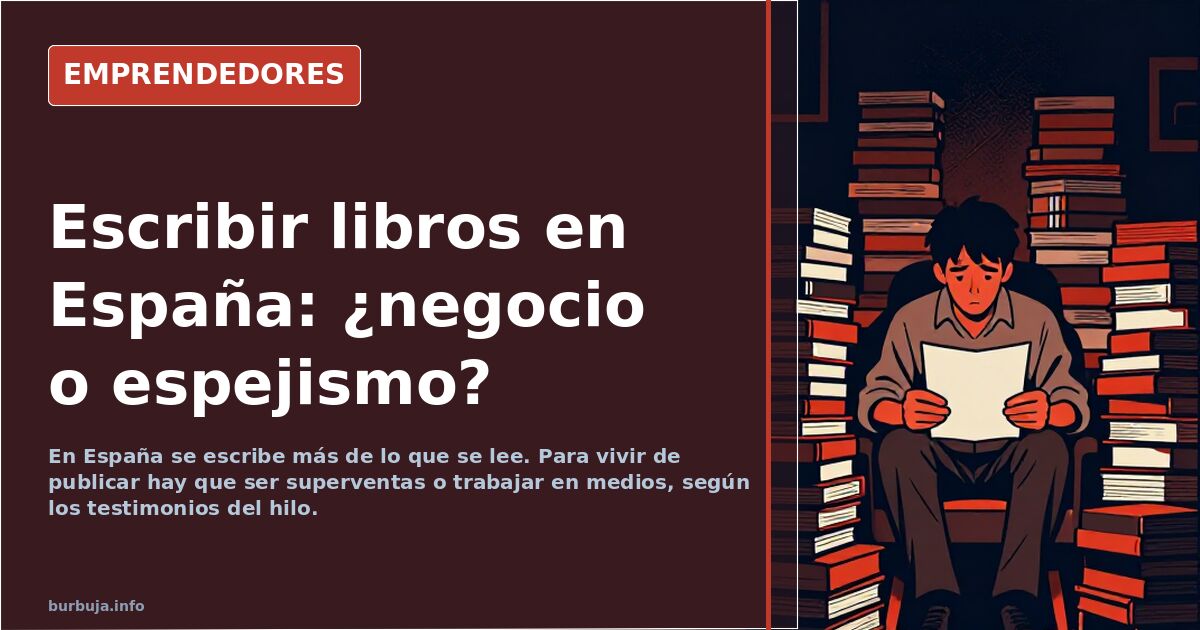
The business of writing books: few survive, many try
In Spain, people write far more than they read, including those writing about getting rich through writing. The opening thesis is blunt: in a country with few readers, more people are trying to make a fortune publishing, arriving two decades late. The model sold today—manuals on finance, crypto, and foolproof methods—was already exploited in the early 2000s by a divulgator who likely earned more from his courses and books than from market speculation.
The thread argues that aspiring authors confuse desire with business. This diagnosis clashes with a starting contradiction: the same country that barely reads produces a flood of manuscripts. Few live from this. Many try.
How much is read in Spain? Figures from readers themselves
The numbers vary by source. One claims to have read 27 books this year, prudently assessing: "not many, but not few." Another reads around 20 annually. A third recalls hitting 100 per year when younger and with more time. On the opposite extreme, someone admits the most modern book they have read is from 1903.
Some summarize with irony: little and poorly. Others note there is more underground authorship than fifty years ago, thanks to self-publishing. Against these nuances, a response is quick: the problem was never quantity, but reading trash.
The myth of the millionaire writer
The most cited case to debunk the fantasy is that of an author with two published books and presence in major bookstores who, according to a shared testimony, remained "poorer than the rats" and needed other jobs to survive. The publisher, in that version, kept an extremely high percentage. The recurring conclusion: to live from this, you must be a bestseller or work in media, complementing with writing.
The figure cited as proof of the mirage is that of a popular presenter who, according to one message, sold 100,000 copies of her book. From there, the analysis complicates: some see these sales as the exception that proves the rule; others calculate that only a filmable title brings real money, assuming someone buys, adapts, and the adaptation works. The full calculation, with all its assumptions, warrants another entire discussion.
Why do historical novels sell more than History books?
This question runs through much of the conversation. The most repeated answer concerns the packaging: historical novels sell as rigor without demanding it, and the author herself proclaims them documented. Meanwhile, the average reader prefers the narrative to the data. Saturation is also pointed out: authors publishing twenty nearly identical titles, grouped in sagas and repeated each season.
For those who wrote adventures before author marketing existed, the comparison is bitter. What is today presented as rigorous historical fiction was, decades ago, simply kiosk adventures with another wrapper.
Self-publishing: from the drawer to Amazon
Self-publishing is no longer a rarity. Some upload their book to a digital platform for 0.99 euros—or even give it away—while others argue it is not a time to speak, but to listen. In between, a nuance changes the business: the book as a tool. A coaching professional self-publishes 200 copies and gives them to each potential client, because the value lies not in the sale, but in being able to say "I wrote a book." The book is no longer the end; it is the means.
Here also enters the discussion on Spanish science fiction, which some consider dominated by international tastes and awards that repeat, while others defend it as a living ecosystem precisely thanks to self-publishing.
The book as art, not product
Not everyone buys into the economic framework. A persistent voice argues that writing does not seek to sell: "Writing is the deepest way to read life," and those who see only business in it understand nothing. For this current, publishing is increasingly pretentious, and the guarded manuscript is a work worthy of itself. The counter-argument is harsh: what no one has published are stories in a drawer, not books.
The other possible balance is shared by those who write merely for relief, without professional pretension, and those who recall that the vast majority of writers will never get rich.
What does not add up
With these figures, the book market in Spain should be in a bubble and freefall simultaneously. The paradox remains: in the country that barely reads, everyone writes; in the country that barely pays to read, some insist on living from it. No one fully explains why it still makes sense to try.
In Spain, people write far more than they read, including those writing about getting rich through writing. The opening thesis is blunt: in a country with few readers, more people are trying to make a fortune publishing, arriving two decades late. The model sold today—manuals on finance, crypto, and foolproof methods—was already exploited in the early 2000s by a divulgator who likely earned more from his courses and books than from market speculation.
The thread argues that aspiring authors confuse desire with business. This diagnosis clashes with a starting contradiction: the same country that barely reads produces a flood of manuscripts. Few live from this. Many try.
How much is read in Spain? Figures from readers themselves
The numbers vary by source. One claims to have read 27 books this year, prudently assessing: "not many, but not few." Another reads around 20 annually. A third recalls hitting 100 per year when younger and with more time. On the opposite extreme, someone admits the most modern book they have read is from 1903.
Some summarize with irony: little and poorly. Others note there is more underground authorship than fifty years ago, thanks to self-publishing. Against these nuances, a response is quick: the problem was never quantity, but reading trash.
The myth of the millionaire writer
The most cited case to debunk the fantasy is that of an author with two published books and presence in major bookstores who, according to a shared testimony, remained "poorer than the rats" and needed other jobs to survive. The publisher, in that version, kept an extremely high percentage. The recurring conclusion: to live from this, you must be a bestseller or work in media, complementing with writing.
The figure cited as proof of the mirage is that of a popular presenter who, according to one message, sold 100,000 copies of her book. From there, the analysis complicates: some see these sales as the exception that proves the rule; others calculate that only a filmable title brings real money, assuming someone buys, adapts, and the adaptation works. The full calculation, with all its assumptions, warrants another entire discussion.
Why do historical novels sell more than History books?
This question runs through much of the conversation. The most repeated answer concerns the packaging: historical novels sell as rigor without demanding it, and the author herself proclaims them documented. Meanwhile, the average reader prefers the narrative to the data. Saturation is also pointed out: authors publishing twenty nearly identical titles, grouped in sagas and repeated each season.
For those who wrote adventures before author marketing existed, the comparison is bitter. What is today presented as rigorous historical fiction was, decades ago, simply kiosk adventures with another wrapper.
Self-publishing: from the drawer to Amazon
Self-publishing is no longer a rarity. Some upload their book to a digital platform for 0.99 euros—or even give it away—while others argue it is not a time to speak, but to listen. In between, a nuance changes the business: the book as a tool. A coaching professional self-publishes 200 copies and gives them to each potential client, because the value lies not in the sale, but in being able to say "I wrote a book." The book is no longer the end; it is the means.
Here also enters the discussion on Spanish science fiction, which some consider dominated by international tastes and awards that repeat, while others defend it as a living ecosystem precisely thanks to self-publishing.
The book as art, not product
Not everyone buys into the economic framework. A persistent voice argues that writing does not seek to sell: "Writing is the deepest way to read life," and those who see only business in it understand nothing. For this current, publishing is increasingly pretentious, and the guarded manuscript is a work worthy of itself. The counter-argument is harsh: what no one has published are stories in a drawer, not books.
The other possible balance is shared by those who write merely for relief, without professional pretension, and those who recall that the vast majority of writers will never get rich.
What does not add up
With these figures, the book market in Spain should be in a bubble and freefall simultaneously. The paradox remains: in the country that barely reads, everyone writes; in the country that barely pays to read, some insist on living from it. No one fully explains why it still makes sense to try.
Summary of a discussion on Burbuja.info - Foro de economía, actualidad y política., translated from Spanish and reviewed before publication. Read the full discussion (242 replies).
More summaries
-
Paid reader gigs: feedback or fake review factory?
An ad pays for reading books and giving feedback. With no visible rate and the EU Omnibus Directive in the background: flexible work or fake review factory?
-
Mechatronics vocational training: high demand in northern Spain and €26,000 job offer
A supermarket maintenance job pays €26,000, but workers warn of bosses who ignore rules, travel and broken schedules.
-
Create Free AI Videos from Photos in Minutes Using Hailuo
Hailuo AI animates photos into videos with four words for free. This tutorial is free; monetization faces TikTok censorship and shadowban.
-
Amateur Predicts AI Will Replace Front-End Developers by 2027
An amateur generates a functional exam interface in 10 minutes using ChatGPT 3.5, predicting the imminent replacement of web developers by artificial intelligence.
-
Cleaning vs Coding: Why Spanish Freelance Developers Struggle
A Spanish developer earned 30 euros hourly, while cleaners made 5, reigniting debate on manual labor versus freelance tech work in Spain.
-
Spain’s 800,000 Euro Failure: The Hidden Cost of Entrepreneurship
A case study of business failure in Spain, revealing how 800,000 euros were lost over five years. It highlights the structural barriers and personal debts faced by small business owners.