
Spain’s 800,000 Euro Failure: The Hidden Cost of Entrepreneurship
A case study of business failure in Spain, revealing how 800,000 euros were lost over five years. It highlights the structural barriers and personal debts faced by small business owners.
English · Original discussion in Spanish · Published
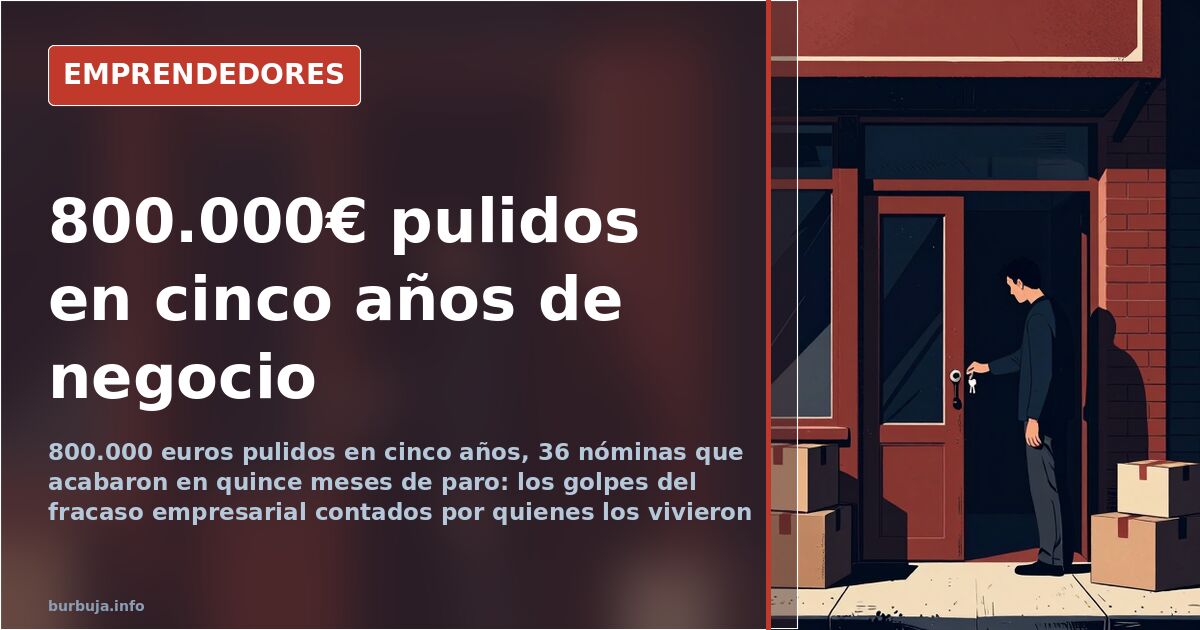
Bars, franchises, and 800,000 euros of entrepreneurial failure
An IT technician starts a business with just 10 euros: business cards and a hundred cold calls. The answer, repeated until boredom, is always the same: the company already has its maintenance contracted by someone else. This is the first unsettling fact: without new businesses, there are no new clients, and whoever wants to sell has to steal them from a competitor who is already earning. His conclusion, after getting his hands dirty, was that dedicating more time and money was not profitable. The question left open is: how much of what we call entrepreneurship is actually a market that no longer exists?
Why do so many small businesses fail in Spain?
The first reason that emerges in these cases is not a lack of ideas. It is a mature market. Almost all sectors where one tries to enter already have an established provider, an inherited takeover, or a competitor with years of clientele. Some argue that the way out is to find uncovered niches.
Another, harsher perspective points to the accumulation of taxes, certifications, registrations, and union fees. A business starting with tight margins struggles to bear this weight. The recurring idea is cruel: if the owner is involved every hour and still does not earn a net profit, that is not a business, it is self-employment in disguise.
The severance pay that ends up in a bar with a three-year life
The most cited case takes the form of a classic. A 55-year-old professional, dismissed from a pharmaceutical company with a significant severance package, invests everything in opening a restaurant bar. Prior experience in hospitality: none. In three years, he lost it all. Now, nearing 58, he is without a business and without money. This pattern repeats in a catering venue where 300,000 euros were available, proving insufficient, and in a café whose renovation cost 180,000 euros.
This is compounded by the domino effect on families. There is one case where an individual spent more than 800,000 euros over five years, chained loans, closed and peine under another name, and dragged his own son into signing. Result: nearly 60,000 euros pending self-employed contributions—making retirement impossible—and 130,000 euros of bank debt for the son after several seizures, money he never spent. Under this logic, some see debt not as an accident, but as the model.
The problem of partners and the problem of employees
Almost no story comes without partners. A group of five set up a free bar for university students with 400 euros and a rule agreed with a wine merchant: pay only for the alcohol consumed. The experiment went wrong for the usual reason: of the five, only one brought in people; two barely covered costs; the other two brought four people between them. A participant who heard this at a conference summarizes the choice of the number of partners thus: with three, two ally and the third is left out; with two, there is either agreement or no business.
On the other side of the table are the workers. Some complain that you hire, train, and the employee learns just enough to turn against you with your client portfolio. Another intervention suggests including the severance pay for dismissal of each worker in the costs before deciding to hire. If you do not, in the trough you must choose between closing or borrowing to pay for exits.
Sectors that are dying without anyone decreeing it
There are businesses that fail not due to poor management, but because the ground is sinking beneath their feet. An event production company managed to pay 36 salaries in 2006, all insured. In 2007, it began to cut back. Today, it has been fifteen months in the public employment services without entitlement to benefits, in a sector where, according to its own account, 80 or 90 percent of workers do not contribute or sign contracts. Competing under these conditions is impossible.
Something similar happens with a franchise real estate office peine at the height of the bubble: five employees, monthly revenues of 10,000 to 15,000 euros in the best years, and a closure when the market turned. Or with a family-owned car dealership in Madrid that lasted 35 years and reached twelve employees. Thirty-five years. And one morning, it closes.
Can you start a business without debt?
One of the experiences that succeeded without its own dramas was the one done without external financing. Its author summarizes the lesson in one idea: failure teaches more than success, especially in distinguishing who approaches to see what they can extract. The recommendation he gives to anyone wanting to start something is simple: do not do it with debt. The business may fail; the debt, however, does not.
And the debate on filtering arises. Some argue that the State should require exams for anyone applying for a loan to start a business, because not everyone has the minimum knowledge to be an entrepreneur.
With the market as it is, the final data is the most uncomfortable: the cheapest project of all—10 euros in cards—barely left any investment to regret. Others, meanwhile, continue to pay their debts years later.
An IT technician starts a business with just 10 euros: business cards and a hundred cold calls. The answer, repeated until boredom, is always the same: the company already has its maintenance contracted by someone else. This is the first unsettling fact: without new businesses, there are no new clients, and whoever wants to sell has to steal them from a competitor who is already earning. His conclusion, after getting his hands dirty, was that dedicating more time and money was not profitable. The question left open is: how much of what we call entrepreneurship is actually a market that no longer exists?
Why do so many small businesses fail in Spain?
The first reason that emerges in these cases is not a lack of ideas. It is a mature market. Almost all sectors where one tries to enter already have an established provider, an inherited takeover, or a competitor with years of clientele. Some argue that the way out is to find uncovered niches.
Another, harsher perspective points to the accumulation of taxes, certifications, registrations, and union fees. A business starting with tight margins struggles to bear this weight. The recurring idea is cruel: if the owner is involved every hour and still does not earn a net profit, that is not a business, it is self-employment in disguise.
The severance pay that ends up in a bar with a three-year life
The most cited case takes the form of a classic. A 55-year-old professional, dismissed from a pharmaceutical company with a significant severance package, invests everything in opening a restaurant bar. Prior experience in hospitality: none. In three years, he lost it all. Now, nearing 58, he is without a business and without money. This pattern repeats in a catering venue where 300,000 euros were available, proving insufficient, and in a café whose renovation cost 180,000 euros.
This is compounded by the domino effect on families. There is one case where an individual spent more than 800,000 euros over five years, chained loans, closed and peine under another name, and dragged his own son into signing. Result: nearly 60,000 euros pending self-employed contributions—making retirement impossible—and 130,000 euros of bank debt for the son after several seizures, money he never spent. Under this logic, some see debt not as an accident, but as the model.
The problem of partners and the problem of employees
Almost no story comes without partners. A group of five set up a free bar for university students with 400 euros and a rule agreed with a wine merchant: pay only for the alcohol consumed. The experiment went wrong for the usual reason: of the five, only one brought in people; two barely covered costs; the other two brought four people between them. A participant who heard this at a conference summarizes the choice of the number of partners thus: with three, two ally and the third is left out; with two, there is either agreement or no business.
On the other side of the table are the workers. Some complain that you hire, train, and the employee learns just enough to turn against you with your client portfolio. Another intervention suggests including the severance pay for dismissal of each worker in the costs before deciding to hire. If you do not, in the trough you must choose between closing or borrowing to pay for exits.
Sectors that are dying without anyone decreeing it
There are businesses that fail not due to poor management, but because the ground is sinking beneath their feet. An event production company managed to pay 36 salaries in 2006, all insured. In 2007, it began to cut back. Today, it has been fifteen months in the public employment services without entitlement to benefits, in a sector where, according to its own account, 80 or 90 percent of workers do not contribute or sign contracts. Competing under these conditions is impossible.
Something similar happens with a franchise real estate office peine at the height of the bubble: five employees, monthly revenues of 10,000 to 15,000 euros in the best years, and a closure when the market turned. Or with a family-owned car dealership in Madrid that lasted 35 years and reached twelve employees. Thirty-five years. And one morning, it closes.
Can you start a business without debt?
One of the experiences that succeeded without its own dramas was the one done without external financing. Its author summarizes the lesson in one idea: failure teaches more than success, especially in distinguishing who approaches to see what they can extract. The recommendation he gives to anyone wanting to start something is simple: do not do it with debt. The business may fail; the debt, however, does not.
And the debate on filtering arises. Some argue that the State should require exams for anyone applying for a loan to start a business, because not everyone has the minimum knowledge to be an entrepreneur.
With the market as it is, the final data is the most uncomfortable: the cheapest project of all—10 euros in cards—barely left any investment to regret. Others, meanwhile, continue to pay their debts years later.
Summary of a discussion on Burbuja.info - Foro de economía, actualidad y política., translated from Spanish and reviewed before publication. Read the full discussion (254 replies).
More summaries
-
Christian Bresser: another young Spaniard proving how mediocre you are
Analysis of the debate on Christian Bresser in Burbuja.info: legitimate entrepreneurship or digital smoke selling? Discover the key points of the thread here.
-
Free WooCommerce: The Store That Caps Out at 50 Products
WooCommerce is free and sets up a store in an afternoon, but the catalog is limited to 50 products and paid plugins increase the bill.
-
How Much YouTube Actually Pays in Spain: Real Earnings Revealed
Channels with 200,000 monthly views earn just 70 euros. The myth of €1 per 1,000 views collapses under niche reality.
-
Why Writing Books Rarely Makes You Rich in Spain
In Spain, publishing rarely brings wealth. Most authors need side jobs or bestseller status to survive, as a recent thread reveals.
-
Create Free AI Videos from Photos in Minutes Using Hailuo
Hailuo AI animates photos into videos with four words for free. This tutorial is free; monetization faces TikTok censorship and shadowban.
-
Amateur Predicts AI Will Replace Front-End Developers by 2027
An amateur generates a functional exam interface in 10 minutes using ChatGPT 3.5, predicting the imminent replacement of web developers by artificial intelligence.