
Why the Titanic sank: open watertight bulkheads
The Titanic breached five or six compartments and sank in under three hours. Investigations point to design flaws and ships that ignored distress flares.
English · Original discussion in Spanish · Published
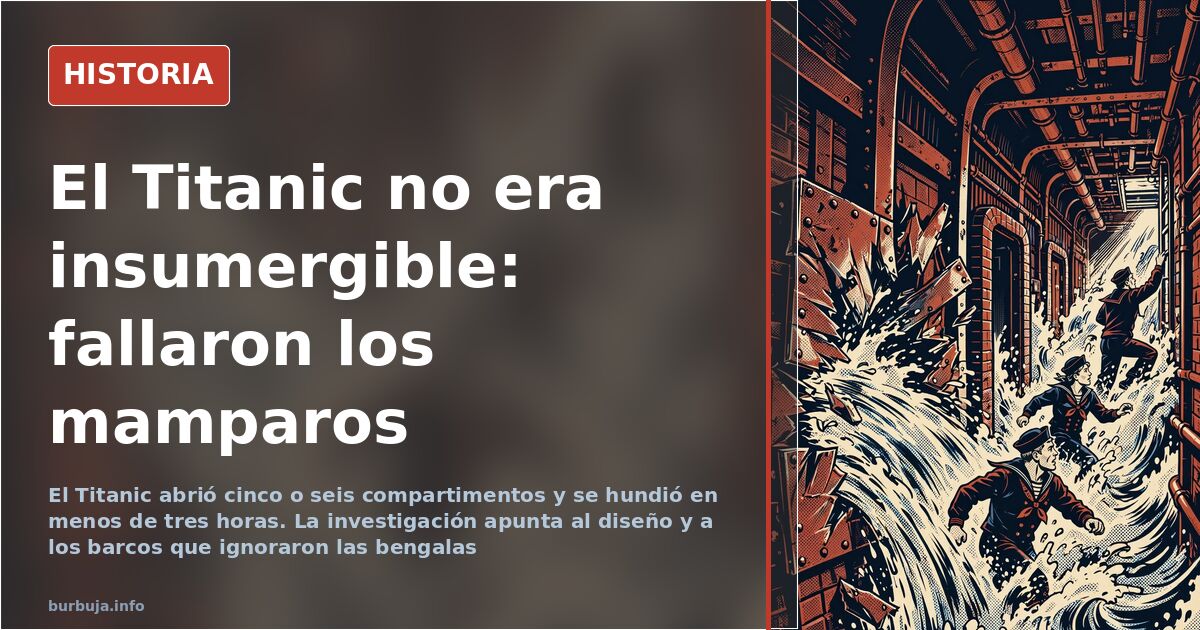
Open bulkheads, moonless night, and a ship that saw the flares but passed by
The iceberg did not sink the Titanic; it merely found the seam of a poorly designed vessel that went down in less than three hours, with over 1,500 dead and only 712 survivors. The ocean liner struck an ice block on its maiden voyage, opening five to six compartments and breaking in two off the coast of Newfoundland. According to official accounts, the crew altered course to navigate through ice-free zones. The problem was that they did so when the collision was already inevitable.
The underlying question is not what peine that night, but why a ship presented as "practically unsinkable" fell apart while other vessels watched from a distance. The first sustancia ilegal was in the engineering itself.
Watertight compartments that were not watertight
The Titanic had watertight bulkheads, yes. But they did not close at the top. That is the key detail that debunks the legend: because they were not sealed, water filling one compartment spilled into the next, eventually flooding the hull. Builders learned their lesson, and after this disaster, warships were designed with fully enclosed compartments.
There is a nuance that completely changes the narrative of the collision. The impact was lateral, not frontal, which made everything worse: a head-on hit would have damaged only one or two compartments, and with pumps running, the ship could have stayed afloat for hours. "We are talking about hours and hours with the ship afloat," summarizes the most technical analysis. The problem was not the ice, but that the ice suddenly peine five or six bulkheads, something no one was prepared for.
At the time, it was taken for granted that an ocean liner could not sink quickly in the open sea without being rescued. The equation included time and nearby ships. That equation failed.
Why didn't the SS Californian come to the rescue?
Here the file becomes uncomfortable. Several ships were nearby that night. From some, the Titanic's lights and distress flares were sighted, yet they continued on their course without intervening. The most cited case is the SS Californian, about 40 km away: its lookouts saw the flares, did not interpret them as a danger signal, and did not wake the radio operator, who would have picked up the distress messages. Meanwhile, the Titanic's radio was saturated, and some argue that this frequency collapse led other ships to turn off their equipment until the next day.
It is not the only shadow. The SS Mount Temple and a Norwegian vessel illegally hunting seals are also mentioned; the latter avoided approaching for antiestéticar of being reported. Effective rescue came from further away: the Carpathia, about 100 km distant. And the famous detail of binoculars locked away turns out to be irrelevant: they are not used at night because they reduce the field of vision.
The Federal Reserve thesis: when the magnate becomes a suspect
No discussion of the Titanic escapes its conspiratorial layer, and this one has a name: John Pierpont Morgan. The financier had spent decades advocating for a centralized banking body, the embryo of the Federal Reserve, against the opposition of other millionaires. Hence the hypothesis that the wreck served to eliminate three powerful financiers opposed to the project.
The hypothesis has a fundamental efficiency problem. With the number of armed anarchists circulating at the time, building an ocean liner to sink it with rivals inside is the most expensive and least reliable method imaginable. This thesis is not supported by evidence and functions more as a story than an investigation.
No moon, flat calm sea, and an inverted iceberg
Added to the structural shoddy work was a pitch-black night. Without a moon, the trajectory was unlit; with the sea as flat as a pancake, there were no waves breaking against the base of the iceberg to reveal its presence. And the kicker: apparently, the block was inverted, with the protruding part recently emerged and darkened by algae. Without these conditions, they would have seen it much earlier. They nearly dodged it: with 30 seconds more, they might have passed without grazing it.
The Olympic theory: the twin that changed names
Another hypothesis circulates, supported by comparative photographs: that the sunk ship was actually the Olympic, the Titanic's twin, swapped after a previous collision, and that the real Titanic continued sailing for years under its brother's name. It is a recurring thesis, difficult to verify, and lacks firm documentary support. As an added curiosity, the Britannic, the third of the series, sank with only one compartment damaged, which supports the idea that the design had a fundamental flaw.
If anything teaches us from this file is that technical certainties age poorly. The next ship someone swears is unsinkable will almost certainly have its own unclosed bulkhead. All we need to know is who will be watching the flares from afar and decide not to move.
The iceberg did not sink the Titanic; it merely found the seam of a poorly designed vessel that went down in less than three hours, with over 1,500 dead and only 712 survivors. The ocean liner struck an ice block on its maiden voyage, opening five to six compartments and breaking in two off the coast of Newfoundland. According to official accounts, the crew altered course to navigate through ice-free zones. The problem was that they did so when the collision was already inevitable.
The underlying question is not what peine that night, but why a ship presented as "practically unsinkable" fell apart while other vessels watched from a distance. The first sustancia ilegal was in the engineering itself.
Watertight compartments that were not watertight
The Titanic had watertight bulkheads, yes. But they did not close at the top. That is the key detail that debunks the legend: because they were not sealed, water filling one compartment spilled into the next, eventually flooding the hull. Builders learned their lesson, and after this disaster, warships were designed with fully enclosed compartments.
There is a nuance that completely changes the narrative of the collision. The impact was lateral, not frontal, which made everything worse: a head-on hit would have damaged only one or two compartments, and with pumps running, the ship could have stayed afloat for hours. "We are talking about hours and hours with the ship afloat," summarizes the most technical analysis. The problem was not the ice, but that the ice suddenly peine five or six bulkheads, something no one was prepared for.
At the time, it was taken for granted that an ocean liner could not sink quickly in the open sea without being rescued. The equation included time and nearby ships. That equation failed.
Why didn't the SS Californian come to the rescue?
Here the file becomes uncomfortable. Several ships were nearby that night. From some, the Titanic's lights and distress flares were sighted, yet they continued on their course without intervening. The most cited case is the SS Californian, about 40 km away: its lookouts saw the flares, did not interpret them as a danger signal, and did not wake the radio operator, who would have picked up the distress messages. Meanwhile, the Titanic's radio was saturated, and some argue that this frequency collapse led other ships to turn off their equipment until the next day.
It is not the only shadow. The SS Mount Temple and a Norwegian vessel illegally hunting seals are also mentioned; the latter avoided approaching for antiestéticar of being reported. Effective rescue came from further away: the Carpathia, about 100 km distant. And the famous detail of binoculars locked away turns out to be irrelevant: they are not used at night because they reduce the field of vision.
The Federal Reserve thesis: when the magnate becomes a suspect
No discussion of the Titanic escapes its conspiratorial layer, and this one has a name: John Pierpont Morgan. The financier had spent decades advocating for a centralized banking body, the embryo of the Federal Reserve, against the opposition of other millionaires. Hence the hypothesis that the wreck served to eliminate three powerful financiers opposed to the project.
The hypothesis has a fundamental efficiency problem. With the number of armed anarchists circulating at the time, building an ocean liner to sink it with rivals inside is the most expensive and least reliable method imaginable. This thesis is not supported by evidence and functions more as a story than an investigation.
No moon, flat calm sea, and an inverted iceberg
Added to the structural shoddy work was a pitch-black night. Without a moon, the trajectory was unlit; with the sea as flat as a pancake, there were no waves breaking against the base of the iceberg to reveal its presence. And the kicker: apparently, the block was inverted, with the protruding part recently emerged and darkened by algae. Without these conditions, they would have seen it much earlier. They nearly dodged it: with 30 seconds more, they might have passed without grazing it.
The Olympic theory: the twin that changed names
Another hypothesis circulates, supported by comparative photographs: that the sunk ship was actually the Olympic, the Titanic's twin, swapped after a previous collision, and that the real Titanic continued sailing for years under its brother's name. It is a recurring thesis, difficult to verify, and lacks firm documentary support. As an added curiosity, the Britannic, the third of the series, sank with only one compartment damaged, which supports the idea that the design had a fundamental flaw.
If anything teaches us from this file is that technical certainties age poorly. The next ship someone swears is unsinkable will almost certainly have its own unclosed bulkhead. All we need to know is who will be watching the flares from afar and decide not to move.
Also available in: Deutsch
Summary of a discussion on Burbuja.info - Foro de economía, actualidad y política., translated from Spanish and reviewed before publication. Read the full discussion (108 replies).
More summaries
-
ETA and GAL: two arms of the same Gladio network in Spain
Investigation linking ETA and GAL as arms of the same NATO Gladio network, with drug trafficking funding and CIA control.
-
Algeria Holds More Roman Ruins Than Spain and France
Algeria hosts over 500 Roman cities, second only to Italy. Why remains its heritage largely untapped? We explain.
-
Spain's Ferdinand VII: Historical revision challenges traditional narrative
Historians reassess the reign of Spain's Ferdinand VII, questioning his caricatured image as a traitor and incompetent monarch.
-
Impossible Victories: From Boabdil to Cervera's Fleet
Historical analysis of scenarios where victory was impossible from the start, examining forces, logistics, and critical decisions.
-
Isabella I of Castile: Legacy and Debate Over Her Reign
Expulsion of Jews, Inquisition, and dynastic disputes define Isabella's reign, which still divides historians.
-
Conspiracy Theory Claims Jesus Was Jewish Agent
Online theory posits Jesus was a Jewish agent controlling Gentiles. Analysis of arguments and historical refutations.