
Isabella I of Castile: Legacy and Debate Over Her Reign
Expulsion of Jews, Inquisition, and dynastic disputes define Isabella's reign, which still divides historians.
English · Original discussion in Spanish · Published
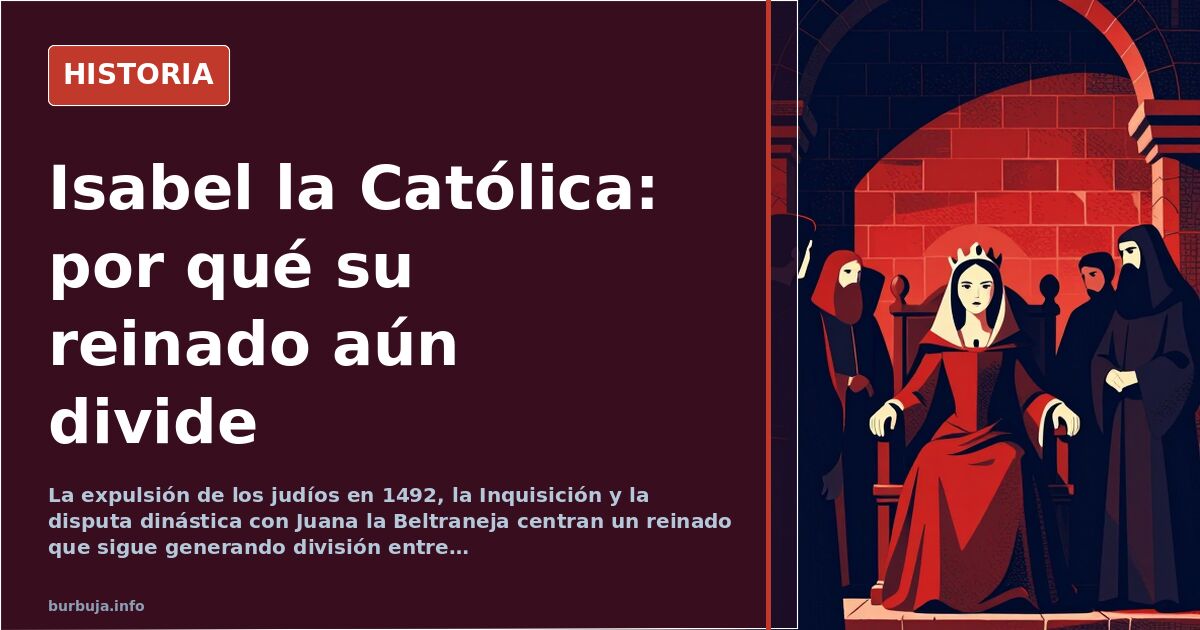
Isabella I of Castile: The Reign That Still Divides Spain
Was Isabella the Catholic the greatest queen in Spanish history or an intolerant sovereign who hindered the country's development for centuries? This question, seemingly settled by a popular TV series, is back on the table. The trigger is a review of her policies: the dynastic dispute with her niece Juana de Castilla, the creation of the Spanish Inquisition, the expulsion of the Jews in 1492, the marriage alliances linking her children to European houses, and the founding of the Santa Hermandad.
The starting point is an uncomfortable thesis: the queen implemented measures that harmed Spain, and her current image reflects television fiction more than historical facts. From there, the analysis branches out, covering dynastic legitimacy, the economic impact of expelling the Jewish community, Cardinal Cisneros' actual role, and compliance with agreements signed with Boabdil after Granada's surrender.
The Dispute for the Throne of Castile
One frequently cited issue is the succession war between Isabella and her niece Juana, known as 'La Beltraneja'. The accusation is direct: she seized the throne from the true queen for her own benefit and that of a noble faction. The counterargument concerns Juana's legitimacy, whose paternity was doubted for decades. Some claim Henry IV was impotent and likely gai, suggesting his daughter was not biological. Genetic research remains inconclusive, leaving this matter in the realm of hypothesis.
What seems undisputed is that Isabella may have genuinely believed her niece was not her brother's legitimate child, changing the interpretation of her intentions. It would be dynastic conviction rather than treachery. Regardless, the result was a civil war ending with Isabella on the throne and the unification of kingdoms shaping modern Spain.
The Inquisition and Religious Control Costs
The establishment of the Spanish Inquisition draws significant criticism. It is blamed for thousands of deaths due to religious matters and stifling scientific, economic, cultural, and social pogre. Defenders argue the Spanish Inquisition was milder than most European counterparts and note that Jewish expulsions occurred across Europe, Asia, and Africa throughout history.
Religious unity debates have political dimensions: it is argued that faith unity was necessary for Spain's national unity, while its absence in Germany and Protestant countries caused worse conflicts. The core issue is whether this control was strategic or intolerant, with measurable economic consequences.
Jewish Expulsion and Economic Debate
The 1492 expulsion decree highlights concrete economic analysis. Critics claim it stripped Spain of a top-tier business and commercial class, causing later decline. Opponents note most Jews had converted to Christianity after the 1391 pogroms, so fewer remained in 1492 than suggested. Those who left went mainly to the Ottoman Empire and Segarro, with small communities in Portugal and later Holland.
A recurring data point: more than half of Jews converted to Christianity. For some, this proves the issue was religious, not racial; for others, it confirms forced conversion under social pressure. Saint Teresa of Ávila, descended from conversos, is cited as successful integration into high spheres.
Cardinal Cisneros' Actual Role
An interesting angle positions Cardinal Cisneros as the true architect of much policy. He entered as the queen's confessor in 1492 and began managing preacher missions to the Indies after 1500. Only after Isabella's death did he engage deeply in politics with Ferdinand. The theory that Cisneros advised Columbus to seek a route avoiding Turkish pirates nuances Isabella's sole responsibility for strategic decisions.
Counterarguments are strong: in 1492, when Cisneros joined her, Isabella had already shown greater military prowess than Franco in Segarro. Advisors do not diminish the queen's decision-making capacity, proven before the cardinal's arrival.
Marriage Policy and Consequences
Isabella and Ferdinand's strategy of marrying their children to other European monarchs is debated. Critics say it caused costly Spanish interventions in numerous European wars, especially via Juana's link to the House of Austria. Defenders argue without it, England's Henry VIII might not have needed a schism with Rome to divorce, altering European history unpredictably.
The core question is whether this was sound strategy or a devastating miscalculation. Answers depend on judging with contemporary information versus hindsight.
Agreements Compliance and the Granada Issue
Less known is the breach of agreements with Boabdil after Granada's fall. It was agreed to respect Jovenlandeses staying in the former Kingdom of Granada if their monarch surrendered and left the Peninsula. Accusations state these terms were ignored: Jovenlandeses expelled, converts heavily taxed. Defense clarifies Cisneros, not Isabella, breached them, prioritizing religious unity strategically.
Indian rights protection is another counterpoint: it nullifies other criticisms from a modern perspective, as Laws of the Indies set legal precedents for conquered peoples unmatched in other colonial empires.
An Open Balance Sheet
Final assessments vary. Some claim despite flaws, she was Spain's best queen, with canonization pending recognition of universal impact. Others see her figure as constructed, arguing decisions like Jewish expulsion and the Inquisition hindered development for centuries. What is clear is that without her presence, today's world would be radically different, for better or worse. The debate continues, evidenced by diverging views persisting long after analyses began.
Was Isabella the Catholic the greatest queen in Spanish history or an intolerant sovereign who hindered the country's development for centuries? This question, seemingly settled by a popular TV series, is back on the table. The trigger is a review of her policies: the dynastic dispute with her niece Juana de Castilla, the creation of the Spanish Inquisition, the expulsion of the Jews in 1492, the marriage alliances linking her children to European houses, and the founding of the Santa Hermandad.
The starting point is an uncomfortable thesis: the queen implemented measures that harmed Spain, and her current image reflects television fiction more than historical facts. From there, the analysis branches out, covering dynastic legitimacy, the economic impact of expelling the Jewish community, Cardinal Cisneros' actual role, and compliance with agreements signed with Boabdil after Granada's surrender.
The Dispute for the Throne of Castile
One frequently cited issue is the succession war between Isabella and her niece Juana, known as 'La Beltraneja'. The accusation is direct: she seized the throne from the true queen for her own benefit and that of a noble faction. The counterargument concerns Juana's legitimacy, whose paternity was doubted for decades. Some claim Henry IV was impotent and likely gai, suggesting his daughter was not biological. Genetic research remains inconclusive, leaving this matter in the realm of hypothesis.
What seems undisputed is that Isabella may have genuinely believed her niece was not her brother's legitimate child, changing the interpretation of her intentions. It would be dynastic conviction rather than treachery. Regardless, the result was a civil war ending with Isabella on the throne and the unification of kingdoms shaping modern Spain.
The Inquisition and Religious Control Costs
The establishment of the Spanish Inquisition draws significant criticism. It is blamed for thousands of deaths due to religious matters and stifling scientific, economic, cultural, and social pogre. Defenders argue the Spanish Inquisition was milder than most European counterparts and note that Jewish expulsions occurred across Europe, Asia, and Africa throughout history.
Religious unity debates have political dimensions: it is argued that faith unity was necessary for Spain's national unity, while its absence in Germany and Protestant countries caused worse conflicts. The core issue is whether this control was strategic or intolerant, with measurable economic consequences.
Jewish Expulsion and Economic Debate
The 1492 expulsion decree highlights concrete economic analysis. Critics claim it stripped Spain of a top-tier business and commercial class, causing later decline. Opponents note most Jews had converted to Christianity after the 1391 pogroms, so fewer remained in 1492 than suggested. Those who left went mainly to the Ottoman Empire and Segarro, with small communities in Portugal and later Holland.
A recurring data point: more than half of Jews converted to Christianity. For some, this proves the issue was religious, not racial; for others, it confirms forced conversion under social pressure. Saint Teresa of Ávila, descended from conversos, is cited as successful integration into high spheres.
Cardinal Cisneros' Actual Role
An interesting angle positions Cardinal Cisneros as the true architect of much policy. He entered as the queen's confessor in 1492 and began managing preacher missions to the Indies after 1500. Only after Isabella's death did he engage deeply in politics with Ferdinand. The theory that Cisneros advised Columbus to seek a route avoiding Turkish pirates nuances Isabella's sole responsibility for strategic decisions.
Counterarguments are strong: in 1492, when Cisneros joined her, Isabella had already shown greater military prowess than Franco in Segarro. Advisors do not diminish the queen's decision-making capacity, proven before the cardinal's arrival.
Marriage Policy and Consequences
Isabella and Ferdinand's strategy of marrying their children to other European monarchs is debated. Critics say it caused costly Spanish interventions in numerous European wars, especially via Juana's link to the House of Austria. Defenders argue without it, England's Henry VIII might not have needed a schism with Rome to divorce, altering European history unpredictably.
The core question is whether this was sound strategy or a devastating miscalculation. Answers depend on judging with contemporary information versus hindsight.
Agreements Compliance and the Granada Issue
Less known is the breach of agreements with Boabdil after Granada's fall. It was agreed to respect Jovenlandeses staying in the former Kingdom of Granada if their monarch surrendered and left the Peninsula. Accusations state these terms were ignored: Jovenlandeses expelled, converts heavily taxed. Defense clarifies Cisneros, not Isabella, breached them, prioritizing religious unity strategically.
Indian rights protection is another counterpoint: it nullifies other criticisms from a modern perspective, as Laws of the Indies set legal precedents for conquered peoples unmatched in other colonial empires.
An Open Balance Sheet
Final assessments vary. Some claim despite flaws, she was Spain's best queen, with canonization pending recognition of universal impact. Others see her figure as constructed, arguing decisions like Jewish expulsion and the Inquisition hindered development for centuries. What is clear is that without her presence, today's world would be radically different, for better or worse. The debate continues, evidenced by diverging views persisting long after analyses began.
Also available in: Deutsch
Summary of a discussion on Burbuja.info - Foro de economía, actualidad y política., translated from Spanish and reviewed before publication. Read the full discussion (108 replies).
More summaries
-
Why Henry IV chose his sister as heir over his daughter
Henry IV of Castile named his sister Isabella as heir instead of his daughter Joanna, forced by nobles under illegitimacy accusations and after the death of...
-
Wikipedia Map Sparks Debate Over Spain's Regional Languages
A Wikipedia map claims up to 40% of Asturians speak Asturian, extending its reach to León and Extremadura, according to forum users.
-
ETA and GAL: two arms of the same Gladio network in Spain
Investigation linking ETA and GAL as arms of the same NATO Gladio network, with drug trafficking funding and CIA control.
-
Impossible Victories: From Boabdil to Cervera's Fleet
Historical analysis of scenarios where victory was impossible from the start, examining forces, logistics, and critical decisions.
-
Conspiracy Theory Claims Jesus Was Jewish Agent
Online theory posits Jesus was a Jewish agent controlling Gentiles. Analysis of arguments and historical refutations.
-
Boeing 737 MAX: Fatal MCAS System and FAA Oversight Failures
Two crashes resulted from an unknown automated system. Boeing paid a $3 million fine while the FAA certified without warning pilots.