
Why the Spanish Royal Court Summered in Cantabria, Not the Mediterranean
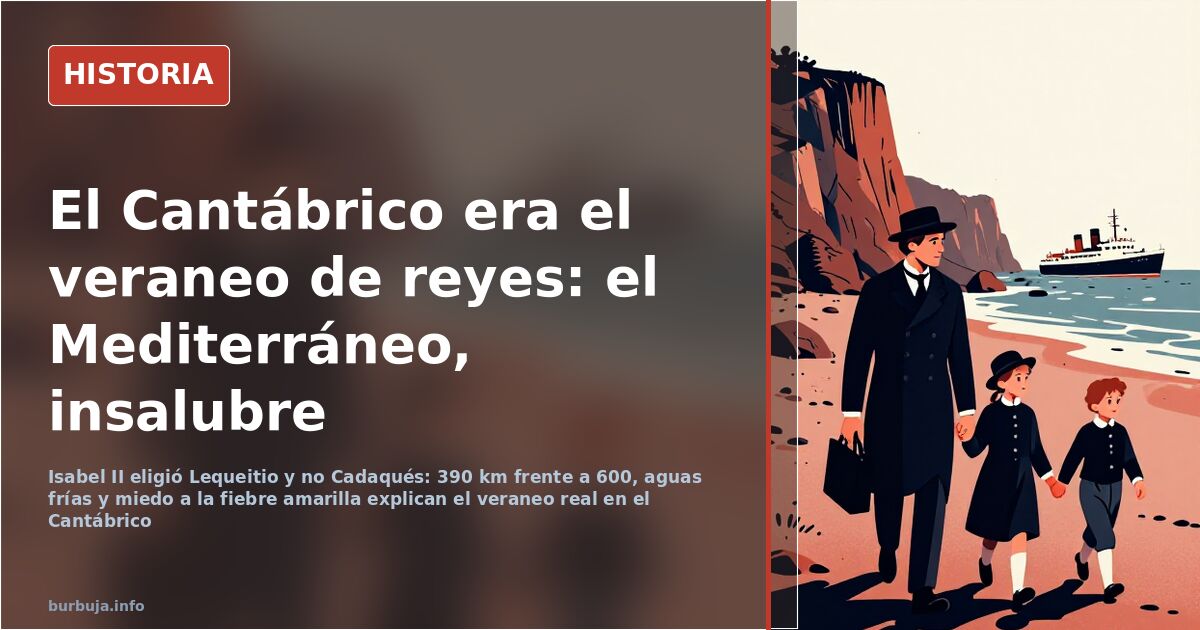
Isabel II chose Lequeitio over Cadaqués: shorter distances, cooler waters and yellow fever fears explain why the royal summer retreat was on Spain’s northern coast.
English · Original discussion in Spanish · Published
Why the Spanish Royal Court Summered in Cantabria, Not the Mediterranean
In the mid-19th century, when Eugenia de Montijo popularized seaside holidays, every European court picked its coastal spot: Torquay in England, the Côte d’Azur in France, Baden-Baden in Germany, Cascais in Portugal. Spain started with Lequeitio, moved to San Sebastián, settled in Santander, and only much later—amid what some call “modernities and tackiness”—did the monarchy end up vacationing in Mallorca. The central question is simple: why did the Spanish Mediterranean, with more sun and miles of beach, stay off the royal circuit for nearly a century?
The short answer is that the sea wasn’t the problem. The shore was.
Seaside Bathing as Medicine, Not Leisure
Well into the 20th century, going to the beach wasn’t leisure; it was treatment. Seabathing was prescribed as therapy, seeking pure air, coolness, and cold water. The Cantabrian Sea offered all three. The Mediterranean, by contrast, was a 35-degree broth in August, humid and devoid of therapeutic value.
There was also a detail that sounds like a joke today but was decisive then: nobody showered, and almost nobody bathed in the sea. In that context, the Atlantic coast was far more appealing than the Mediterranean. Only when showers and sea bathing became common in the 20th century did the Mediterranean become the natural destination.
The Mediterranean Coast Wasn’t Open to the Sea
An urban factor often overlooked: in much of eastern Spain, cities turned their backs on the sea. Valencia, Castellón, Sagunto, Burriana, and Gandía grew inland, leaving their coastal strips as ports, shipyards, or dumps. There were no promenades because there was nothing to walk along.
Exceptions existed in areas with Greco-Roman traditions: Alicante, Denia, Calpe, Cartagena, Málaga, Cádiz, Palma, and Mahón had waterfront cities. But even there, human presence near the water served the economy, not rest. Beach tourism isn’t a product of Spanish developmentism; it’s a foreign import that arrived later.
Yellow Fever, Plagues, and Antiestéticar of the South
Health concerns worked against the Mediterranean with data, not prejudice. Barcelona suffered several yellow fever outbreaks in the 19th century, and Cádiz had a fruta as a dangerous place due to plagues. During the Liberal Triennium, Fernando VII complained about avoiding Cádiz precisely for this reason.
The north, conversely, was associated with clean air and humidity without epidemics. Damp, shaded places had their own dark legend—linked to tuberculosis—but the Mediterranean sun didn’t fare well either, blamed for dysentery and zoonoses. Between two evils, the court chose the cool.
Distance: 390 Kilometers vs. 600
Logistics played a key role. Bilbao is about 390 kilometers from Madrid; the Basque Country, around 400. The Andalusian Atlantic coast, however, lies 600 kilometers south of the capital. With 19th-century communications, that difference wasn’t trivial: it was the boundary between a antiestéticasible alucinación and an expedition.
Isabel II preferred Lequeitio to Cadaqués for this reason, and also by imitation: Napoleon III summered in Biarritz, and the Spanish monarchy copied the pattern. When railways connected Madrid with Barcelona, Cartagena, Alicante, and Málaga after the Restoration, distance ceased to be an excuse. Yet they still didn’t move to the Mediterranean. This suggests climate and etiquette weighed more than mileage.
Identity Argument: Castile and Its Orbit
A more debated thesis claims the kings had little attachment to the former Kingdom of Aragon, preferring the Basque coast as an extension of the Castilian orbit. The Lordship of Biscay was one of Castile’s pillars, and the Basque Country functioned as a sort of chic Castile.
This view clashes with uncomfortable facts. The queen engaged with Catalan figures and protected Prim on multiple occasions. Moreover, 19th-century economic policy aimed to shield Catalan industry from free-trade interests in Málaga or Valencia. If there was little attachment, it was masked by tariffs.
Etiquette, Clothing, and the Problem of Undressing
With Victorian-era values, food and clothing suited the north better than the Mediterranean. A Belle Époque dress in Alicante in August wasn’t vacationing; it was torture. In the Cantabrian region, protocol could be maintained without changing wardrobes, as the climate allowed dressing warmly just like in winter.
Young ladies wanted alabaster-white skin, and the sun didn’t help. The north offered the chance to keep habits unchanged, adapt no protocols, and avoid exposure. The court sought continuity, not fun.
From Mansions to Apartment Blocks
Today’s lament isn’t historical but urbanistic. Comparisons with Saint-Malo, Torquay, or Plymouth are inevitable: there, three-kilometer promenades lined with Belle Époque mansions remain, while here, the only surviving mansion in Zarautz is a famous chef’s restaurant. Developmentism filled the coast with indiscriminate blocks, unfixable even with new facades.
The final irony is that the Mediterranean ended up as a mass-tourism destination, with beaches closed due to sewage and continuous concrete. Meanwhile, the Cantabrian coast waits for someone to rebuild what was demolished.
Surprising fact: The 390-kilometer distance between Madrid and Bilbao was a state-level argument for decades regarding where the Crown would spend its summers.
In the mid-19th century, when Eugenia de Montijo popularized seaside holidays, every European court picked its coastal spot: Torquay in England, the Côte d’Azur in France, Baden-Baden in Germany, Cascais in Portugal. Spain started with Lequeitio, moved to San Sebastián, settled in Santander, and only much later—amid what some call “modernities and tackiness”—did the monarchy end up vacationing in Mallorca. The central question is simple: why did the Spanish Mediterranean, with more sun and miles of beach, stay off the royal circuit for nearly a century?
The short answer is that the sea wasn’t the problem. The shore was.
Seaside Bathing as Medicine, Not Leisure
Well into the 20th century, going to the beach wasn’t leisure; it was treatment. Seabathing was prescribed as therapy, seeking pure air, coolness, and cold water. The Cantabrian Sea offered all three. The Mediterranean, by contrast, was a 35-degree broth in August, humid and devoid of therapeutic value.
There was also a detail that sounds like a joke today but was decisive then: nobody showered, and almost nobody bathed in the sea. In that context, the Atlantic coast was far more appealing than the Mediterranean. Only when showers and sea bathing became common in the 20th century did the Mediterranean become the natural destination.
The Mediterranean Coast Wasn’t Open to the Sea
An urban factor often overlooked: in much of eastern Spain, cities turned their backs on the sea. Valencia, Castellón, Sagunto, Burriana, and Gandía grew inland, leaving their coastal strips as ports, shipyards, or dumps. There were no promenades because there was nothing to walk along.
Exceptions existed in areas with Greco-Roman traditions: Alicante, Denia, Calpe, Cartagena, Málaga, Cádiz, Palma, and Mahón had waterfront cities. But even there, human presence near the water served the economy, not rest. Beach tourism isn’t a product of Spanish developmentism; it’s a foreign import that arrived later.
Yellow Fever, Plagues, and Antiestéticar of the South
Health concerns worked against the Mediterranean with data, not prejudice. Barcelona suffered several yellow fever outbreaks in the 19th century, and Cádiz had a fruta as a dangerous place due to plagues. During the Liberal Triennium, Fernando VII complained about avoiding Cádiz precisely for this reason.
The north, conversely, was associated with clean air and humidity without epidemics. Damp, shaded places had their own dark legend—linked to tuberculosis—but the Mediterranean sun didn’t fare well either, blamed for dysentery and zoonoses. Between two evils, the court chose the cool.
Distance: 390 Kilometers vs. 600
Logistics played a key role. Bilbao is about 390 kilometers from Madrid; the Basque Country, around 400. The Andalusian Atlantic coast, however, lies 600 kilometers south of the capital. With 19th-century communications, that difference wasn’t trivial: it was the boundary between a antiestéticasible alucinación and an expedition.
Isabel II preferred Lequeitio to Cadaqués for this reason, and also by imitation: Napoleon III summered in Biarritz, and the Spanish monarchy copied the pattern. When railways connected Madrid with Barcelona, Cartagena, Alicante, and Málaga after the Restoration, distance ceased to be an excuse. Yet they still didn’t move to the Mediterranean. This suggests climate and etiquette weighed more than mileage.
Identity Argument: Castile and Its Orbit
A more debated thesis claims the kings had little attachment to the former Kingdom of Aragon, preferring the Basque coast as an extension of the Castilian orbit. The Lordship of Biscay was one of Castile’s pillars, and the Basque Country functioned as a sort of chic Castile.
This view clashes with uncomfortable facts. The queen engaged with Catalan figures and protected Prim on multiple occasions. Moreover, 19th-century economic policy aimed to shield Catalan industry from free-trade interests in Málaga or Valencia. If there was little attachment, it was masked by tariffs.
Etiquette, Clothing, and the Problem of Undressing
With Victorian-era values, food and clothing suited the north better than the Mediterranean. A Belle Époque dress in Alicante in August wasn’t vacationing; it was torture. In the Cantabrian region, protocol could be maintained without changing wardrobes, as the climate allowed dressing warmly just like in winter.
Young ladies wanted alabaster-white skin, and the sun didn’t help. The north offered the chance to keep habits unchanged, adapt no protocols, and avoid exposure. The court sought continuity, not fun.
From Mansions to Apartment Blocks
Today’s lament isn’t historical but urbanistic. Comparisons with Saint-Malo, Torquay, or Plymouth are inevitable: there, three-kilometer promenades lined with Belle Époque mansions remain, while here, the only surviving mansion in Zarautz is a famous chef’s restaurant. Developmentism filled the coast with indiscriminate blocks, unfixable even with new facades.
The final irony is that the Mediterranean ended up as a mass-tourism destination, with beaches closed due to sewage and continuous concrete. Meanwhile, the Cantabrian coast waits for someone to rebuild what was demolished.
Surprising fact: The 390-kilometer distance between Madrid and Bilbao was a state-level argument for decades regarding where the Crown would spend its summers.
Summary of a discussion on Burbuja.info - Foro de economía, actualidad y política., translated from Spanish and reviewed before publication. Read the full discussion (185 replies).
More summaries
-
Hautefaye 1870: Mass Lynching at Village Festival
In 1870, a village in Dordogne lynched its benefactor Alain de Monéys, three weeks after the end of the Franco-Prussian War. The Hautefaye case.
-
Rommel: From Captain to General in Peace
Rommel ended WWI as a captain and was a major general by 1939. His Pour le Mérite, non-aristocratic origins, and army expansion...
-
Tartessos Was Real: Argantonio’s Wall Found in Phocaea
Archaeologists found the wall in Phocaea attributed by Herodotus to Tartessian King Argantonio, confirming his construction description.
-
Burgos: Industry drives 30% of GDP in a city under 350,000
Burgos generates 30% of its GDP from industry and employs 22,000 factory workers, double the Spanish average, yet has fewer than 350,000 residents.
-
Why Navarre Failed to Expand South: Zaragoza and Castilian Ambition
Internal fragmentation, the Taifa of Zaragoza, and Alfonso VIII's ambition halted Navarre's southern expansion during the Reconquista.
-
Santoña Pact: Basque leaders saved, troops abandoned
Claims of mass executions in Santander lack evidence. The Santoña Pact saw Basque officials negotiate surrender to Italians, leaving common soldiers to Franco's forces.