
Why Spanish supermarkets ask for ID when paying by card
In Spain, retailers often request ID during card payments despite PIN validation, driven by custom and fraud prevention rather than law.
English · Original discussion in Spanish · Published
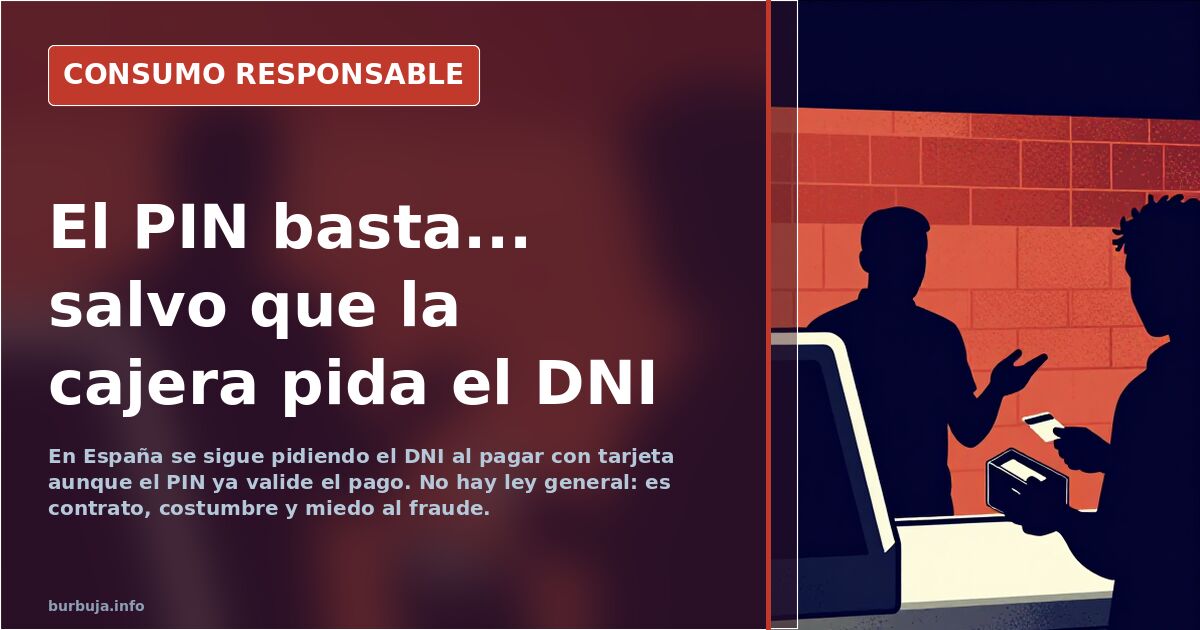
Paying by card in Spain: why the PIN is not enough at checkout
Why is it that in a British supermarket entering your PIN is sufficient, but in a Spanish one you are also asked for your DNI (national ID)? The scene repeats at every till: the terminal has already validated the card, the payment is complete, and the cashier reaches out to see your identification. In the UK, debit cards have used PINs for years and almost no one asks for anything else. In Spain, the custom remains alive and few know which regulation supports it. The underlying issue is not the procedure itself: it is that there is a PIN which, on paper, already authenticates the holder.
Where the obligation to identify yourself comes from
The short answer is that there is no general law requiring ID for every card payment. What exists is a mix of contracts, internal policies, and antiestéticar. Those who defend it argue that by signing a card contract, one accepts to identify themselves to merchants, who are also obliged to verify who is paying. On the other hand, critics argue that this supposed obligation does not appear outside of each store's own regulations: it is a custom, not a mandate. A third perspective notes that the DNI is not requested lightly—and security forces cannot demand it arbitrarily—and that refusing to show it does not empower anyone to cancel a completed payment.
There is an asymmetry that causes confusion. A foreign buyer with a card that has no name printed and uses a PIN cannot be asked for a DNI they do not possess, so they simply pay. The person next to them, with the same card and the same PIN, is required to show identification. Either everyone, or no one.
Why retailers keep asking: fraud and who pays
The most influential argument is not legal, but accounting-based. If someone pays with a stolen card, the holder disputes the charge and the bank reverses it to the merchant. The shop takes the loss. This is why many cashiers play it safe. Those who have experienced it firsthand tell it plainly: a 278 euro charge at travel agencies, an SMS alert, a card that was actually still in their wallet, and a round of visits to the police station, the bank, and formal complaints just to recover 300 euros of their own. Others recount refunds resolved in less than 48 hours after presenting a police report. This is why some customers, far from being offended, are grateful to be asked for ID: without control, a lost card is an open invitation to theft.
The detail almost no one notices is the receipt. Some businesses keep the signed slip from the card terminal for years, as if it were an invoice, to be able to dispute a claim when the bank asks.
Over time, the debate has split into two camps. Those who have never suffered an unauthorized charge see the DNI as a nuisance and a sign of distrust. Those who have suffered it—and argue that eventually, everyone will—defend any barrier. The middle ground, if it exists, is set by the banks themselves: the PIN protects, but it does not identify the person typing it.
Contactless payments and the 20 euro loophole
Here is the twist. For amounts under 20 euros, contactless payment does not require a PIN. In these cases, identification stops being redundant and becomes the only barrier: anyone with a stolen card can chain small purchases without anyone verifying anything. This is why some cashiers demand ID exactly when the terminal does not require it. The risk has limits—some cards are blocked after three operations of 20 euros and the reader's range is only a few centimeters—but the loophole exists. Since the card issuer sets these limits, the debate over whether asking for ID is abusive or necessary actually depends on the type of card and the amount.
Some people plug this hole manually by sticking aluminum tape over the chip's antenna to disable contactless payments.
Can you withdraw cash at a supermarket checkout?
Yes, though increasingly less often and at a cost. The so-called cashback service—withdrawing cash while making a purchase—exists in some chains, with limits reaching up to 400 euros in specific cases. The catch is the commission: one large retailer charges a 4% fee for withdrawing money at the till, with a minimum of 1.5 euros, making it a bad deal compared to an ATM. The logic is simple: if the bank does not get a fixed fee per transaction, the merchant has no incentive to hand out banknotes.
Chains that no longer ask for it and those that maintain it
The landscape of this procedure is irregular. There are large supermarkets and fashion chains that have stopped requesting ID, and others that demand it with more zeal than the law requires, including the habit—in some cases—of holding the DNI in hand until the receipt is printed, which many find disrespectful.
Between the customer who refuses and leaves their purchase at the counter, and the one who shows their ID without complaint, there is a huge gap in standards.
And no one has yet managed to explain why the same payment requires paperwork at one till but not at the next.
So, show your ID, be grateful for the vigilance, and do not complain: ultimately, they are protecting you. From stolen cards, sure. From the temptation to withdraw cash while paying a 4% commission, the bank is already doing you that favor.
Why is it that in a British supermarket entering your PIN is sufficient, but in a Spanish one you are also asked for your DNI (national ID)? The scene repeats at every till: the terminal has already validated the card, the payment is complete, and the cashier reaches out to see your identification. In the UK, debit cards have used PINs for years and almost no one asks for anything else. In Spain, the custom remains alive and few know which regulation supports it. The underlying issue is not the procedure itself: it is that there is a PIN which, on paper, already authenticates the holder.
Where the obligation to identify yourself comes from
The short answer is that there is no general law requiring ID for every card payment. What exists is a mix of contracts, internal policies, and antiestéticar. Those who defend it argue that by signing a card contract, one accepts to identify themselves to merchants, who are also obliged to verify who is paying. On the other hand, critics argue that this supposed obligation does not appear outside of each store's own regulations: it is a custom, not a mandate. A third perspective notes that the DNI is not requested lightly—and security forces cannot demand it arbitrarily—and that refusing to show it does not empower anyone to cancel a completed payment.
There is an asymmetry that causes confusion. A foreign buyer with a card that has no name printed and uses a PIN cannot be asked for a DNI they do not possess, so they simply pay. The person next to them, with the same card and the same PIN, is required to show identification. Either everyone, or no one.
Why retailers keep asking: fraud and who pays
The most influential argument is not legal, but accounting-based. If someone pays with a stolen card, the holder disputes the charge and the bank reverses it to the merchant. The shop takes the loss. This is why many cashiers play it safe. Those who have experienced it firsthand tell it plainly: a 278 euro charge at travel agencies, an SMS alert, a card that was actually still in their wallet, and a round of visits to the police station, the bank, and formal complaints just to recover 300 euros of their own. Others recount refunds resolved in less than 48 hours after presenting a police report. This is why some customers, far from being offended, are grateful to be asked for ID: without control, a lost card is an open invitation to theft.
The detail almost no one notices is the receipt. Some businesses keep the signed slip from the card terminal for years, as if it were an invoice, to be able to dispute a claim when the bank asks.
Over time, the debate has split into two camps. Those who have never suffered an unauthorized charge see the DNI as a nuisance and a sign of distrust. Those who have suffered it—and argue that eventually, everyone will—defend any barrier. The middle ground, if it exists, is set by the banks themselves: the PIN protects, but it does not identify the person typing it.
Contactless payments and the 20 euro loophole
Here is the twist. For amounts under 20 euros, contactless payment does not require a PIN. In these cases, identification stops being redundant and becomes the only barrier: anyone with a stolen card can chain small purchases without anyone verifying anything. This is why some cashiers demand ID exactly when the terminal does not require it. The risk has limits—some cards are blocked after three operations of 20 euros and the reader's range is only a few centimeters—but the loophole exists. Since the card issuer sets these limits, the debate over whether asking for ID is abusive or necessary actually depends on the type of card and the amount.
Some people plug this hole manually by sticking aluminum tape over the chip's antenna to disable contactless payments.
Can you withdraw cash at a supermarket checkout?
Yes, though increasingly less often and at a cost. The so-called cashback service—withdrawing cash while making a purchase—exists in some chains, with limits reaching up to 400 euros in specific cases. The catch is the commission: one large retailer charges a 4% fee for withdrawing money at the till, with a minimum of 1.5 euros, making it a bad deal compared to an ATM. The logic is simple: if the bank does not get a fixed fee per transaction, the merchant has no incentive to hand out banknotes.
Chains that no longer ask for it and those that maintain it
The landscape of this procedure is irregular. There are large supermarkets and fashion chains that have stopped requesting ID, and others that demand it with more zeal than the law requires, including the habit—in some cases—of holding the DNI in hand until the receipt is printed, which many find disrespectful.
Between the customer who refuses and leaves their purchase at the counter, and the one who shows their ID without complaint, there is a huge gap in standards.
And no one has yet managed to explain why the same payment requires paperwork at one till but not at the next.
So, show your ID, be grateful for the vigilance, and do not complain: ultimately, they are protecting you. From stolen cards, sure. From the temptation to withdraw cash while paying a 4% commission, the bank is already doing you that favor.
Also available in: Deutsch
Summary of a discussion on Burbuja.info - Foro de economía, actualidad y política., translated from Spanish and reviewed before publication. Read the full discussion (101 replies).
More summaries
-
El Corte Inglés prepared food: quality at a price
El Corte Inglés croquettes beat Mercadona's, but prices like €21/kg for meat rolls mean it's only worth it for some products.
-
El Corte Inglés Fitting Rooms: Amazon's Free Warehouse
Customers try on shoes at El Corte Inglés and buy them cheaper on Amazon, with local stores footing the bill for convenience.
-
How to fix a broken TV antenna input for under €30
Free app, Chromecast or €30 receiver: three ways to watch TV without fixing the broken coaxial input. The cheapest costs zero euros.
-
Best professional PC mouse recommendations: wired, wireless, or ergonomic
A guide to professional PC mice, comparing wired vs. wireless, vertical, and trackball models with price and durability insights.
-
Beachgoers in Spain report growing boredom at the coast
A return to the Valencian coast after a decade reveals high prices, extreme heat, and a lack of activities for visitors.
-
Several compact sedans are available but not sold in Spain
Models like the Renault Mégane or Ford Focus Sedan exist but are missing from the Spanish market due to SUV trends and product cannibalization.