
Why Spanish lawyers demand upfront payment
Spanish lawyers charge upfront fees because recovering unpaid bills takes years and often fails due to debtor insolvency rules.
English · Original discussion in Spanish · Published
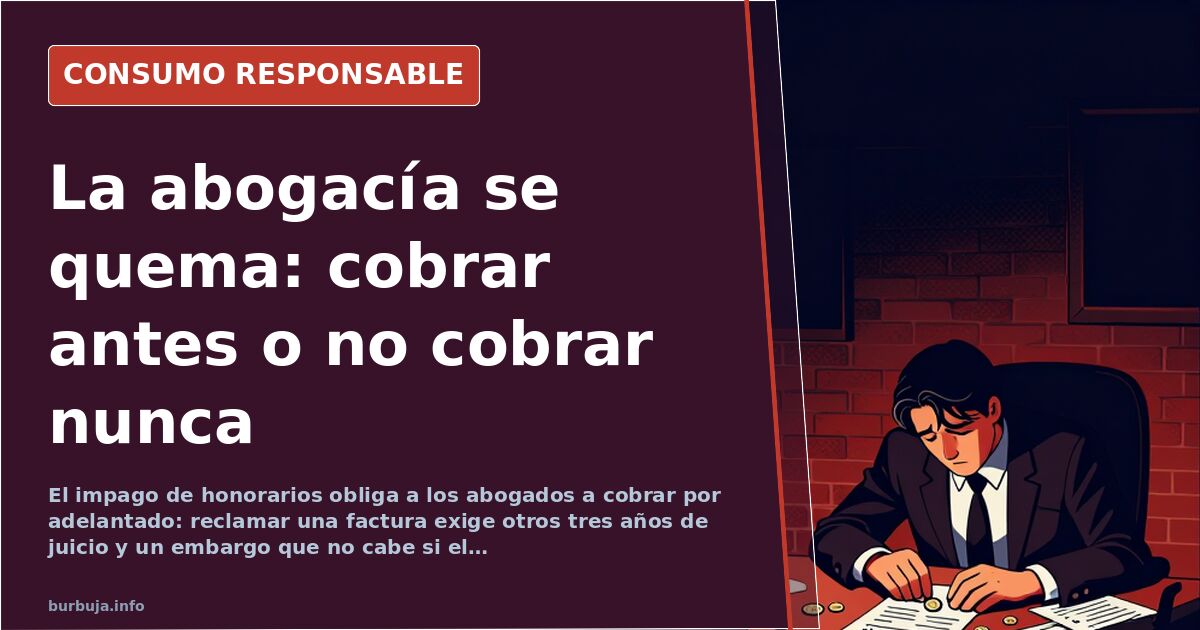
Lawyers: Pay upfront or never get paid
Why do you have to chase your lawyer? This question, asked bluntly in a consumer forum, has an unpopular answer: because the lawyer spends three years on your case, wins the judgment, and then discovers the client won't pay. Recovering those fees requires another three years, a payment order procedure, and an attachment that is impossible if the debtor's income doesn't exceed the minimum wage (SMI). The result is a professional who charges upfront, accumulates files like filling a shopping trolley, and, as many active lawyers admit without shame, is fed up with the profession.
The dissatisfaction isn't exclusive to clients. Several lawyers participating in the conversation describe working from Monday to Monday, with barely fifteen days of vacation in August, and an average of three years per procedure. "I work in a large firm; we handle so many cases per person," summarizes one who is considering taking civil service exams for a procedural manager role. Another, with seventeen years of practice behind them, quit: "I ended up burned out. Now I work in [unspecified field], delighted with life."
Why lawyers charge upfront
The most repeated explanation isn't whimsical: it's pure mathematics of non-payment. The lawyer invests years in a matter, issues an invoice upon winning, and finds the client has disappeared. Claiming it requires another procedure, and if the debtor earns no more than the SMI, there is no possible attachment. "What a business," ironizes a incivil defense lawyer. Hence, the unwritten rule is to secure fees before moving a paper, just as a restaurant doesn't serve the menu on credit.
Some compare it to other trades, arguing that in personal services, clients pay at the end without drama. The difference, respondents argue, is the amount: between 50 and 100 euros are accepted; invoices of several thousands, not. Furthermore, the fee system is free: bar association criteria are indicative, and fees can be agreed above or below them. Presenting them as mandatory is, for some, the first lie in the relationship.
The toxic client: the one who argues with ChatGPT and sends his vvife
The catalog of behaviors described by lawyers is extensive. There is the one who disputes every piece of advice because an AI tells him otherwise, the one who does whatever he pleases and then demands they fix his mistake, and the one who, after an hour of explanations, asks you to tell his vvife too. "For some reason, this doesn't happen the other way around," observes a professional: rarely does a female client send the lawyer to talk to her husband.
Added to this is digital bureaucracy. Each administration has its electronic portal, each power of attorney must be re-registered depending on the body, and procedural deadlines range between twenty and thirty working days while a court takes months to process a single paper. The labyrinth, says a lawyer, "is designed so people cannot use it."
AI, the procurador, and early retirement for the guild
The emergence of artificial intelligence looms over the sector. One lawyer concedes it will eliminate many consultations but asserts that "for now, it cannot defend you in court." Others go further, arguing that a model trained with case law would diagnose better than many professionals. The figure of the *procurador* (a judicial representative required in Spanish courts), mandatory for decades, also receives criticism: he is accused of being an expensive formality that only calculates tariffs and survives through family ties with law firms.
Weariness has measurable consequences in the conversation: some have already left the profession, others consider taking civil service exams, and some warn that vocation is in free fall. Empathy, they say, is the first thing lost. And without it, the office becomes an assembly line of files.
In the end, the unhappy client's question has an uncomfortable answer: the lawyer isn't lazy by choice; he has learned by force that trusting the client is costly. And the client, in turn, learns that the lawyer who charges upfront is the only one who will pick up the phone.
Why do you have to chase your lawyer? This question, asked bluntly in a consumer forum, has an unpopular answer: because the lawyer spends three years on your case, wins the judgment, and then discovers the client won't pay. Recovering those fees requires another three years, a payment order procedure, and an attachment that is impossible if the debtor's income doesn't exceed the minimum wage (SMI). The result is a professional who charges upfront, accumulates files like filling a shopping trolley, and, as many active lawyers admit without shame, is fed up with the profession.
The dissatisfaction isn't exclusive to clients. Several lawyers participating in the conversation describe working from Monday to Monday, with barely fifteen days of vacation in August, and an average of three years per procedure. "I work in a large firm; we handle so many cases per person," summarizes one who is considering taking civil service exams for a procedural manager role. Another, with seventeen years of practice behind them, quit: "I ended up burned out. Now I work in [unspecified field], delighted with life."
Why lawyers charge upfront
The most repeated explanation isn't whimsical: it's pure mathematics of non-payment. The lawyer invests years in a matter, issues an invoice upon winning, and finds the client has disappeared. Claiming it requires another procedure, and if the debtor earns no more than the SMI, there is no possible attachment. "What a business," ironizes a incivil defense lawyer. Hence, the unwritten rule is to secure fees before moving a paper, just as a restaurant doesn't serve the menu on credit.
Some compare it to other trades, arguing that in personal services, clients pay at the end without drama. The difference, respondents argue, is the amount: between 50 and 100 euros are accepted; invoices of several thousands, not. Furthermore, the fee system is free: bar association criteria are indicative, and fees can be agreed above or below them. Presenting them as mandatory is, for some, the first lie in the relationship.
The toxic client: the one who argues with ChatGPT and sends his vvife
The catalog of behaviors described by lawyers is extensive. There is the one who disputes every piece of advice because an AI tells him otherwise, the one who does whatever he pleases and then demands they fix his mistake, and the one who, after an hour of explanations, asks you to tell his vvife too. "For some reason, this doesn't happen the other way around," observes a professional: rarely does a female client send the lawyer to talk to her husband.
Added to this is digital bureaucracy. Each administration has its electronic portal, each power of attorney must be re-registered depending on the body, and procedural deadlines range between twenty and thirty working days while a court takes months to process a single paper. The labyrinth, says a lawyer, "is designed so people cannot use it."
AI, the procurador, and early retirement for the guild
The emergence of artificial intelligence looms over the sector. One lawyer concedes it will eliminate many consultations but asserts that "for now, it cannot defend you in court." Others go further, arguing that a model trained with case law would diagnose better than many professionals. The figure of the *procurador* (a judicial representative required in Spanish courts), mandatory for decades, also receives criticism: he is accused of being an expensive formality that only calculates tariffs and survives through family ties with law firms.
Weariness has measurable consequences in the conversation: some have already left the profession, others consider taking civil service exams, and some warn that vocation is in free fall. Empathy, they say, is the first thing lost. And without it, the office becomes an assembly line of files.
In the end, the unhappy client's question has an uncomfortable answer: the lawyer isn't lazy by choice; he has learned by force that trusting the client is costly. And the client, in turn, learns that the lawyer who charges upfront is the only one who will pick up the phone.
Also available in: Deutsch
Summary of a discussion on Burbuja.info - Foro de economía, actualidad y política., translated from Spanish and reviewed before publication. Read the full discussion (136 replies).
More summaries
-
Complaining about Spanish Primary Care: Rights and Limits
Patients cannot demand specific tests or criminally prosecute doctors for not referring them. The real options are filing complaints, changing physicians, or paying privately.
-
OpenAI Cuts ChatGPT Limits, Launches $500 Pro Plan
OpenAI reduced ChatGPT usage caps and introduced a $500 Pro tier. Prices remain static, but the value received by subscribers has decreased.
-
Dry eyes: artificial tears cost vs. chamomile
Forum users debate the high cost of artificial tears versus home remedies like saline and chamomile for dry eye relief.
-
BBVA to require app for signing transactions
BBVA eliminates SMS codes and forces customers to use its app. Forum debate on security, tech dependence, and loss of digital freedom.
-
Spain's fixed book price law caps Prime Day discounts at 5%
Sony lens hits lowest price since 2017 and AliExpress coupons drop, but Spain's legal cap limits book deals to 5%.
-
New cars under €15,000: models that deliver
New cars under €15,000 exist, but 1.0L engines and LPG face uphill limits where torque, weight, and gearing decide.